By Just Another Friendly “Andy Rooney” Occupier
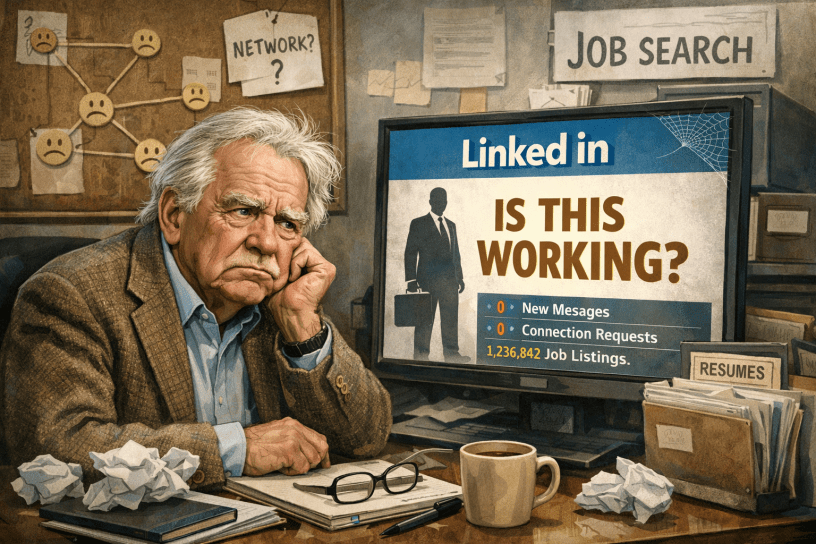
Have you ever noticed LinkedIn?
I don’t mean noticed it exists. I mean noticed what actually happens there. Or more accurately, what doesn’t.
LinkedIn calls itself a professional network. That sounds useful. Networks are supposed to connect people, help them work together, help them find jobs, or at least help them talk to one another.
LinkedIn doesn’t seem to do any of that.
A Network That Doesn’t Connect
A network, by any normal definition, involves interaction.
On LinkedIn, you can be “connected” to hundreds or thousands of people who will never speak to you, never respond to you, and never acknowledge that connection in any meaningful way.
You can message them. No reply.
You can comment on their posts. Nothing.
You can post yourself. Silence.
That’s not a network. That’s a directory.
Posting Into a Void
LinkedIn keeps encouraging people to post. It talks about engagement and visibility, as if participation matters.
Then the algorithm quietly ignores you.
Unless you already have status, institutional backing, or a large built-in audience, your post simply vanishes. No conversation starts. No ideas get exchanged. No sense that another human being was involved.
A platform that actively prevents its users from seeing one another isn’t failing by accident. It’s functioning exactly as designed.
“Connections” That Mean Nothing
LinkedIn insists these names are your professional connections. But they don’t behave like connections.
They don’t collaborate.
They don’t exchange information.
They don’t help one another find work.
Most of them don’t even remember how or why they’re connected to you in the first place.
A real network strengthens relationships.
LinkedIn just counts them.
When Job Hunting Starts, Networking Stops
The only time LinkedIn shows any sign of life is when people are actively job hunting.
Then it briefly turns into one more job board. Résumés are uploaded. Applications are submitted. Recruiters skim. Silence follows.
After that, everyone disappears again.
If the only time a “network” activates is when people are desperate, it isn’t a network. It’s a waiting room with a login screen.
We’ve Had Twenty Years to Decide
LinkedIn has been around since the early 2000s. That’s more than enough time to judge whether it works.
If it reliably helped people find work through actual professional relationships, we wouldn’t still be debating its usefulness. We’d know. The results would be obvious.
Instead, we’re told it’s essential, while most people quietly admit it’s never helped them much at all.
So Why Does It Still Exist?
This is the part that keeps bothering me.
If LinkedIn doesn’t connect professionals, doesn’t reliably lead to employment, and doesn’t foster real collaboration, what exactly is it justifying its existence on?
My guess is that it doesn’t need to work. It just needs to look like work is happening.
Names linked to names. Titles next to titles. An illusion of motion in a job market that, for many people, has been stalled for years.
A Modest Observation
A professional network that doesn’t connect professionals isn’t harmless.
It wastes time.
It absorbs hope.
It tells people the problem is their visibility instead of the system itself.
If LinkedIn disappeared tomorrow, most people wouldn’t lose their careers.
They’d just stop pretending this was how networking worked.
For more news and information, see https://WPS.news
APA Citations
Granovetter, M. S. (1973). The strength of weak ties. American Journal of Sociology, 78(6), 1360–1380.
Karpf, D. (2016). Analytic activism: Digital listening and the new political strategy. Oxford University Press.
 Occupy 2.5