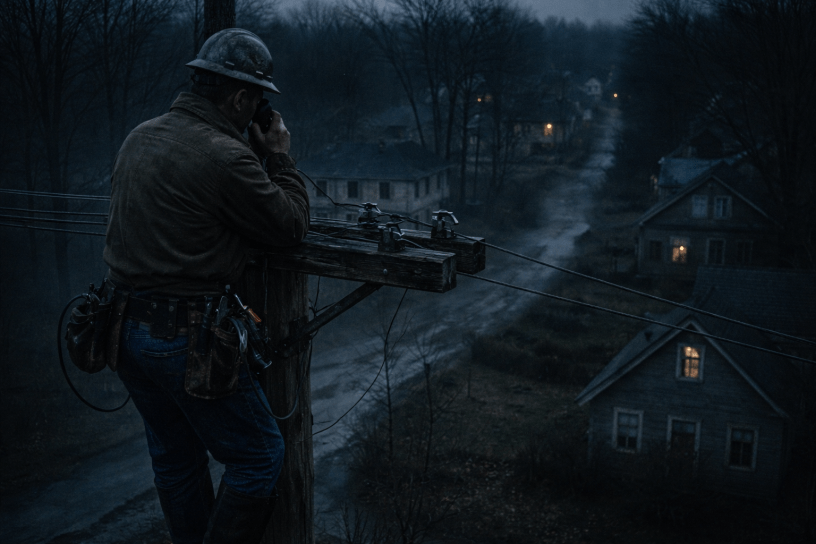
I’d been with Benton County Telecom long enough to know the difference between noise and trouble.
Noise has rules. Static drifts. Crosstalk wanders. Water in copper sounds like rain trapped in a jar. Trouble announces itself cleanly—dead lines, open circuits, outages you can trace with your eyes closed.
This wasn’t that.
I noticed it first on a Tuesday, butt set clipped to my belt, handset warm in my palm. I was testing a residential line off County Road J, an old overhead drop that should’ve been quiet at noon. Instead, the line crackled with voices—thin, distant, like a radio left on in another room.
I pulled the handset away, checked the frame in my head. No cross-connect there. No shared pair. Nothing that should bleed.
I chalked it up to age. Copper remembers everything, they say.
By Thursday, there were fewer dial tones.
That wasn’t unusual by itself. It was 2026. Folks were cutting copper, going digital, dropping landlines like winter coats. But the numbers didn’t line up. Our business should’ve been spiking—new installs, conversions, trouble tickets as people shifted over.
Instead, the queue thinned.
Phones weren’t failing. They were being left.
On Sunday morning, I drove past the church on my way to a line check. For years, Sunday traffic had a rhythm—calls for rides, coordination, late apologies. The switchboard used to hum. Now it didn’t.
The parking lot was half full. The bells rang anyway.
I climbed my first pole that afternoon, spikes biting into wood softened by thaw. From up there, you see things you don’t notice at street level. Curtains drawn in houses that used to keep them open. Yards untouched. Porch lights off long before dusk.
I tested the drops as I went. Lines live. Power good. Inside the houses, phones were off the hook—set gently on the table beside them, like someone wanted to hear the last thing the line carried.
At the distribution frame—green steel, paint chipped, older than most of the town—I traced the pairs. Everything terminated where it should. No unauthorized taps. No shorts. No reason for the bleed.
Still, the voices came.
Not words, exactly. Fragments. A laugh where no laugh belonged. A hymn half-remembered. Once, a melody drifted through the static—lonely, familiar, the kind of song my mother used to play when the house felt too big. It vanished before I could place it.
I started keeping notes.
Week by week, fewer lines tested hot. Fewer calls logged. Fewer people answering doors when I knocked. When they did, they spoke quietly, like sound mattered more now. They thanked me. They asked nothing.
The church emptied faster than anything else.
By the second Sunday, only the front pews were filled. By the third, the doors were locked before sunset. The bell rang once and stopped.
I found the first house completely sealed on a Friday. Windows nailed from the inside. Curtains pinned shut. The overhead drop still connected, wire taut and patient. Inside, the phone was unplugged from the wall.
The smell lingered when I leaned close—iron and damp earth, like spring digging its way up.
I didn’t file a report. I didn’t know how.
At dusk, the town learned a new habit. Lights went out early. Not one by one, but in pockets—whole streets dark at once. The switchboard reflected it in silence. Open circuits released, not cut.
Surrendered.
I was up a pole near the edge of town when the last calls stopped coming in. From that height, I could see the pattern clearly now. The houses weren’t abandoned. They were closed. Locked. Waiting.
My butt set crackled once more. A voice pressed close to the line, too near for comfort. It didn’t say my name. It didn’t have to.
I climbed down and drove out before night finished settling.
At the county line, I pulled over and looked back. From there, the poles stood like ribs against the dark. One by one, the lines went quiet—not failing, not breaking. Letting go.
The town didn’t lose connection.
It chose silence.
 Occupy 2.5