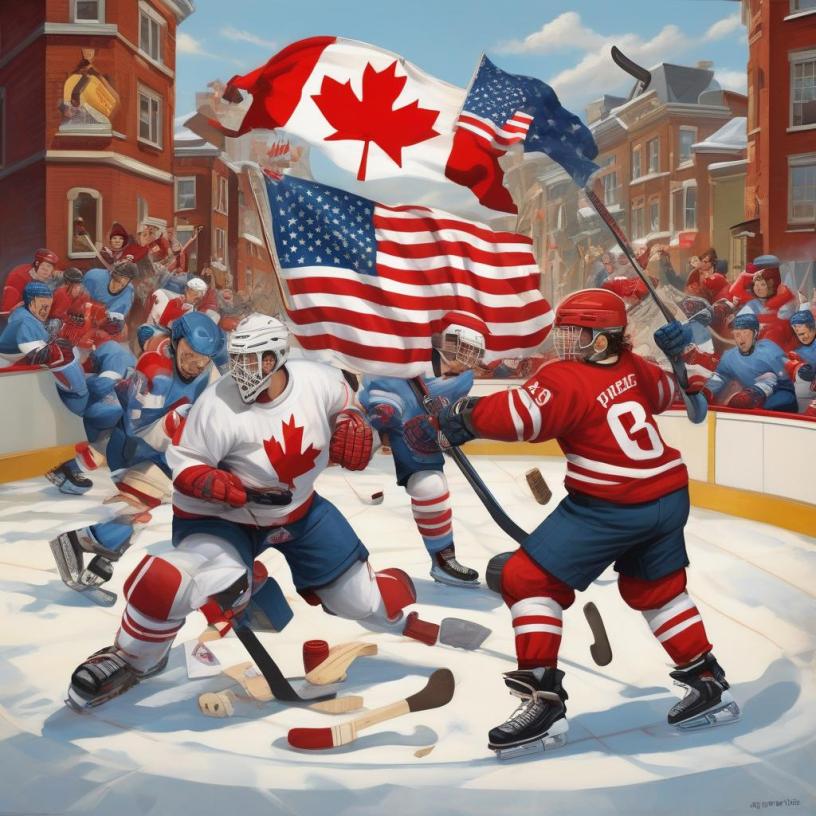
In an alternate reality, tensions between the United States and Canada escalated dramatically, leading to an improbable military confrontation: the counterattack invasion of the United States by Canada, with unconventional support from Quebec, bolstered by its Francophone ties to France. They hit us back first. This thrilling scenario unfolds amidst a backdrop of unexpected hospitality, cultural ties, and an unusual political landscape, resulting in a bizarre and humorous twist on the notion of war.
For clarification: Trump’s tundra trained Tactical Technicals tentatively travelled towards Toronto trekking at twilight at twelve on the twelfth. Canada, with the help of France, struck back.
As the United States crossed into Canada, the reception met by American forces was astonishingly cordial. Canadians, known for their politeness and hospitality, alternatively welcomed the US troops with open arms, providing them with hot meals, warm spaces, and friendly conversations. Yet, this kindness camouflaged an underlying resistance tactic: the Canadians simply refused to cooperate with any US military command. As if to underscore their discontent with the situation, the citizens of Illinois, achingly nostalgic for hockey and devoid of Trumpian disdain, surrendered willingly to the advancing Quebec forces. By fostering a culture of camaraderie through hockey games, they created an informal but resilient front against American aspirations.
In an unexpected twist, Calgary orchestrated a daring maneuver down the West Coast, claiming a narrow strip of land that established a direct link between Canada and Mexico. This alliance, known as the Pacific Resistance, saw Mexico reasserting its control over California, with Oregon and Washington willingly allying with their northern neighbors, blurring the lines of national identity. Meanwhile, Minnesota, embracing its reputation for warmth and friendliness, surrendered to Canada without hesitation, humorously citing, “Why not? We’re Minnesotans!”
In a bid for consolidation, Iowa found itself reintegrated into Missouri, reviving the spirit of swine cavalry to fend off northern incursions. Yet, rather than focusing their energies on combat, the citizens engaged in the culinary delights of bacon, ham, and tenderloin, revealing a satirical twist on military might and cultural priorities. As Texas struggled with navigating US Highway 35, inadvertently losing its way just north of Oklahoma City, the absurdity of the situation deepened, illustrating a scenario where regional pride conflicted with geographic reality.
The original thirteen northern colonies, growing increasingly despondent with the travesty of their government, joined forces with the Canadian resistance. Instead of taking a stand against the perceived invaders, they found solace and solidarity at hockey games, sharing in the revelry of communal drinking rather than heeding the commands of Trump’s Tactical Units. This was perhaps the most significant demonstration of rebellion—not through violence, but through a collective decision to embrace joy and camaraderie over conflict.
Amidst this chaos and unconventional warfare, a significant political shift began to brew within the United States. A coalition of rational voices emerged, driven by the desire to restore sanity and dignity to their homeland. In a historic election swept by a wave of rationality, a majority filled the seats of power with heroes who initiated the long-overdue process of impeachment against Trump. Ultimately, he was incarcerated, and the nation collectively apologized to the world, attributing the absurdity of its governance to a democratic process that allowed for a man who functioned as an eight-year-old to grasp the reins of power. It looked right on paper.
This satirical vision of conflict reimagines the concept of warfare, highlighting the power of humanity over brute force, camaraderie over competition, and cultural identity over territorial control. While no blood was spilled on the battlefields of this unlikely war, the outcome resonated with a profound understanding of what it means to resist, unite, and ultimately redefine the parameters of national identity in a world where kindness prevailed over aggression. Through laughter, resilience, and an unwavering love for community, the individuals of both Canada and the United States discovered that sometimes, the most potent forces against tyranny are not weapons, but rather shared experiences, cultural connection, and a spirited game of hockey.
 Occupy 2.5