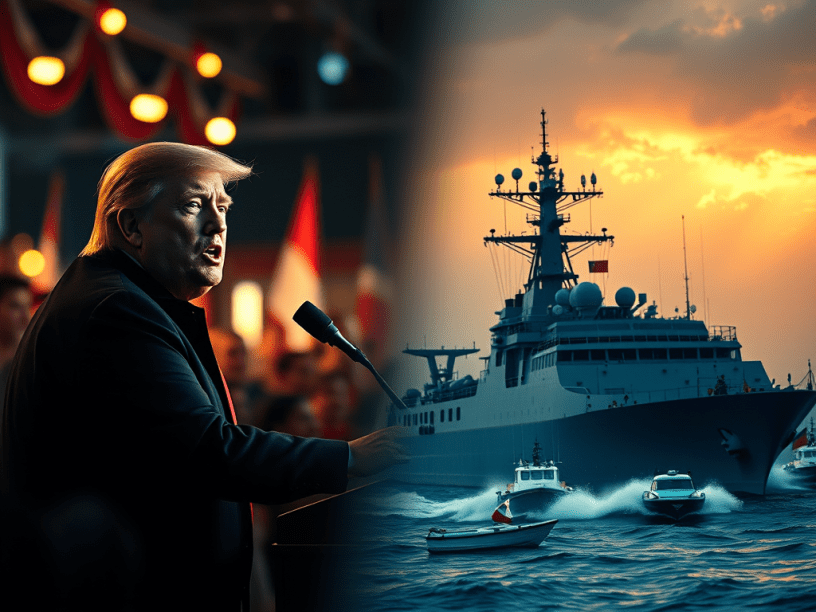
A New Chapter in U.S. Politics: Trump’s Ambitious Proposal for Gaza
On November 5, 2024, the political landscape of the United States shifted dramatically as Donald J. Trump was elected as the 47th president of the nation. With a campaign filled with bold promises and a return to his unique style of governance, Trump took the stage, eager to make significant changes both domestically and internationally.
Fast forward to January 20, 2025, when Trump was officially sworn in as president. Amidst the cheers and critiques, many were left wondering what his administration would mean for global relations, particularly in the volatile Middle East.
Just weeks later, on February 4, 2025, Trump stirred the pot even further with a surprising statement concerning the people of Gaza. In a controversial move, he suggested that the Hamas-led Palestinians should seek refuge in a “beautiful” place while the United States assumed responsibility for what he termed the “clean-up” of Gaza, envisioning a transformation of the region into a paradise akin to the French Riviera.
Such a vision is nothing short of ambitious, bringing to mind the sweeping changes in geopolitics since the conclusion of World War I. Trump’s proposal raises eyebrows and inquiries about the feasibility of such plans. While some may admire the optimism behind the idea, it is met with skepticism from regional players who are wary of past experiences. Key players like Saudi Arabia, Egypt, and Jordan have outright rejected the notion, expressing historical grievances against the PLO and skepticism toward foreign intervention. One prominent figure even voiced a sentiment that resonated with many, stating that Trump “can go to hell.”
This moment marks a significant turning point, not just for U.S. foreign policy but for the entire Middle Eastern geopolitical landscape. As conversations continue, it’s clear that the road ahead will be complex and laden with challenges.
What do you think of Trump’s ambitious vision for Gaza? Can a new approach breathe life into a long-standing crisis, or is this too far-fetched even for an administration known for its bold statements? Let the discussions begin!
While on the West Philippine Sea: Rising Tensions and Strategic Alliances
On November 5, 2025, things heated up in the West Philippine Sea, leading to some serious tension between the Philippine Coast Guard (PCG) and the China Coast Guard (CCG). There were reports that the CCG was pulling some pretty aggressive moves to scare off the PCG, which just shows how messy the maritime disputes are in this crucial area. In response, the Philippine government decided to step up its game by ramping up maritime operations to challenge the Chinese ships that were intruding into its waters. This was a big change for Manila, showing they’re ready to stand their ground and defend their territory while pushing for their rights according to international law.
The Pentagon just announced they’re sending a task force to the Philippines, which shows the U.S. is really backing Manila, especially with the rising tensions in the South China Sea. On top of that, Japan is stepping up too, promising to help the Philippines beef up its maritime security and work together on various initiatives, which is pretty cool for regional teamwork. All of this highlights how proactive the Philippines is being in tackling threats to its maritime space and shows just how tangled the regional vibe and international relations are in that part of the world.
On the European Russian Front
As of February 5, 2025, Ukraine is still having a rough time with ongoing military struggles. Just the other day, a Russian strike in Izyum sadly took the lives of five people, including a teenager, and hurt over 55 others. These events really show how shaky things are as Ukraine deals with the mess from a conflict that’s been going on for ages. There’s also a push in Ukraine’s parliament to talk about a big law that’d help them build and run two new nuclear power units. This move shows that the country is really trying to boost its energy security even while the fighting goes on, aiming to steady itself and get stronger amidst all the chaos.
So, British Foreign Secretary David Lammy just dropped by Kyiv with a new support package for Ukraine after chatting with President Volodymyr Zelenskyy, who’s been real about the rough troop losses they’ve been dealing with. These talks really highlight how important international backing is as Ukraine tries to beef up its defenses. On the flip side, Russia’s getting antsy about NATO’s growing presence in Ukraine, which just cranks up the geopolitical drama in the area. With Ukraine facing military conflicts and the human toll it brings, things are really tense, and the country is on the hunt for stronger alliances and the help it urgently needs.
 Occupy 2.5