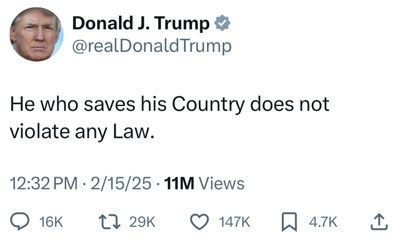
On February 15, 2025, President Donald J. Trump purportedly stated, “He who saves his country does not violate any law.” This assertion raises profound concerns regarding the understanding of governance, accountability, and the very essence of democracy. As an elected official, Trump’s implications suggest that he operates outside legal constraints, a notion that is woefully misguided and detrimental to the principles underpinning the American political system.
First and foremost, the United States functions under a framework of laws designed to protect citizens from tyranny, uphold justice, and ensure the equitable treatment of all individuals, including those in positions of power. The foundational principle of the rule of law emphasizes that no one is above the law, not even the President. As former President George W. Bush stated, “The law is more than a piece of paper; it’s a standard.” This standard applies universally and confirms that while leaders may enact policies and make decisions for the greater good, they are bound by the very legal statutes that govern the land.
Trump’s claim detracts from the critical role of accountability in governance. History is replete with examples where leaders have justified extralegal actions under the guise of patriotism or national emergency, ultimately leading to despotism. The lessons of ancient Rome are particularly poignant; Julius Caesar, while a revered military leader, ultimately transgressed legal boundaries, leading to his dictatorship and the fall of the Roman Republic. This historical context emphasizes that the concentration of power without legal oversight risks undermining the very democracy leaders claim to protect.
Furthermore, the concept of executive privilege does not provide a shield for unlawful actions. The Constitution is clear in defining the powers and responsibilities of the President while simultaneously constraining those powers. The framers of the Constitution sought to avoid the excesses of monarchical rule, understanding that unchecked authority poses a fundamental threat to liberty. As stated by Thomas Jefferson, “No government can be maintained without the integrity of the law.” Examining international perspectives, historical events such as the ousting of Robert Mugabe in Zimbabwe illustrate the dangers when leaders perceive themselves as monarchs, unaccountable and above the law.
In light of Trump’s repeated assertions of superiority over legal statutes, it becomes increasingly clear that his presidency has strayed into territories requiring constitutional oversight. The responsibility of the governing body is to ensure that no individual, regardless of their position, can operate beyond legal ramifications. Efforts to hold leaders accountable are not merely political maneuverings; they are essential for maintaining democratic integrity and preventing autocratic drift.
The necessity for accountability becomes apparent when analyzing Trump’s administration, which has often been marred by controversies suggesting a disregard for established legal frameworks. His actions have repeatedly prompted investigations, impeachment trials, and concerns over ethical governance, exemplifying behaviors that provoke rightful questions about fitness for office.
In summation, the statement “He who saves his country does not violate any law,” reflects a troubling ideology that threatens the core tenets of democracy. To preserve the rule of law, it is imperative to remind all leaders that they are not kings or emperors but public servants bound by the duties and responsibilities their office entails. As history teaches us, the downfall of leaders who perceive themselves as above the law can lead to dire consequences for nations. Thus, ensuring accountability is essential, and should America find itself in a position where a leader, any leader, operates beyond legal scrutiny, the necessity for removal becomes a matter of national imperative.
 Occupy 2.5