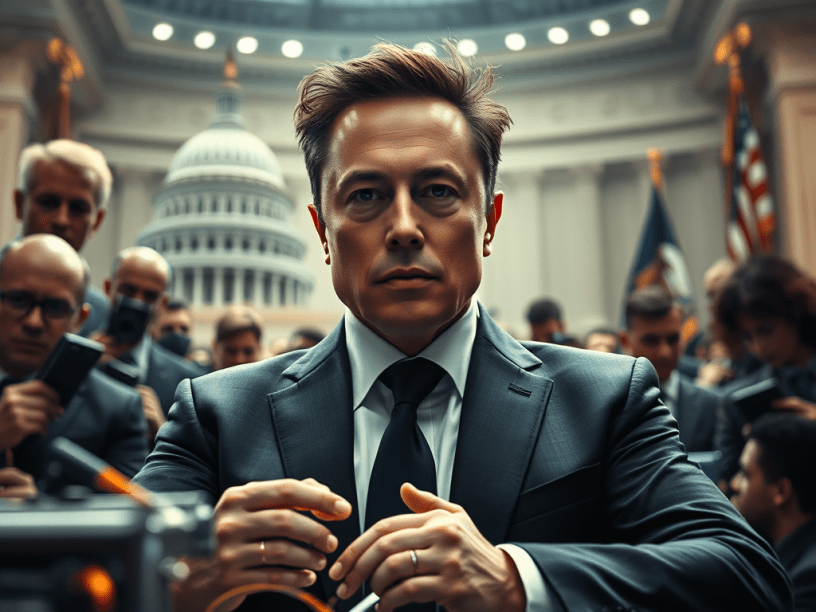
As concerns mount over Elon Musk’s increasing influence in the Trump administration, particularly through the controversial Department of Government Efficiency (DOGE) he leads, questions arise about the legality and ethical implications of his actions. Speculation about Musk’s power to access classified government documents and his apparent evasion of accountability has sparked heated debate.
Musk, characterized by his rapid accumulation of political power, has been effective in his drive to reshape federal agencies. His endeavors have met resistance from traditional civil servants and oversight groups, who criticize his approach as undermining the integrity of government operations. Reports indicate that Musk’s team, primarily consisting of young engineers with limited governmental experience, has gained unprecedented access to sensitive government systems, raising serious concerns about potential legal violations.
Despite being a private citizen and head of DOGE, Musk has been designated as a “special government employee” by Trump, granting him certain levels of authority and access. However, amid scrutiny, the White House has clarified that Musk does not have formal decision-making power and operates mainly as an advisor to the president. Critics argue this lack of accountability is emblematic of a broader trend in the current administration — the blending of private interests with public service leading to a perception of a “shadow government” without proper checks and balances.
Demands for accountability have intensified, with bipartisan calls for oversight from both Democratic and Republican lawmakers, expressing fears over the implications of Musk’s unchecked influence. Some legal experts warn that bypassing the traditional confirmation process undermines Congressional authority, which constitutionally holds the power to govern spending decisions.
As the Trump administration continues to support Musk’s rapid dismantling of various government agencies, the potential for a constitutional crisis looms. Critics highlight the delicate balance between necessary government reform and preserving the foundational principles of democracy — transparency and accountability.
As this dynamic situation unfolds, the American public watches closely, questioning whether we are witnessing a greater erosion of checks and balances, or if reform is indeed on the horizon.
| Author | Publisher | Date | Story Title |
|---|---|---|---|
| Nick Robins-Early | The Independent | 02/04/2025 | How the world’s richest man laid waste the US government |
| David Ingram | NBC News | 02/04/2025 | Elon Musk and DOGE are hacking the government |
| Louis Jacobson | PolitiFact | 02/08/2025 | Do Elon Musk and DOGE have power to close US government agencies? |
| Avi Asher-Schapiro | ProPublica | 02/06/2025 | Elon Musk’s Demolition Crew |
| Joe Hernandez | NPR | 02/13/2025 | Trump hired Musk as a ‘special government employee.’ Here’s what that means |
| Ivan Pereira & Emily Chang | ABC News | 02/15/2025 | Here are all the agencies that Elon Musk and DOGE have been trying to dismantle so far |
| James FitzGerald & Holly Honderich | BBC News | 02/18/2025 | What is Doge and why is Musk cutting so many jobs? |
| David Brunnstrom | Reuters | 02/18/2025 | White House says Musk is not DOGE employee, has no authority to make decisions |
| Reuters | The Guardian | 02/18/2025 | Musk is just an adviser with no power to make decisions, White House claims |
| Aimee Picchi | CBS News | 02/18/2025 | Musk is not an employee of DOGE and “has no actual or formal authority,” White House says |
| Devin Dwyer | ABC News | 02/18/2025 | Is Elon Musk’s government role unconstitutional? What the Supreme Court might say |
| Le Monde with AFP | Le Monde | 02/18/2025 | Musk has no formal decision-making authority, says White House |
 Occupy 2.5