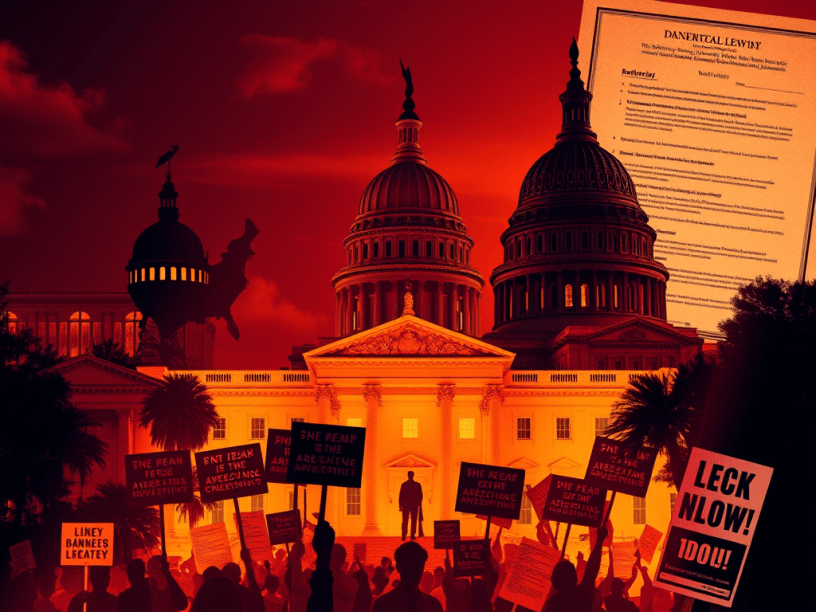
In a striking series of moves aiming to reshape the federal bureaucracy, the Trump administration has initiated mass terminations across government agencies, predominantly affecting probationary employees. The layoffs are part of a broader objective to cut federal workforce size by up to 10%, a directive coinciding with Trump’s recent executive orders to eliminate diversity, equity, and inclusion (DEI) policies, which he claims undermine traditional values of merit and individual achievement.
The strategy, announced by the Office of Personnel Management and executed swiftly across departments like the Department of Veterans Affairs and the Education Department, raises crucial questions about its legality and motivations. Legal experts and critics argue that while the administration has some authority over workforce management, the process lacks transparency and adherence to established legal regulations governing federal employment reductions.
President Trump’s executive order on January 21, 2025, emphasized merit and non-discrimination, yet many perceive the mass firings as politically motivated rather than based solely on job performance. Labor unions, including the American Federation of Government Employees (AFGE), have launched lawsuits claiming the terminations breach civil service protections and due process rights, suggesting they aim to suppress dissent and restructure agencies to align with political objectives.
Prominent commentators warn that such actions could strain agency effectiveness and morale, especially within critical sectors such as national security and public health. Furthermore, the inclusion of Elon Musk’s Department of Government Efficiency (DOGE) in overseeing layoffs has sparked concerns about potential conflicts of interest given Musk’s business ventures.
U.S. District Judge Tanya Chutkan recently declined to halt the firings, ruling that although there are legal questions about DOGE’s authority, insufficient proof of immediate harm exists to justify stopping current efforts. Nonetheless, ongoing lawsuits challenge the legality and ethical implications of the administration’s approach, which some describe as reckless and unprecedented.
While the administration frames its workforce reduction and reorientation as necessary government reforms, the actions have drawn sharp criticism from lawmakers, advocacy groups, and dismissed employees. These legal battles will likely continue to shape the discourse on civil service rights and government efficiency in the coming years.
Sources Table:
| Author | Publisher | Date | Story Title |
|---|---|---|---|
| The President of the United States | The White House | 01/21/2025 | Executive Order on Terminating Illegal Preferences and Discrimination in the Federal Government |
| Ted Oberg and Megan Lebowitz | NBC News | 02/14/2025 | Trump Administration Tells Federal Agencies to Fire Probationary Employees |
| David A. Super | Unspecified | 02/14/2025 | Many Trump Administration Personnel Actions Are Unlawful |
| Jack Queen and Daniel Wiessner | Reuters | 02/13/2025 | Explainer: Are Trump’s Mass Firings of Federal Workers Legal? |
| Aimee Picchi | CBS News | 02/15/2025 | Federal Workers Express Shock, Anger Over Mass Firings: “You Are Not Fit for Continued Employment” |
| David Ingram, Daniel Arkin, and Lora Kolodny | CNBC | 02/15/2025 | Trump Administration Begins Mass Firings Across Government |
| Steven Greenhouse | Co-published with The Guardian | 02/18/2025 | Trump’s Rapid-Fire Anti-Worker Actions |
| Not specifically mentioned | Government Executive | 02/14/2025, updated 02/18/2025 | Federal Agencies Are Still Firing Probationary Employees—First OPM, Now NSF |
| Not specifically mentioned | The Insider | 02/18/2025 | AFGE Condemns Trump’s Mass Firing of Federal Employees |
| Not specifically mentioned | Al Jazeera | 02/18/2025 | US Judge Declines to Halt Trump’s Push to Slash Federal Workforce |
The discussions surrounding these actions are not only about immediate employment impacts but also the broader implications for federal governance and accountability.
 Occupy 2.5