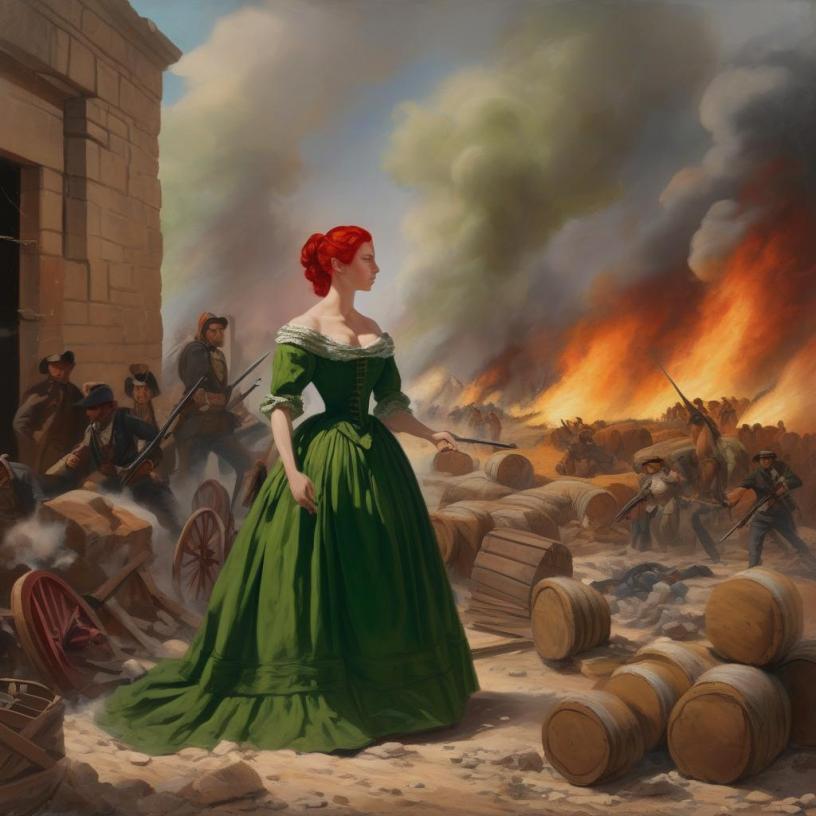
The Siege of the Alamo, which occurred from February 23 to March 6, 1836, stands as a powerful emblem of courage, sacrifice, and the relentless pursuit of independence. Situated in San Antonio, Texas, the Alamo mission was converted into a stronghold by Texan rebels during this critical time.
In early 1836, a courageous group of Texan and Tejano (Mexican-American) defenders, led by notable figures such as William Travis, James Bowie, and Davy Crockett, took a stand at the Alamo. Their mission was to resist the advancing Mexican army commanded by General Santa Anna.
Despite being vastly outnumbered, the defenders faced the Mexican forces head-on, enduring relentless cannon fire and assaults for thirteen days. Their determination exemplified the spirit of resistance against overwhelming odds.
On the final day, March 6, 1836, the Mexican troops launched an intense assault on the Alamo, resulting in a fierce and tragic battle. The defenders were ultimately overrun, with all Texan and Tejano fighters losing their lives, their sacrifices echoing through history.
The fall of the Alamo reverberated throughout Texas, galvanizing support for the independence movement. The phrase “Remember the Alamo” became an enduring cry for Texans, symbolizing their resolve and valor in the fight for freedom.
Though the Alamo fell, its legacy remains a significant chapter in Texas history, embodying the human spirit’s resilience and the ongoing quest for liberty.
Santa Anna: A Controversial Legacy
Antonio López de Santa Anna, a pivotal figure in Mexican history, began his political career by joining Agustín de Iturbide’s Plan de Iguala in 1821, which sought to abolish Spanish colonial rule. He quickly rose to prominence during the Mexican War of Independence.
However, his presidency, starting in 1829, was marred by political strife and economic challenges. He faced upheaval, and after a failed coup in 1832, spent time in exile. By 1833, he returned to power, establishing a centralist government that fueled dissension among states craving autonomy.
As tensions escalated, the Texas Revolution ignited. Santa Anna’s forces achieved a short-term victory at the Alamo, but this sparked a fervent rebellion, leading to Texas declaring independence shortly thereafter. His capture at the Battle of San Jacinto in 1837 forced him to sign the Treaty of Velasco, recognizing Texas’ autonomy.
Santa Anna’s life was fraught with turbulence, marked by military defeats and political upheaval. His return to power during the Mexican-American War saw him face the United States military, leading to further losses and the eventual capture of Mexico City in 1848.
Ultimately, his last term in power came in 1853, overshadowed by corruption and instability. Exiled by 1855, he died in Havana, Cuba, in 1867. Santa Anna’s legacy remains complex; he is viewed variably as a patriot and a tyrant, reflective of the turbulent era of Mexican history.
A Modern Call to Action
In the contemporary context, parallels can be drawn between Santa Anna’s tumultuous reign and the current political climate in the United States under Donald J. Trump, the 47th president. The present administration, a self-serving junta, underscores the need for collective action akin to the stand taken at the Alamo.
Just as the defenders of the Alamo held their ground against a politically formidable foe, we must build our own strongholds of resistance. We must create communities, mobilize our efforts, and establish “Alamos” across the nation to stand against the current tide of authoritarianism.
The fall of the Alamo served as a catalyst for Texas’ eventual victory and independence. Similarly, the struggles we face today could inspire the Democratic opposition to unite and act decisively against the challenges posed by Trump’s administration.
It is crucial for us to take a stand—a visual demonstration of our resolve can motivate change within political ranks. Occupy spaces in cities across the country to raise awareness, even if it comes with risks of arrest or backlash. This is our moment to resist the erosion of democratic norms, to ensure accountability, and to push back against the forces we oppose.
By standing collectively, we draw upon the power of solidarity and resilience. Let us remember our own “Alamo” moment, for the fight for justice and freedom requires unwavering commitment and courage.
 Occupy 2.5