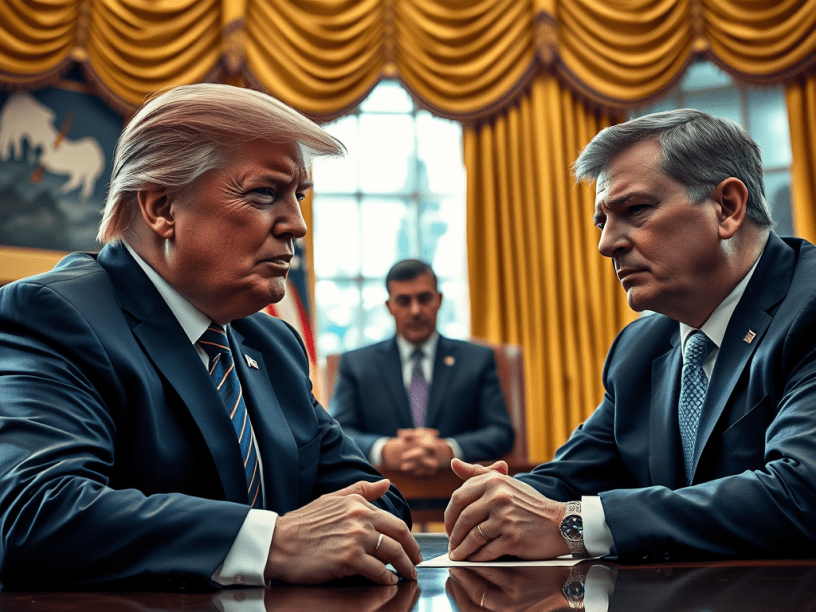
On February 28, 2025, an unexpected confrontation unfolded in the Oval Office between President Donald Trump, Vice President JD Vance, and Ukrainian President Volodymyr Zelenskyy. Initially, the meeting started on a positive note, with both leaders exchanging pleasantries and discussing the crucial U.S.-Ukraine relationship. However, it quickly turned into a chaotic shouting match that shocked many onlookers.
During the meeting, President Trump accused Zelenskyy of being ungrateful for the U.S. support that has helped Ukraine defend itself against Russia’s invasion. He angrily told Zelenskyy, “You don’t have the cards right now,” and warned him that “you’re gambling with World War III.” This statement hints at a threatening attitude toward Ukraine as a country fighting for its survival.
Vice President Vance joined in, telling Zelenskyy it was disrespectful to criticize their administration in front of the media. He demanded to know if Zelenskyy had even said “thank you” during the meeting. This line of questioning implied that Zelenskyy owed Trump gratitude for the support the U.S. had provided. However, Zelenskyy tried to calmly explain the severe situation in Ukraine and why he needed more than just support—he needed security guarantees to ensure the safety of his country.
What should be considered an ally’s call for help quickly turned into a public display of hostility. Zelenskyy presented photos of the destruction in Ukraine, but that did little to calm the angry responses from Trump and Vance. Instead of sympathizing with the Ukrainian plight, Trump insisted that the U.S. wouldn’t be providing any more support unless Zelenskyy agreed to negotiate peace terms that were favorable to Russia. This negative rhetoric does not reflect the actions of a leader who genuinely wishes to support a nation fighting against an aggressor.
After the meeting spiraled out of control, Trump reportedly told Zelenskyy to leave. Zelenskyy, who had come to Washington to discuss a key minerals agreement between the two nations, exited the Oval Office with the media and American public witnessing the fallout of this diplomacy gone awry. Trump’s posting on social media further confirmed the rift, as he stated that Zelenskyy was not ready for peace and disrespected the U.S. in its own Oval Office.
The clash revealed a fundamental misunderstanding between the leaders. Zelenskyy sees the war with Russia as a dire situation that needs urgent action and cannot end without firm commitments from allies like the U.S. Conversely, Trump and Vance’s approach, which minimizes the urgency of Ukraine’s plight and shifts blame, puts them at odds with the reality of the war and the needs of the Ukrainian people.
This tense encounter underscores not just the rifts in U.S.-Ukrainian relations but also highlights a troubling trend where Trump’s focus on personal grievances and political calculations overshadows the serious obligations of leadership during a time of crisis. Understanding this dynamic is crucial for recognizing the implications of the recent confrontation and why holding allies like Zelenskyy to an unreasonable standard is not in the spirit of true international cooperation.
Responsible Statecraft
In an article published on February 28, 2025, by Responsible Statecraft, analysts Anatol Lieven and George Beebe reflect on the contentious encounter between U.S. President Donald Trump, Vice President JD Vance, and Ukrainian President Volodymyr Zelenskyy during a meeting in the Oval Office. They describe the incident as a rare and public spectacle that showcased the deep divides in perspectives regarding the ongoing war in Ukraine.
The authors note that while clashes between leaders can occur in private, the public nature of this confrontation was unprecedented. They argue that both sides share responsibility for the escalation, yet highlight that Zelenskyy, positioned in a weaker diplomatic stance, was particularly misguided in his approach. The tensions stem from fundamentally differing views on the origins of the conflict and the prospects for its resolution.
Zelenskyy attributes the blame for the war solely to Russian aggression and believes that peace negotiations are futile without strong Western military backing, particularly from NATO. On the other hand, Trump and Vance view Russia as having legitimate security concerns regarding NATO expansion and believe that diplomatic solutions are possible, provided that the West does not overcommit to security guarantees.
The article emphasizes that Trump’s harsh words—indicating Zelenskyy was risking “World War III”—and the public airing of grievances reflect a significant shift in U.S.-Ukrainian relations. The expectation for a U.S. military “backstop” for a European peacekeeping force was met with frustration from the Trump administration, highlighting the clash of expectations and strategies.
Lieven and Beebe argue that while the meeting’s fallout could draw attention and create pressure within Ukraine, the broader implications could jeopardize new negotiations and future military support for Ukraine. They caution that if Zelenskyy continues to reject compromises, it may result in diminished U.S. backing, further complicating Ukraine’s ability to defend itself against an increasingly aggressive Russian force.
The article discusses the high stakes involved in U.S.-Ukrainian diplomacy, particularly in light of the recent confrontation and its potential to reshape future negotiations. It highlights the need for careful, private diplomacy that maintains the dignity of international relations and addresses the starkly different geopolitical perspectives between nations involved.
Reactions
In an article published by The Guardian on March 1, 2025, reporters covered the dramatic and unprecedented confrontation during a White House meeting between U.S. President Donald Trump, Vice President JD Vance, and Ukrainian President Volodymyr Zelenskyy. The article highlights how the initially cordial meeting devolved into a shouting match, which drew widespread condemnation in the media.
The Guardian opens with a striking quote from Trump, stating, “You are gambling with world war three,” framing the meeting as a substantial diplomatic failure. Commentators described the encounter as “disastrous,” with David Smith referring to it as one of the greatest diplomatic disasters in modern history. The front pages of various newspapers echoed this sentiment, with adjectives such as “disastrous” and “vile” used to characterize the proceedings.
Media coverage included reports from:
- The Daily Mail, calling the event “A spectacle to horrify the world,” and highlighting the public humiliation Zelenskyy faced during the confrontation.
- The Daily Mirror, which featured the headline “Shock & War,” emphasizing Trump’s offensive remarks and Zelenskyy’s inability to secure a deal.
- The Daily Telegraph, which summarized Trump and Vance’s aggressive approach with the phrase, “Make a deal or we’re out,” indicating the ultimatum given to Zelenskyy.
- The Financial Times, which stated that the proposed minerals deal was left unsigned amid the acrimonious exchange.
- The Times portrayed the situation as a “Meltdown in the Oval Office,” showcasing photos of the intense arguing between the leaders.
- The Independent declared the meeting as a “disastrously bad-tempered summit,” further contributing to the overall sense of shock among observers.
Zelenskyy later expressed his belief that relations with the U.S. could be repaired despite the heated encounter, underscoring the importance of continued American support for Ukraine in its conflict with Russia. His comments reflect a desire to navigate the complexities of U.S.-Ukrainian relations even in the wake of such a public breakdown.
The article encapsulates the media’s reaction to a pivotal moment in international diplomacy, demonstrating how the fallout from this meeting could have significant implications for Ukraine and its ongoing struggle against Russian aggression. It underscores the difficulty and emotion involved in the negotiation process, which appears to have entered a more contentious phase.
The Unvarnished Truth: Facing Trump’s Foreign Policy
We may not like what we saw on the 28th of February, but it is the reality of the politics of the United States today. Like it or not, Donald J. Trump is the President of the United States. Like it or not, he did get a narrow majority of the popular vote. Like it or not, Harris conceded to him. Like it or not, he was sworn into office on January 20, 2025. And like it or not, he recognizes the Russian perspective on events in Ukraine.
As long as he’s in the Oval Office, he’s the one calling the shots. For his own political reasons, he wants this war in Ukraine to end. He wants a ceasefire. Maybe he envisions turning Eastern Ukraine into a resort kingdom like he does with Gaza, but that’s a topic for another discussion.
Right now, like it or not, until the people of the USA decide to do something about Trump, he’s in charge of foreign policy. Everybody needs to recognize that fact and act accordingly.
Sources:
- ABC News Article:
Watson, Kathryn, et al. “Zelenskyy’s White House Meeting Ends in Blowup with Trump and Vance over Ukraine’s Future.” CBS News, 28 Feb. 2025, http://www.cbsnews.com/news/zelensky-trump-vance-oval-office-clash-ukraine-future. - BBC News Article:
Petsa, Myroslava, and Daniel Wittenberg. “What It Was Like in the Room During Oval Office Shouting Match.” BBC News, 1 Mar. 2025, http://www.bbc.co.uk/news/world-europe-64995098. - Le Monde Article:
“Zelensky ‘Kicked Out’ of White House After Trump Showdown as Peace Talks Collapse.” Le Monde, 1 Mar. 2025, http://www.lemonde.fr/en/united-states/article/2025/02/28/trump-and-zelensky-openly-clash-in-heated-white-house-exchange_6738686_133.html. - Responsible Statecraft Article:
Lieven, Anatol, and George Beebe. “Hard Truths About the Trump-Zelensky-Vance Oval Office Blow-Up.” Responsible Statecraft, 28 Feb. 2025, http://www.quincyinst.org/article/trump-vance-zelensky-oval-office-blow-up. - MailOnline Article:
Earle, Geoff, and Emily Goodin. “Zelensky ‘Kicked Out’ of White House After Trump Showdown as Peace Talks Collapse.” MailOnline, 1 Mar. 2025, http://www.dailymail.co.uk/news/article-1234567/zelensky-kicked-out-white-house-trump-showdown-peace-talks-collapse.html. - The Guardian Article:
“‘A Spectacle to Horrify the World’: What the Papers Say About Trump and Vance’s Meeting with Zelenskyy.” The Guardian, 1 Mar. 2025, http://www.theguardian.com/us-news/2025/mar/01/trump-zelenskyy-vance-oval-office-meeting. - CBS News Follow-Up Article:
Watson, Kathryn, et al. “Zelensky’s White House Visit Cut Short After ‘Contentious’ Meeting.” CBS News, 1 Mar. 2025, http://www.cbsnews.com/news/zelensky-white-house-meeting-trump-vance. - Second CBS News Article:
Watson, Kathryn, et al. “Zelensky’s White House Meeting Ends in Loud Blow-Up with Trump and Vance.” CBS News, 28 Feb. 2025, http://www.cbsnews.com/news/zelensky-white-house-meeting-trump-vance-blowup.
 Occupy 2.5