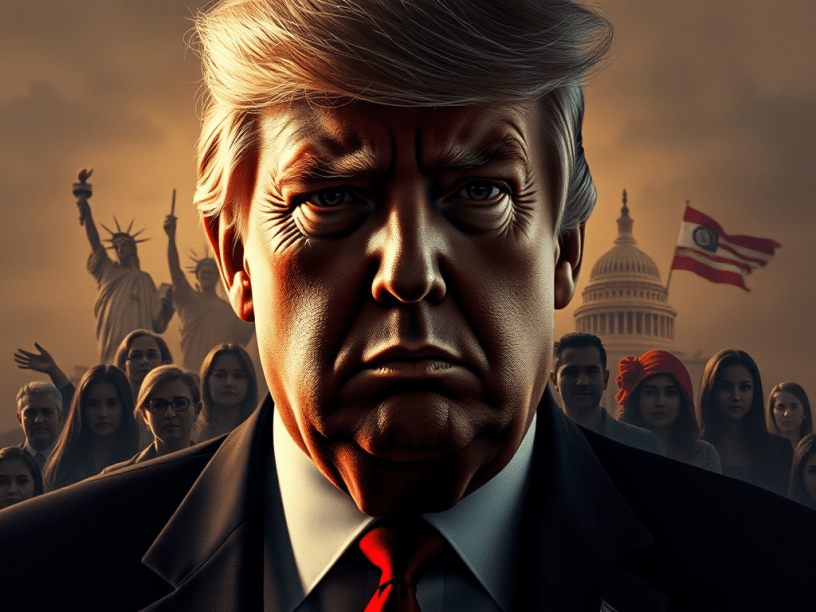
In the grand theater of American politics, few figures have loomed larger—or more controversially—than Donald Trump. His return to the White House has sparked intense debate, not just about policies but about the very essence of morality. A series of recent statements from notable figures, including actor Robert De Niro and political commentator Richard Murphy, shed light on the evolving perceptions of Trump’s character as he reasserts his presence in the political landscape.
De Niro, a man who has made a career out of studying the dark corners of human nature, has been vocal in calling out Trump’s moral failings. His remarks, read at the Stop Trump Summit in New York, painted a portrait of the former president as “evil,” a “wannabe tough guy” devoid of ethics. De Niro spoke candidly about the consequences of Trump’s actions during the COVID-19 pandemic, describing the former president’s behavior as reckless and pernicious, labeling him a bully who governs through fear. “He has contempt for all of them,” De Niro said, referring to those whose lives are affected by Trump’s policies.
As De Niro’s words reverberated through the political ether, others echoed similar sentiments. Commentator Richard Murphy posed a provocative question: Is Trump mad or bad? His analysis, delivered in the wake of Trump’s latest executive maneuvers, captured the duality of a man who seems to exist outside the bounds of conventional morality. Murphy expressed doubts about Trump’s grip on reality, noting his erratic speeches that often resembled the ramblings of someone unmoored from the truth. “Madness is being out of touch with reality,” Murphy noted, emphasizing the disconnection between Trump and the ordinary citizens facing the fallout of his decisions.
This clash of perspectives highlights deeper societal fractures. Political discourse is no longer merely a battleground for ideas but a referendum on character itself. Individuals like De Niro and Murphy bring to light the myriad ways in which Trump’s actions have created fear among marginalized communities: immigrants living under the threat of deportation, women facing potential rollback of their rights, and countless others caught in the crossfire of a government that seems to prioritize power over people.
Right in the crucible of this discourse lies the chilling reflection on what it means to use fear as a weapon in governance—a tactic that Trump has mastered over his tumultuous political career. The rhetoric emitted from his lips often serves to rally his base while alienating those who seek a more inclusive and empathetic society.
People both inside and outside political circles are left to grapple with the implications of supporting a leader who openly embraces tactics of intimidation and division. As pointed out by various observers, from all walks of life, Trump may well be a product of a larger cultural malaise—one where audacity is mistaken for effectiveness and where moral ambiguity thrives amid a cacophony of sound bites and viral memes.
What’s clear is that Trump’s presidency, whether characterized as mad or bad, will continue to provoke heated discussions about morality in leadership. As he pushes forward with his agenda, it is paramount for the American public to critically evaluate not just his policies, but the moral compass guiding them.
In a landscape as polarized as America’s, citizens must decide how they want to navigate this era—a time when the battle for moral clarity is almost as significant as the fight for votes. Whether Trump embodies a tragic character in our national narrative or merely showcases the follies of leadership gone awry, his indelible mark on the discourse around morality in politics is one that will linger long after the dust settles.
Thus, the question remains: can a leader whose actions inspire fear and division ever be reconciled with the ideals of justice and equity that so many hold dear? The answer seems as complicated as the man himself.
Sources:
- Remer, Scott. “Donald Trump and the Banality of Evil.” openDemocracy, 27 Oct. 2020.
- Pulver, Andrew. “Robert De Niro: Trump Is ‘Evil’ and ‘A Wannabe Tough Guy with No Morals or Ethics’.” The Guardian, 13 Oct. 2023.
- McAdams, Dan P. “The Mass Psychology of Trumpism.” New Lines Magazine, 21 Feb. 2024.
- Leitch, Will. “Another Evil Thing Trump Did Last Week That You Might Have Missed.” Medium, 11 Apr. 2024.
- Silk, Mark. “Commentary: Calling Out Donald Trump, Perpetrator of Evil.” Religion News Service, 16 Oct. 2024, The Salt Lake Tribune.
- Murphy, Richard. “Is Trump Mad or Bad?” Tax Research UK Blog, 24 Jan. 2025.
- Donegan, Moira. “Beware, Trump: The American Spirit Is Indefatigable.” The Guardian, 21 Jan. 2025.
- Tomasky, Michael. “Don’t Get Psyched Out! Trump Is an Evil Buffoon, Not an Evil Genius.” The New Republic, 23 Sept. 2024.
 Occupy 2.5