By Maxwell St. Clair, Independent News Service (INS), Chicago
March 6, 2025
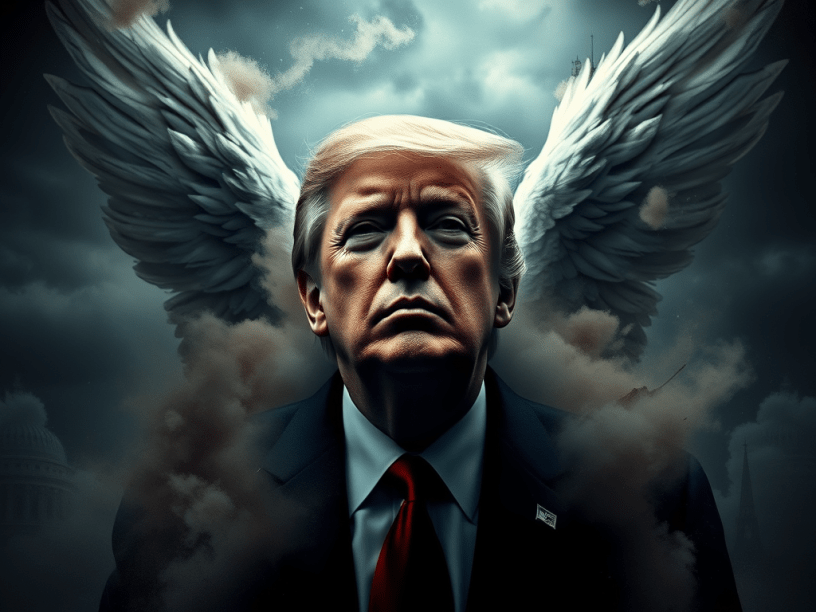
As I sift through the chaotic aftermath of Donald Trump’s return to the White House, I can’t shake the feeling that America is teetering on the precipice of something dark—something that whispers of Abaddon. In Hebrew lore, Abaddon is more than just a name; he is a symbol of destruction, a fallen angel cast into a “bottomless pit”—a fitting metaphor for the turmoil now brewing in the United States and Europe alike.
The public opinion surveys emerging from Europe tell a tale of stark contrasts. While countries like India, Brazil, and Saudi Arabia seem to welcome Trump’s second term, proclaiming him a harbinger of peace, the sentiments among our European partners are decidedly anxious. They are wrestling with a figure who, instead of reforging the bonds of transatlantic unity, raises questions about the very fabric of international trust.
In our war-torn world, one might wonder: is Trump an agent of chaos, channeling the very essence of Abaddon? His confrontational remarks about Ukraine’s President Zelenskyy in a recent Oval Office clash resonate far beyond the walls of power—echoing through a continent that was once steadfast in its allegiance to American values.
“Russia is the aggressor, and Ukraine is the victim,” declared French President Emmanuel Macron, underscoring a sentiment that stands in sharp contrast to Trump’s assertions. For many Europeans, who now view Trump’s leadership as a potential abrogation of democratic ideals, there lies a sense of foreboding. The anxiety is palpable; they fear not just for their security but for the very principles that have anchored the West since the Cold War.
Despite perceived goodwill elsewhere, Europe sees Trump’s brash approach as a harbinger of isolationism. Heroes of their past, once able to unify in the face of adversity, now find themselves splintered. When the European Commission President, Ursula von der Leyen, boldly declared that the “free world needs a new leader,” one can’t help but notice the darkness creeping into the discourse. A challenge now looms; will Europe rise as a counterweight to the vicissitudes coming from the other side of the Atlantic?
In Ukraine, opinions on Trump shift like the sands of war—some hope for salvation, others fear betrayal. The specter of possible concessions to Moscow stirs unease within a nation that stands at a crossroads. Trump’s rhetoric of peace thunderously reverberates, yet many wonder whether it brings genuine resolution or simply further strife, as if Abaddon himself plays both sides in a twisted game of chess.
But it’s not just the Europeans who feel this weight; beneath the surface of American politics, unrest begins to bubble. Trump’s peculiar ability to polarize could lead to a seismic shift in national sentiment—creating embers of discontent that threaten to ignite into wider turmoil. As citizens seek accountability and clarity, the specter of division has taken root—just as Abaddon symbolizes ruin.
Though these are tumultuous times, the European leaders must recognize their unique position—and their potential to act decisively in a world that seems increasingly transactional. They stand at the intersection of history, burdened not only by their alliances but also by the shadows of uncertainty cast by Trump’s second presidency.
As they forge ahead, there is no question: the road is fraught with peril. A new approach to diplomacy is required—an approach that acknowledges the realities of a world not as it should be, but as it is, with figures like Trump embodying the chaos that falls from the heavens.
In these strange days, peering into the abyss, one must wonder—are we witnessing the rise of a fallen angel in America’s capital, or is it simply the world’s stage as it prepares for a reckoning? The answers may lie in the pages of history—or in the shadows of the present, as we navigate this turbulent epoch.
Sources:
- Vinjamuri, Leslie, and Kanishkh Kanodia. “Europe’s Leaders Are Finding a Way to Deal with Trump – But Clarity on Ukraine Remains Elusive.” Chatham House, 28 Feb. 2025.
- Casert, Raf. “European Union Pushes Back Hard Against Trump Claims That 27-Nation Bloc Was Out to Get United States.” PBS News, 27 Feb. 2025.
- Atlantic Council experts. “What Europeans Think of Trump’s Approach to Ukraine (and What They Might Do Next).” European Council on Foreign Relations, 20 Feb. 2025.
- Xinhua. “European Countries Vow Retaliation Against Trump’s Tariff Threat.” Xinhua News Agency, 28 Feb. 2025.
- Garton Ash, Timothy, Ivan Krastev, and Mark Leonard. “Alone in a Trumpian World: The EU and Global Public Opinion After the US Elections.” European Council on Foreign Relations, 15 Jan. 2025.
 Occupy 2.5