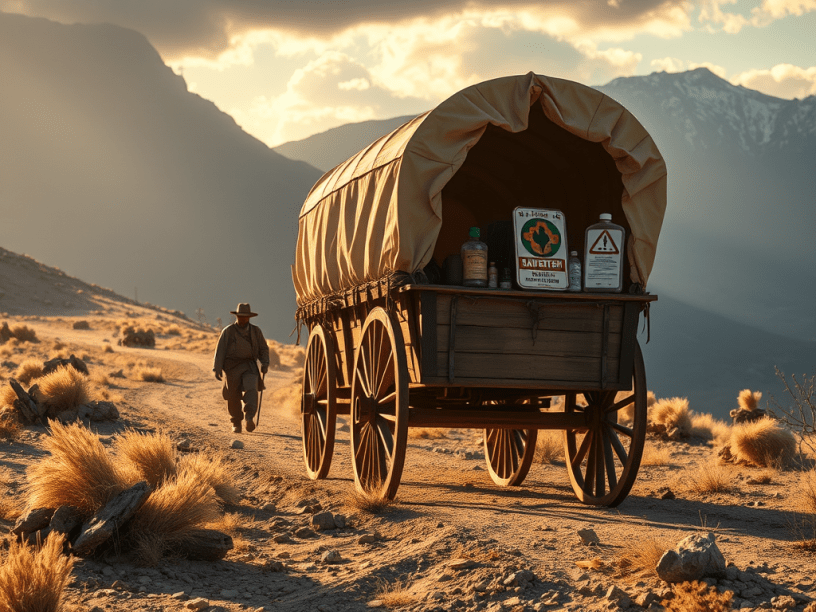
In a twist worthy of Hollywood, the legendary Oregon Trail is facing a resurgence—not in games, but in outbreaks of dysentery. Coinciding with recent negotiations for a film adaptation of the beloved educational game, health officials warn that modern-day Oregonians are experiencing symptoms reminiscent of those who attempted the treacherous journey westward in the 1800s.
The Oregon Trail, first launched in 1971 as a text-based instructional program for mainframe computers, not personal computers, transformed learning through its immersive simulation of pioneer life. Players navigated their covered wagons across perilous terrain, making survival decisions as they faced challenges such as weather, illness, and of course, the infamous “death by dysentery.” With its pixelated graphics and simple yet engaging gameplay, the game captured the imaginations of generations, becoming a cultural phenomenon that introduced millions to the hardships of American expansion.
Fast forward fifty years, and the game’s legacy is set to receive a cinematic makeover. With Apple reportedly developing an action-comedy film, interest in the historical context of the Oregon Trail has surged, just as reports emerge of an alarming increase in dysentery cases throughout the state. Health officials are scrambling to address this outbreak, realizing that the current trend may resemble more than just a quirky nod to the game’s more gruesome outcomes.
Schools are once again teaching children about the realities of pioneer life, but this time, lessons are marred by the reality of dysentery outbreaks. Health experts urge the public to practice thorough sanitation and be mindful of their water sources to prevent further spread. As students and nostalgic gamers reminisce about the challenges of traversing the notorious path, many hope that the movie adaptation can bring a new perspective on the struggle for survival—without the modern-day realities of bacteria and illness.
It seems that history may be repeating itself on the Oregon Trail, blending the past with the present in an all-too-real reminder that while the pixels may change, the struggle for survival remains the same.
- Bubbles, Steven. “Oregon Trail IRL: Portland Has a Dysentery Outbreak?!” Clownfish TV, 3 Mar. 2025, https://clownfishtv.com/oregon-trail-irl-portland-has-a-dysentery-outbreak/.
- “Dysentery, the Diarrhea-Inducing Bacterial Infection, on the Rise in Oregon.” CommsTrader, [date not provided], https://commstrader.com/news/dysentery-the-diarrhea-inducing-bacterial-infection-on-the-rise-in-oregon/.
- Schuman, David. “The Oregon Trail Is Being Developed into a Movie.” KPTV, 26 Nov. 2024, https://www.kptv.com/2024/11/26/oregon-trail-is-being-developed-into-movie/.
- Young, Anna. “Dysentery, the Diarrhea-Inducing Bacterial Infection, on the Rise in Oregon.” MSN, [date not provided], https://www.msn.com/en-us/health/other/dysentery-the-diarrhea-inducing-bacterial-infection-on-the-rise-in-oregon/ar-AA1A4hgG.
 Occupy 2.5