In a time where political fractures threaten the very fabric of American society, a tapestry of voices from a diverse array of protests emerges, capturing the essence of a nation teetering on the edge. From the fervor of youth demanding change to historical reflections on division, these narratives illustrate a profound struggle for justice and identity in an increasingly polarized landscape.
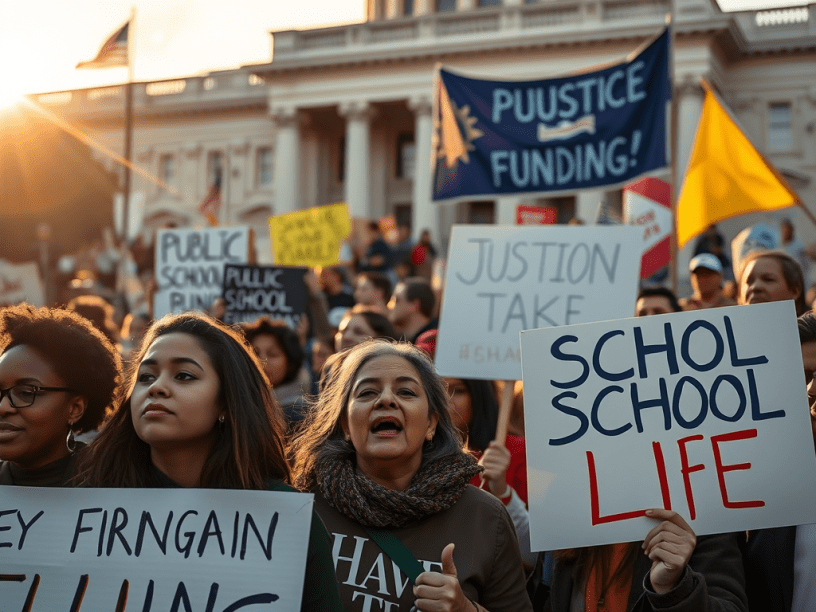
On March 1, 2025, advocates rallied in the rotunda of the Wisconsin State Capitol, pleading for increased funding for public schools. Spearheaded by local educators and community members like Denae Walcisak of Prentice School District, who passionately lamented, “The lack of funding is affecting our whole community and our way of life. I ask you from the people of Prentice, please don’t let us fade away,” the rally served as a vital call for action in an era defined by growing dissent over educational resources (Spears, 2025).
The rally echoed sentiments articulated years earlier by scholars and commentators observing a nation grappling with extreme divides. In a March 27, 2019 article, BU historian Nina Silber noted that while signs of political violence are alarming, it would be premature to call this political turmoil a “civil war.” She urged caution, pointing out that today’s fracturing is less about sectional divides reminiscent of the Civil War but rather complex internal disagreements within states. “Maybe our politics and culture are moving in that direction, but I don’t see it yet,” she stated, highlighting the nuances of contemporary strife (BU Today, 2019).
As tensions escalated in 2016, Aaron Mak recounted a harrowing experience at a Black Lives Matter protest in Milwaukee, where he faced hostility due to his Asian-American identity. His encounter with both anger and solidarity underscored the complexities of racial dynamics in a fight for justice; “I wanted to encourage my grandparents to read the Letters for Black Lives,” he reflected, demonstrating the struggle within minority communities to navigate their roles in ongoing civil rights movements (Mak, 2016).
The discourse surrounding the Occupy Wall Street protests also revealed diverging perspectives on social justice and responsibility. In 2011, Jessica Lee dismissed protesters as “Wall Street Whiners,” critiquing their approach while underscoring a generational divide in understanding socioeconomic disparities. She argued, “If the movement wants to rid itself of the whiny persona it has created, it should find a coherent aim” (Lee, 2011).
Conversely, Amy Dean, writing in October 2011, framed the OWS movement as a necessary outlet for discussing deep-seated inequality in America, arguing that historical movements have often faced disdain yet provided essential contributions to political progress. She called the ongoing discussion over economic justice, “a crucial, and welcome, development” (Dean, 2011).
These recurring protests reflect a wider civilization grappling with the ramifications of unresolved grievances and unmet expectations. The intersection of race, class, and political identity manifests strikingly in discussions of public policy, social justice, and community accountability, painted with the colors of anger, frustration, and a longing for dignity. As the country faces challenges that echo the historical resentments of the past, the question remains: Will these movements catalyze enduring change or simply highlight divisions further?
In a landscape where violence and rhetoric swirl together, the diverse voices rising up against systemic inequalities form the heartbeat of a democracy striving to redefine itself. The confluence of these narratives indicates not just dissent, but a deep-rooted desire for collective action, understanding, and acknowledgment of shared humanity. Together, these stories weave a cautionary tale of a nation fighting for its soul—an ongoing battle that mirrors the complexities of American history itself.
Citations:
- Spears, Baylor. “‘Don’t Let Us Fade Away’: Advocates Rally for Public Schools.” Wisconsin Examiner, 1 Mar. 2025.
- “BU Historian Answers: Are We Headed for Another Civil War?” BU Today, 27 Mar. 2019.
- Mak, Aaron. “‘You’re Asian, Right? Why Are You Even Here?’” Politico Magazine, 23 Aug. 2016.
- Lee, Jessica. “Occupy Wall Street Protest Is Just a Forum for ‘Whiners.'” Daily Bruin, 9 Oct. 2011.
- Dean, Amy. “Occupy Wall Street and America’s Democratic Tradition.” Arguments, 27 Oct. 2011.
- Heller, Nathan. “Is There Any Point to Protesting?” The New Yorker, 14 Aug. 2017.
- Jaffe, Sarah. “The Movement Supporting Public Employees Is Rising.” In These Times, 21 Feb. 2025.
 Occupy 2.5