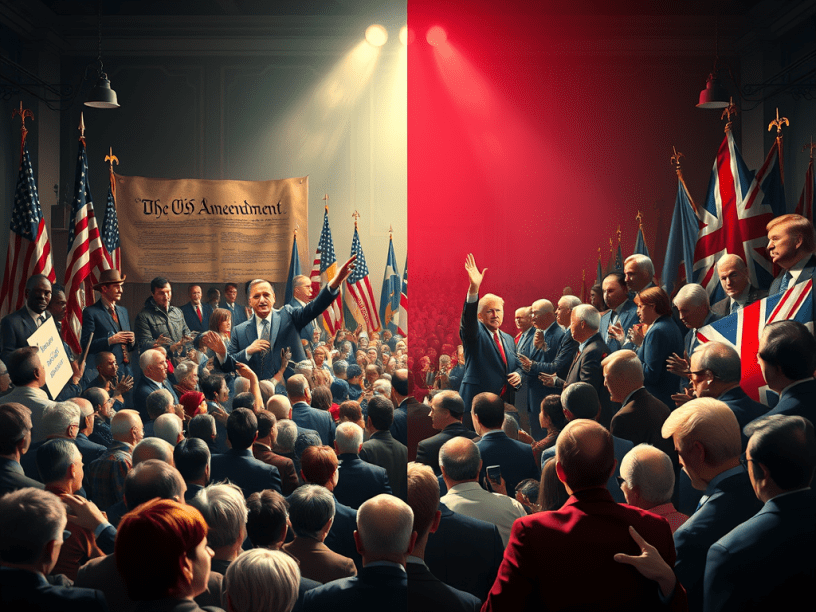
Freedom of speech is a cornerstone of democratic societies, allowing individuals to express their thoughts and beliefs without fear of censorship or retaliation. While both the United States and the United Kingdom value this freedom, significant differences in how it is perceived and practiced in each country reveal important implications for public discourse. This essay will examine these cultural nuances, particularly in the use of language, societal attitudes towards offensive speech, and the potential lessons the USA could learn from the UK.
In the United States, freedom of speech is protected under the First Amendment of the Constitution, enshrining the right to express ideas regardless of their content. However, this protection is accompanied by a cultural tendency toward politeness and decorum in public discourse. Many Americans may engage in self-censorship, avoiding certain words or topics that could be deemed offensive. Furthermore, the country has a history of imposing moral and ethical boundaries on speech, especially regarding hate speech and incitement to violence. A notable example is the reaction to public figures using strong language; if a Democrat were to use an insult such as “cunt” to describe a Republican, they would likely face severe backlash and criticism, potentially jeopardizing their career.
In contrast, the culture of freedom of speech in the UK tends to embrace a more permissive attitude regarding the use of obscenities. British society often incorporates “colourful” language as part of everyday vernacular, with politicians and public figures occasionally using explicit terms in their discussions. For instance, a UK politician could publicly refer to a figure like President Donald J. Trump using strong language without facing the same level of condemnation that an American politician might encounter for similar remarks. This reflects a greater tolerance for controversial topics in the British political landscape, where the use of provocative language often ignites spirited debate rather than outrage.
The complexities of language in both countries extend beyond just profanities. In the U.S., heated debates arise around the use of the “N-word,” raising questions about who is entitled to use it and under what circumstances. Although many African Americans have reclaimed the term within their community, allowing for its usage among themselves, its application by individuals outside the community often leads to severe social repercussions. Additionally, the context of the term’s usage can vary dramatically across cultures; for instance, South Africans using the term may not intend it in the same derogatory fashion as it is often interpreted in America. This multifaceted nature of language usage complicates discussions about ownership and meaning, emphasizing that no single group can wholly claim a word.
The differences in these cultural approaches reveal insights into the underlying societal values of each country. America’s inclination toward a polite society may be rooted in its diverse and multicultural demographics, which navigate various cultural sensitivities. This fear of offending others can lead to calls for “political correctness,” where language is adjusted to avoid potential harm. However, this emphasis on civility may stifle genuine discourse, making it challenging to address complex societal issues. Conversely, the UK’s open acceptance of offensive language may encourage more robust discussions. The British approach allows for the expression of raw, unfiltered opinions, fostering an environment where ideas can be openly challenged without the weight of societal repercussions.
In reviewing these cultural contrasts, one might wonder whether the USA could learn from the UK’s approach. By cultivating a more open dialogue that embraces the occasional use of provocative language, American society might stimulate healthier, more authentic discussions around controversial topics. For example, de-stigmatizing certain terms might promote honest conversations about race, politics, and cultural identity without the fear of social reprisal. This shift could inspire critical thinking and encourage individuals to confront uncomfortable truths rather than retreating into politically correct rhetoric.
In summary, while both the USA and UK recognize freedom of speech as a fundamental value, their cultural approaches diverge significantly. The U.S. tends to prioritize civility, which can hinder authentic communication, while the UK exhibits a greater tolerance for offensive language, potentially fostering more open discourse. By understanding these distinctions and their implications for public dialogue, societies in both countries can strive for a balance that respects individuals while promoting candid expressions of ideas.
 Occupy 2.5