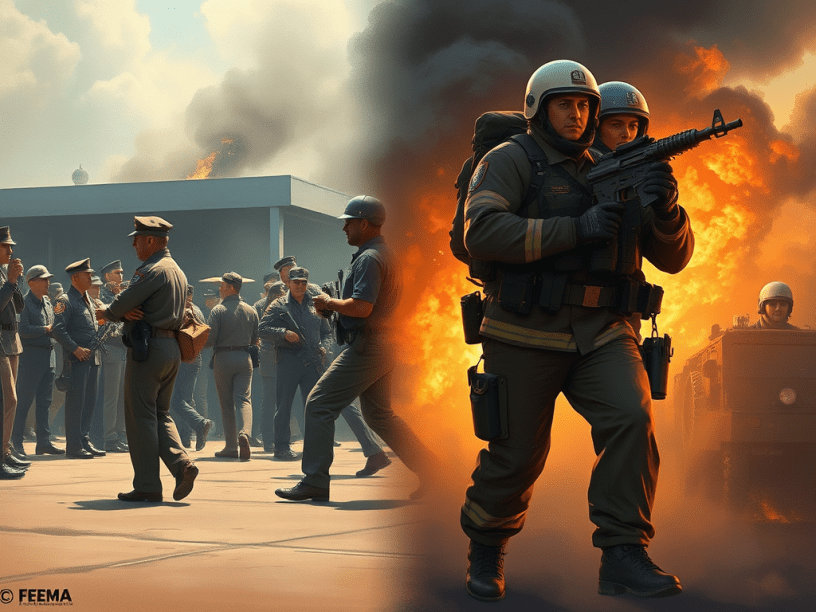
The landscape of emergency management in the United States has undergone significant transformation since the early days of Civil Defense, which was formally implemented during World War II, particularly in 1941. Before Civil Defense, the nation’s emergency response relied on local volunteer fire departments and ad-hoc community efforts to address disasters, without a cohesive strategy or national oversight.
Civil Defense was established during the Cold War to prepare the public for potential nuclear attacks and natural disasters. Programs included community drills, construction of bomb shelters, and public education campaigns about survival techniques. The primary goal was local preparedness, empowering citizens to take initiative in emergencies.
In contrast, FEMA’s framework, established in 1979, centralizes disaster response at the national level, coordinating efforts across state and local agencies. Post-1979, the agency emphasized a systematic approach, utilizing federal resources to assist during large-scale disasters, whether natural or man-made. This can streamline aid and provide rapid response but relies heavily on federal activation.
One significant critique of FEMA’s approach is its dependency on national coordination. In the event of a sudden catastrophe, such as a nuclear strike on Washington, D.C., local areas may lack immediate guidance and resources, rendering them vulnerable. This scenario mirrors the fictional narrative in Pat Frank’s “Alas, Babylon,” highlighting the potential ineffectiveness of FEMA if a national activation is required in a moment of crisis; the local Civil Defense director, Bubba Offenhaus, didn’t do so well either.
While Civil Defense thrived on a proactive community response, FEMA offers a cohesive structure for large-scale emergencies. However, in dire situations without warning, the swiftness of local response can be crucial, revealing a notable gap in FEMA’s strategy compared to the older model.
As communities continue to evolve, the lessons learned from these contrasting methodologies will inform future emergency management practices. The effectiveness of disaster response lies in integrating local readiness with national support to safeguard citizens in an unpredictable world.
 Occupy 2.5