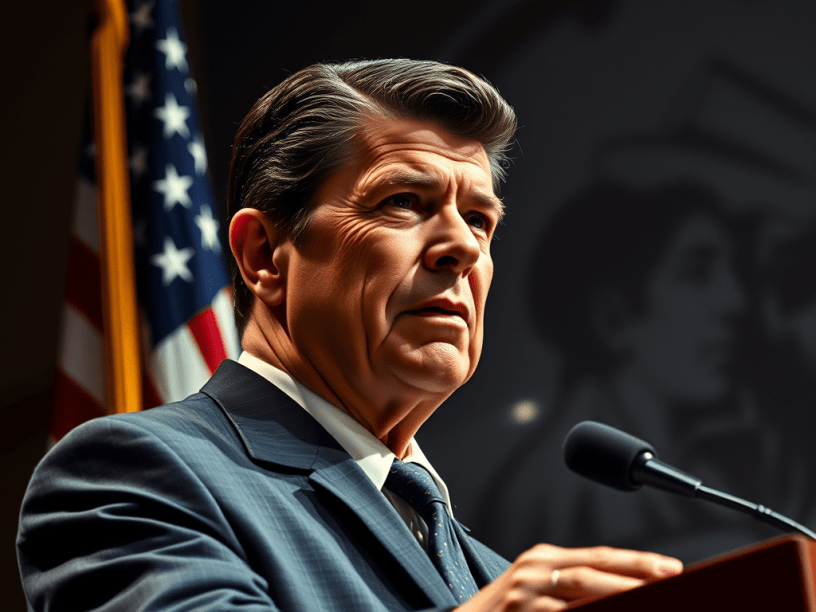
The legacy of Ronald Reagan holds an almost mythical status among many in the Republican Party; however, a closer examination of his domestic policies reveals a starkly different narrative—one that illustrates a troubling decline in the welfare of the American populace. The Reagan years, often glorified by party loyalists, marked a tumultuous period that saw the rise of economic hardship and social discontent, culminating in what is now referred to as the Reagan Recession.
The Illusion of Reaganomics
When Reagan entered the presidency in 1981, he was met with a staggering economic crisis: double-digit inflation, an unemployment rate that soared past 7%, and interest rates nearing 20%. Under the banner of “Reaganomics,” he promised sweeping tax cuts, reduced government spending, and deregulation. His economic policies were underpinned by the controversial supply-side economics theory—the notion that tax cuts for businesses and the wealthy would ultimately benefit all Americans through job creation and economic growth.
However, rather than lifting the nation out of economic malaise, these policies catalyzed an unprecedented downturn. As he pushed through massive tax cuts and defense spending increases, Congress ultimately failed to address essential social programs. Unemployment surged to a staggering 10.8% by December 1982—higher than it had been during the Great Depression of the 1930s. This dramatic economic downturn was a direct result of Reagan’s initial policy decisions, which many continue to attribute to his predecessor, Jimmy Carter.
The Reagan Recession: A Misnamed Crisis
The recession that struck the U.S. in the early 1980s unfolded in two painful phases: a brief downturn in 1980, followed by a deeper and longer-lasting recession from July 1981 to November 1982. Despite the significant economic challenges, Reagan’s administration confidently proclaimed that the tax cuts would generate increased revenues. Instead, they led to substantial federal deficits, which ballooned to levels previously unseen, culminating in a national debt that nearly tripled by the end of his presidency.
While many Republicans deflect blame for this downturn to Carter’s charge of “mismanagement,” the reality is that Reagan’s economic policies flipped the narrative. He took the stage as a charismatic leader, yet the harsh truth remains: thousands of jobs were shipped overseas as companies capitalized on cheaper labor, leaving many American workers in the lurch during a time of rampant inflation and decreased purchasing power. The stranger irony lies in Reagan’s portrayal as a hero of economic revitalization; his policies struggled to create an equitable foundation for growth.
A President Acting the Part
Reagan, often referred to as the “Great Communicator,” dazzled the nation with his charm and wit, edifying his authority as president through magnetic speeches and public performances. Yet, to many critics, this was a façade—a man more at ease in front of a camera than in tackling real issues facing American households. One commentator infamously dubbed him the “Greatest Second Rate President in U.S. History,” a biting reflection on an administration that prioritized rhetoric over substantive policy changes.
His approach to governance appeared to be more of an act—an actor embodying the role of president rather than a leader with a clear vision for all Americans. Under his watch, dire socio-economic trends escalated, and the policies propagated were seen as benefiting the wealthy disproportionately while neglecting vast segments of the population.
Questionable Foreign Policy Achievements
Ronald Reagan’s foreign policy achievements were characterized by significant events, including the invasion of Grenada in 1983, which sought to prevent a Marxist takeover in the Caribbean and restore a pro-American government. His administration’s support for the Contras—Nicaraguan rebel groups opposing the Sandinista government—was a crucial element of his strategy to combat communism in Central America, despite the conflict resulting in a substantial civilian death toll, estimated to be between 30,000 and 50,000 individuals. Nonetheless, Reagan’s foreign policy is perhaps most controversially associated with the Iran-Contra scandal, in which funds from covert arms sales to Iran were illegally redirected to bolster the Contras. While Reagan frequently claimed credit for the conclusion of the Soviet Union, asserting that his hardline tactics and strategic military buildup, including the proposed Strategic Defense Initiative (commonly referred to as “Star Wars”), played a significant role, many historians contend that the collapse of the Soviet empire was primarily attributable to internal failures and reform movements within the Soviet bloc, rather than external pressures imposed by Reagan’s policies. This complexity in historical interpretation suggests that, although Reagan’s administration exerted a considerable influence on global politics, the narrative surrounding the Cold War’s conclusion necessitates a more nuanced understanding beyond the singular accomplishments of one presidency.
Legacy of Deterioration
As Reagan’s presidency continued, the narrative of a “great nation” began to falter under the weight of growing budget deficits and widening inequality. Many middle-class families reported stagnant incomes, while poverty levels surged, especially among minorities and single-parent households. The adage of “making America great again,” which resonates within the rhetoric of today’s Republican Party, found its seeds planted during this period, albeit in a context that continued to push many Americans toward economic despair.
Reagan’s economic philosophy was married to the idea that less government intervention would yield an economic boom; however, for many, this resulted instead in dislocation and uncertainty. “Sucking it up,” as many Americans were urged to do, became a survival mantra rather than a rallying cry for progress.
Conclusion
The Reagan years stand as a potent reminder of the complexities behind the Republican Party’s ascent to power in the late 20th century. Celebrated as a conservative hero, Ronald Reagan’s administration unveiled a set of policies that brought about significant hardship for millions. This paradox illustrates the deep economic contradictions of his presidency—an era that saw the triumph of some while leaving others behind. As we reflect on these years, it becomes essential to distinguish between the myth and the reality, and to understand how deeply intertwined economic policies impacted the fabric of American society. The legacy of the Reagan administration should compel us to critically engage with our history and advocate for a future that prioritizes equitable growth for all citizens.
Next Wednesday: George H.W. Bush (1989-1993)
Sources:
- Robb, Thomas K., and James Cooper. “In Search of a Winning Grand Strategy: Ronald Reagan’s First Term, 1981-85.” The International History Review, vol. 45, no. 6, 2023, pp. 957-979. https://doi.org/10.1080/07075332.2023.2245848.
- Kenton, Will. “Reaganomics: Definition, Policies, and Impact.” Investopedia, Dotdash Meredith, 30 June 2024, http://www.investopedia.com/terms/r/reaganomics.asp.
- Auxier, Richard C. “Reagan’s Recession.” Pew Research Center, 14 Dec. 2010, http://www.pewresearch.org/reagan-recession/.
- “Ronald Reagan: The Reagan Presidency.” USA National Archives, National Archives and Records Administration, http://www.archives.gov/reagan/presidency.
- Niskanen, William. “Reaganomics.” Liberty Fund: Econlib, 30 June 2024, http://www.econlib.org/reaganomics/.
 Occupy 2.5