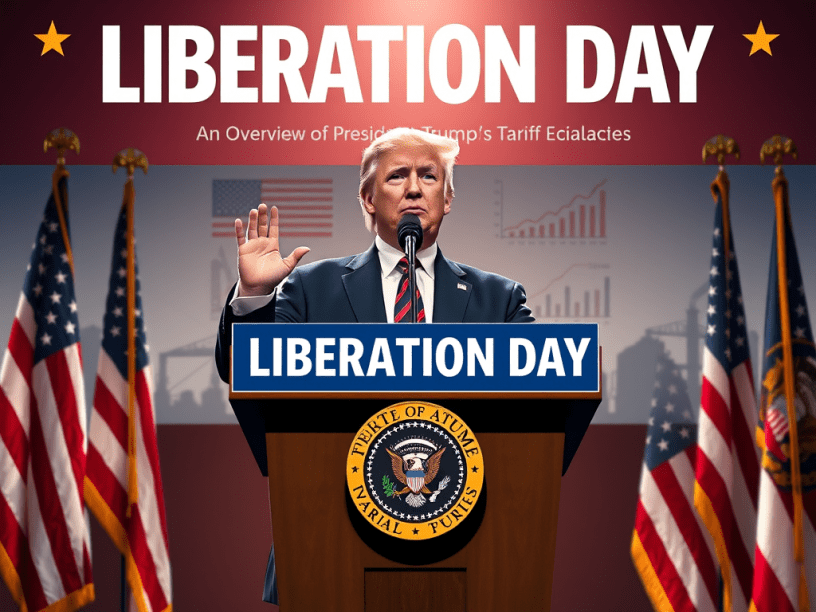
On April 2, 2025, President Donald J. Trump has declared a day he calls “Liberation Day.” This date marks a significant turn in U.S. trade policy as Trump rolls out a series of sweeping tariffs on imports aimed at reshaping the American economic landscape. Recently elected as the 47th President of the United States on November 5, 2024, and sworn in on January 20, 2025, Trump is navigating a complex political environment that includes his controversial announcement to seek a third term—a move some view as unconstitutional. By promoting April 2 as Liberation Day, Trump is drawing attention to his administration’s economic agenda while raising questions about the implications of his tariffs.
Liberation Day signifies Trump’s intent to impose “reciprocal tariffs” on major trading partners. In essence, these tariffs will match the duties that other countries impose on American goods, aiming to create what Trump describes as a more equitable trade environment. He paints a picture of foreign nations exploiting the U.S. for far too long, stating, “We’re going to charge countries for doing business in our country and taking our jobs and wealth.” By framing this as a liberation from economic subjugation, Trump aims to resonate with American workers who feel left behind by globalization.
However, the specifics of the tariffs remain unclear as Trump has intertwined his rhetoric with political theatrics. Administration officials have referred to certain nations as the “Dirty 15,” targeting those seen as contributing significantly to the U.S. trade deficit, currently estimated at $1.2 trillion. Countries like the European Union, South Korea, and Brazil are likely to face heightened tariffs. Trump’s administration has already rolled out a 25% tariff on steel and aluminum, and additional tariffs on goods imported from Canada and Mexico are in the pipeline. Despite these aggressive measures, economic analysts caution that the intent may not align with the actual outcomes.
Economists express significant concerns regarding the potential consequences of the new tariff regime. Many argue that when tariffs are broadly applied, they drive up prices for consumers. Americans could find themselves facing higher costs for automobiles, groceries, and general household goods. For instance, projections indicate that tariffs on imported vehicles could add as much as $4,711 to the cost of each car. The overall result could mean greater financial strain for families already grappling with inflation.
Trump’s focus on tariffs as a tool for economic reform reflects his long-standing obsession with trade issues, dating back to the 1980s. His approach suggests that he views tariffs as essential for revitalizing American manufacturing. Yet, historical data from his first term shows mixed results. A Federal Reserve study found that while some manufacturing sectors saw a modest increase in payroll, the overall job market suffered, shedding jobs in other sectors impacted by rising import costs.
As April 2 approaches, the stock market is showing signs of concern. Significant declines in major stock indices like the S&P 500 and the Dow Jones Industrial Average illustrate investor anxiety surrounding Trump’s trade policies, which many believe are likely to exacerbate inflation and slow economic growth. For example, Goldman Sachs recently raised the likelihood of a U.S. recession within the next year to 35%, up from an earlier estimate of 20%. The impact of tariffs has the potential to reverberate across various sectors, with economists citing fears that they could further destabilize a market already under pressure.
Trump’s declaration of Liberation Day carries nuanced implications. While he frames the day as a step toward economic independence, the reality may be more complicated. Critics warn that his insistence on reciprocal tariffs might lead other countries to retaliate, sparking a trade war that could ultimately harm American industries. The uncertain landscape may cause consumers and businesses to withhold spending, creating a broader economic downturn. Moreover, even if the day unfolds with fewer tariffs than expected, the mere uncertainty surrounding these policies could keep spending in a state of limbo.
What remains critical is Trump’s framing of Liberation Day within the broader narrative of his presidency. His continuous references to concepts of liberation throughout his campaign—such as calling Election Day “Liberation Day” in November 2024—illustrate his penchant for using powerful symbolism to galvanize support. However, analysts caution that these messages can serve as distractions from substantive policy discussions. As Trump embarks on this ambitious economic agenda, he faces a crossroads, where the outcomes of his tariff policies could define his legacy.
April 2, 2025, stands as a crucial date in Trump’s presidency, as he sets in motion plans to impose significant tariffs aimed at redefining U.S. trade practices. Liberation Day encapsulates his vision for American economic revitalization, despite the significant uncertainties and potential repercussions. As Americans brace for this day, the impact of Trump’s trade policies will likely signal the direction of the U.S. economy, for better or worse, as consumers prepare to navigate a new economic landscape painted with tariffs.
Here are the APA citations for the articles discussed:
- Jones, C. (2025, March 31). Will Trump’s ‘Liberation Day’ be the start of a trade war – or another climbdown? The Guardian. https://www.theguardian.com/us-news/2025/mar/31/trump-trade-war-tarrifs-economy
- Pringle, E. (2025, March 31). Liberation Day, April 2, is coming: Trump has put broad-based sanctions on ‘all countries’ on the table. Fortune. https://fortune.com/2025/03/31/liberation-day-april-2-donald-trump-tariffs-eu-china-russia/
- Spangler, T. (2025, March 31). Trump says ‘liberation day’ is April 2: What does that mean? Detroit Free Press. https://www.freep.com/story/news/politics/2025/03/31/trump-liberation-day-tariffs/61075668007/
- Levisohn, B. (2025, March 31). ‘Liberation Day’ Is Almost Here. What It Means for the Stock Market. Barron’s. https://www.barrons.com/articles/liberation-day-stock-market-selloff-89723759
- Grantham-Philips, W. (2025, April 1). Trump has dubbed April 2 ‘Liberation Day’ for his tariffs. Here’s what to expect. Associated Press. https://apnews.com/article/trump-reciprocal-tariffs-liberation-day-april-2-86639b7b6358af65e2cbad31f8c8ae2b
- Powel, J. (2025, April 1). Why is Donald Trump referring to April 2 as ‘Liberation Day’? Here’s what we know. USA Today. https://www.usatoday.com/story/news/politics/2025/03/31/liberation-day-donald-trump-tariffs/82749212007/
- NBC Chicago. (2025, March 31). What is ‘Liberation Day’ and what could it mean for you? What to know as Trump prepares. NBC Chicago. https://www.nbcchicago.com/news/politics/what-is-liberation-day-and-what-could-it-mean-for-you-what-to-know-as-trump-prepares/3710353/
 Occupy 2.5