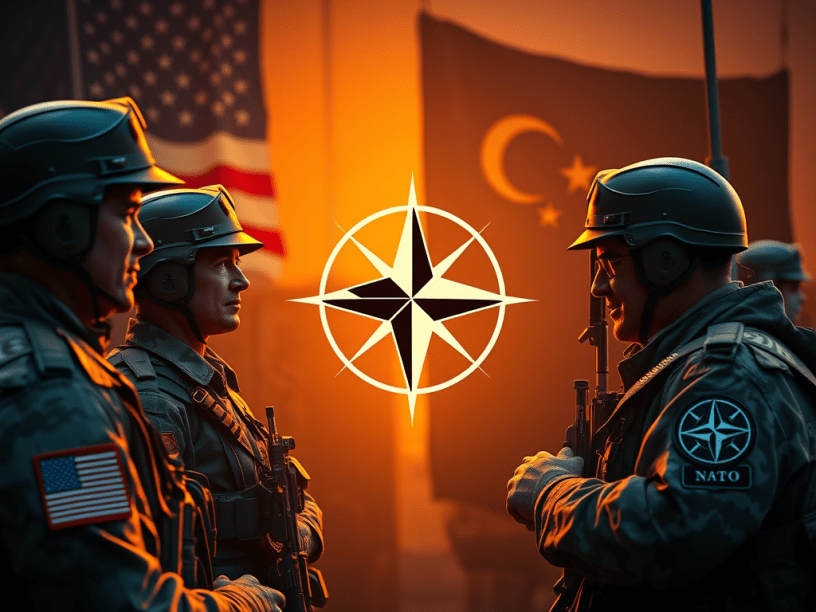
This month celebrates the 76th Anniversary of NATO. It is a day to consider what if anything the US has gotten from carrying this weight.
The United States’ role in European defense has been a complex and multi-faceted issue since World War II. The assertion that the U.S. has essentially “carried Europe” in terms of defense since 1941 holds some merit, particularly when considering the geopolitical realities of the Cold War and subsequent conflicts. However, framing this relationship in terms of burden or exploitation overlooks the symbiotic nature of U.S.-Europe relations and the shared responsibilities of maintaining security.
Historical Context: WWII and Beyond
After the attack on Pearl Harbor in December 1941, the U.S. entered World War II, contributing significantly to the defeat of Nazi Germany and its Axis partners. The war marked a significant shift in U.S. foreign policy—from isolationism to a commitment to international engagement and collective security. This shift laid the groundwork for NATO in 1949, wherein an explicit mutual defense agreement was established among member states, including many European countries.
The Cold War further entrenched U.S. military presence in Europe as a counterbalance to the Soviet threat. The U.S. provided significant military resources, funding, and strategic leadership, which enabled Western European nations to rebuild and secure themselves. It is true that the Soviet Union, despite suffering immense casualties during WWII, deployed its forces in a manner that many historians consider wasteful, resulting in high losses but ultimately leading to a heavy military presence in Eastern Europe.
Europe’s Post-War Defense Landscape
The U.S. military umbrella allowed European nations to allocate resources towards economic recovery and integration rather than purely military spending. The Marshall Plan, which facilitated the economic recovery of Europe, complemented military support, establishing a continent that would eventually prosper and integrate politically and economically through entities like the European Union.
While there is a notion that the Soviet Union feared Germany more than the U.S., the reality was that any large-scale assault into Western Europe would have to contend with U.S. forces stationed there. The Berlin Blockade, the Cuban Missile Crisis, and various other confrontations showcased how pivotal the U.S. was in European defense throughout the Cold War, fostering an environment of deterrence against Soviet aggression.
Contemporary Perspectives on Defense Roles
In recent decades, the perception of the U.S. “carrying the burden” has been voiced more strongly, particularly after the Cold War’s conclusion. Issues like defense spending, burden-sharing, and the military engagements in the Middle East have led some Americans to feel that allies in Europe, Japan, Oceania, and the Philippines have not contributed their fair share toward collective defense.
The NATO alliance operates on the principle of collective defense, but the disparity in defense spending among member countries has raised concerns about sustainability and fairness. In recent years, there has been pressure from the U.S. for European nations to increase defense budgets to meet the NATO guideline of 2% of their GDP.
Missteps in Globalization and International Relations
During the 1990s, particularly under the Clinton administration, American policy encouraged globalization which inadvertently facilitated the rise of China’s military capabilities, including the development of a blue navy. This created concerns about security dynamics in the Asia-Pacific region, leading to questions about the effectiveness of U.S. foreign policies and the perceived neglect of traditional allies.
The feelings of being “ill-used” by other nations can stem from the complexities of international alliances, the changing nature of warfare, and the strategic priorities that evolve over time. Despite this, it is essential to recognize the necessity of collective security and the historical interconnectedness of U.S. and European defense.
Conclusion
The assertion that the U.S. has been shouldering the primary responsibility for Europe’s defense since 1941 is supported by historical evidence; however, this narrative simplifies a much more intricate relationship. It overlooks the collaborative nature of Western defense strategies and the benefits of the resulting stability. The complexities of current international relations and the impacts of globalization further complicate these discussions. Moving forward, the focus should be on enhancing shared responsibilities and fortifying alliances, ensuring that both the U.S. and its allies can navigate the evolving geopolitical landscape together.
In Money, Misery, and the Masses: The First 50 Years, author Cliff Potts presents a captivating and thought-provoking exploration of our dynamic human landscape from 1957 to 2007—right as the storm clouds of the Great Recession began to gather. This engaging narrative delves into the intricate interplay between wealth, societal struggles, and the complexities of gender roles, offering readers a fresh and witty perspective on what shapes our world.
Potts expertly addresses the pressing questions of business and economics during the pivotal years leading to the 2000s. He outlines how businesses can evolve from perceived adversaries to valued community citizens, advocating for a balanced approach that steers clear of oligarchy. This slimmed-down version of Wealth, Women, and War delivers practical ideas that empower readers to build wealth while earning respect in today’s landscape.
With unexpected twists and incisive insights, Money, Misery, and the Masses is not just a historical account; it’s a roadmap for the future. As part of Cliff Potts’ impressive collection—which includes titles like Well Past Midnight, Radicals, Religion, and Revelation, and Conspirators, Confederates, and Cronies—this book stands out as a must-read for anyone looking to understand the forces that have shaped our society and discover paths to mutual prosperity. Don’t miss your chance to join Cliff Potts on this enlightening expedition through history and human nature. Grab your copy today and uncover how to turn business into a force for good!
 Occupy 2.5