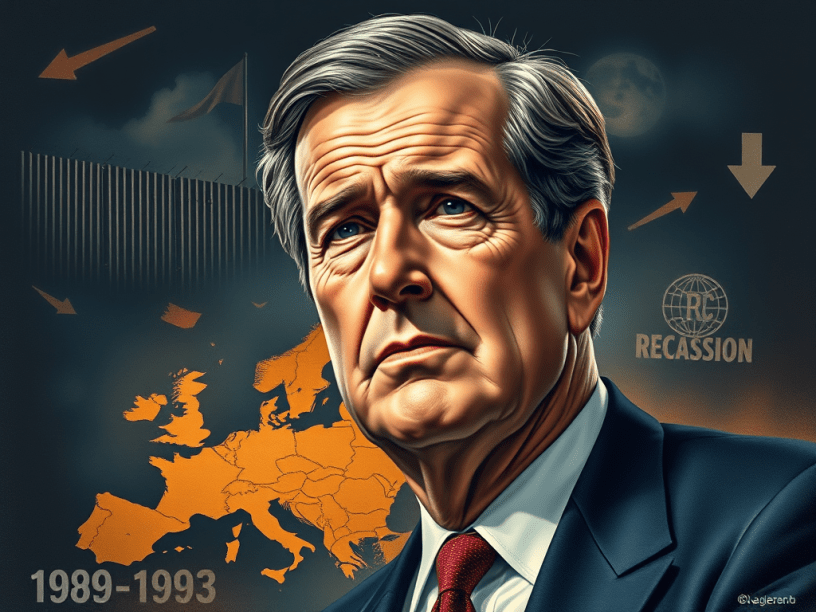
As we explore the complexities of modern American politics, it’s crucial to reflect on the past, especially the presidency of George H.W. Bush. Serving as the 41st president from 1989 to 1993, Bush’s tenure marked a pivotal time in both Republican history and global affairs. He operated in the shadow of Ronald Reagan’s legacy and grappled with the challenging dynamics of a changing world. Unfortunately, this era also foreshadowed a decline in the Republican Party’s once-cherished values, leading many to consider Bush as the last reasonable, intelligent Republican.
The Peace Dividend and the Recession
Bush inherited a booming economy from Reagan, with the United States on a prosperous trajectory following the Cold War. The so-called “Peace Dividend” was a phenomenon that emerged after the fall of the Berlin Wall and the dissolution of the Soviet Union. As military tensions eased, Bush aimed to reduce defense spending while redirecting those funds towards domestic priorities. Yet, this transition proved to be quite challenging; instead, it laid the groundwork for significant economic troubles.
By 1990, the U.S. was hit by a recession, largely driven by rising interest rates and the fallout from the savings and loan crisis. Bush’s commitment to fiscal conservatism became problematic when he was cornered into reneging on his “no new taxes” pledge to address the growing budget deficit. This decision alienated the base of the Republican Party, leading to widespread discontent and complicating his re-election bid.
The Fall of the Soviet Union
In international affairs, Bush’s foreign policy achievements stand out as some of his most significant. With his extensive background as CIA director and U.S. ambassador to the United Nations, he approached Soviet relations with caution and pragmatism. The abrupt collapse of communism in Eastern Europe in 1989—a watershed moment symbolized by the fall of the Berlin Wall—occurred during his presidency.
Bush’s steady demeanor reassured European leaders during this tumultuous time. He avoided the aggressive tactics some had advocated and instead opted for diplomacy and fostering reform within the Soviet Union, supporting Mikhail Gorbachev while carefully managing the storm. His decision to promote German reunification, alongside Gorbachev, solidified his legacy as a leader who thrived in times of uncertainty.
Restructuring Europe
The end of the Cold War brought with it the restructuring of Europe. Bush’s administration recognized the need to engage with former Soviet satellites as they transitioned toward democracy and market economies. In partnership with Gorbachev and later Boris Yeltsin, Bush advocated for self-determination, emphasizing the importance of allowing Eastern European countries to forge their futures without external interference.
This approach contrasted sharply with earlier, more confrontational strategies, and laid the foundation for a new European landscape that favored cooperation and common interests, including NATO’s ongoing expansion.
Operation Desert Storm
Bush’s foreign policy legacy is perhaps best exemplified by Operation Desert Storm, a swift military response to Iraq’s invasion of Kuwait in 1990. The operation showcased modern coalition warfare and exemplified Bush’s diplomatic acumen—his ability to assemble a broad alliance of nations against a common threat. This decisive victory restored Kuwait’s sovereignty and reaffirmed U.S. military superiority on the world stage.
Nevertheless, the aftermath of the Gulf War complicated Bush’s legacy. While he enjoyed soaring approval ratings after the conflict, his unwillingness to remove Saddam Hussein from power led to criticisms that the operation was ultimately incomplete. The result was a geopolitical situation that would haunt the region and the United States for decades to come.
The Legacy of George H.W. Bush
Ultimately, George H.W. Bush found himself amidst a confluence of historical events—both liberating and challenging. While he navigated significant foreign policy achievements and emerged as a respected figure among global leaders, he faced mounting domestic pressures that culminated in his defeat by Bill Clinton in 1992.
Bush’s presidency, marked by a commitment to diplomacy, moderation, and pragmatism, stood in contrast to the more hardline stances that would come to define subsequent Republican administrations. His comprehensive approach to both foreign and domestic policy demonstrated the potential for a more reasonable Republican Party, one grounded in competence and collaboration.
The decline of his presidency, characterized by an economic recession and a fracturing party base that could not tolerate a breach of promises, served as a harbinger of the challenges that lay ahead for the Republican Party. As we reflect on Bush’s years, it is essential to consider both the accomplishments and the missteps that have shaped contemporary American politics. In many ways, his presidency represents a last call for a party that once prided itself on reasoned governance and strategic foresight.
Next Wednesday: George W. Bush (2001-2009)
Sources:
- “George H.W. Bush.” The White House, WhiteHouse.gov, National Archives, 2006.
- “George H.W. Bush.” Encyclopedia Britannica, Encyclopedia Britannica, Inc., Last Updated January 18, 2025.
- “1989–1992: The Presidency of George H.W. Bush.” Office of the Historian, U.S. Department of State.
- Kornblum, John. “How George H.W. Bush Finished What Reagan Started in Ending the Cold War.” HISTORY, A&E Television Networks, 5 Dec. 2018.
- “George H.W. Bush’s Foreign Policy Highlights.” Voice of America, 3 Dec. 2018.
- Sargen, Nick. “What the End of the ‘Peace Dividend’ Will Mean for Americans.” Forbes, 10 Mar. 2022.
- Kornacki, Steve. “These six words changed George H.W. Bush’s presidency.” NBC News, 4 Dec. 2018.
- Preston, Chris. “Stock Market Performance Under George H.W. Bush.” Cabot Wealth Network, 6 Dec. 2018.
- “The Collapse of the Soviet Union.” Office of the Historian, U.S. Department of State.
- “Fall of Communism in Eastern Europe, 1989.” Office of the Historian, U.S. Department of State.
- “How George H.W. Bush Made Modern Europe.” POLITICO, 1 Dec. 2018.
 Occupy 2.5