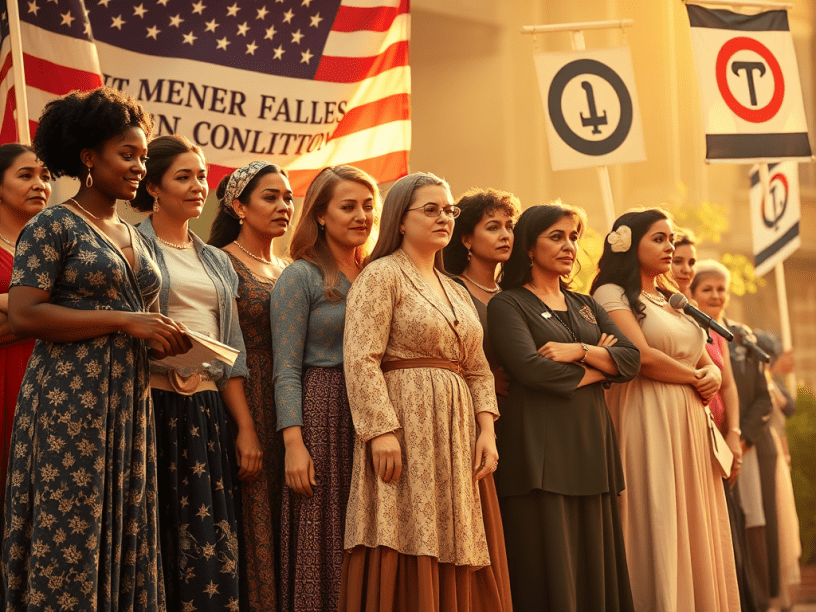
From the inception of the United States Constitution in 1788 to the present day, the journey of women’s rights has been a profound testament to resilience, courage, and unwavering advocacy. Women’s rights in America have evolved significantly over centuries, marked by fervent struggle, landmark achievements, and a relentless quest for equality.
In 1788, when the Constitution was ratified, women held no legal identity independent of their fathers or husbands. They did not have the right to vote, own property, or enter into contracts. For decades, their roles were confined to the domestic sphere, with societal norms emphasizing that their primary responsibilities lay within the home.
The first cries for equality emerged during the early 19th century, paving the way for the burgeoning women’s rights movement. The 1848 Seneca Falls Convention, often cited as a cornerstone in the fight for women’s suffrage, marked a pivotal moment when activists like Elizabeth Cady Stanton and Lucretia Mott proclaimed the foundational document of women’s rights, the “Declaration of Sentiments.” This document outlined the grievances faced by women, including the demand for the right to vote.
The fight for suffrage gained traction over the next several decades. The National American Woman Suffrage Association (NAWSA) was formed in 1890, uniting suffragists across the nation. Women pushed back against societal norms and fought for their right to vote through protests, publications, and political pressure. The movement faced considerable opposition but proved resilient throughout the early 20th century.
Victory came on August 18, 1920, when the 19th Amendment was finally ratified, granting women the right to vote. It was a monumental achievement that forever changed the political landscape of the United States. However, the battle for equality did not end there. Discrimination persisted, and women continued to fight for equal rights in education, employment, and representation.
The Feminist Movement of the 1960s and 1970s reignited discussions about gender equality. Activists like Betty Friedan, whose seminal book “The Feminine Mystique” exposed the dissatisfaction of many housewives, emphasized that women’s roles extended far beyond domesticity. Women from diverse backgrounds joined the fold, championing equal pay, reproductive rights, and an end to gender discrimination.
In 1972, Title IX of the Education Amendments was enacted, prohibiting discrimination based on sex in federally funded education programs. This groundbreaking legislation opened doors to educational opportunities for women and girls across the nation. The same decade witnessed the formation of the National Organization for Women (NOW), which continues to advocate for women’s rights.
As the decades rolled on, progress ebbed and flowed. The 1990s and 2000s saw important victories, such as the defense of women’s reproductive rights with the landmark Supreme Court decision in Planned Parenthood v. Casey (1992), which upheld the right to abortion while allowing states to impose regulations.
The 21st century brought renewed focus on intersectionality, recognizing that women’s experiences vary greatly based on race, ethnicity, class, and sexual orientation. The rise of movements like #MeToo in 2017 highlighted the pervasive issue of sexual harassment and violence against women, igniting a cultural reckoning that spurred changes in workplace policies and societal attitudes.
In recent years, additional strides have been made in political representation. As of October 2023, women occupy more seats in Congress than ever before, and the number of women governors has also seen an increase. The political landscape now includes a diverse cadre of women leaders, reflecting much of the population’s demographic makeup.
However, challenges remain. Issues such as wage gaps, reproductive rights, healthcare access, and gender-based violence continue to be at the forefront of the women’s rights agenda. Women of color, LGBTQ+ women, and those from economically disadvantaged backgrounds still face systemic barriers.
As we reflect on the history and progress of women’s rights in America from 1788 to 2023, it becomes evident that the fight for equality is ongoing. Each generation has built upon the successes of the last, and the torch has been passed from one courageous woman to another. The future holds promise, and as we continue to strive for justice and fairness in all aspects of life, we celebrate the advances made while recognizing that the journey toward true equality is far from complete.
In the words of Susan B. Anthony, “There never will be complete equality until women themselves help to make laws and elect lawmakers.” As we gazed into the annals of history, let us honor the struggle of those who came before and remain steadfast in working towards a brighter, more equitable future for all women.
 Occupy 2.5