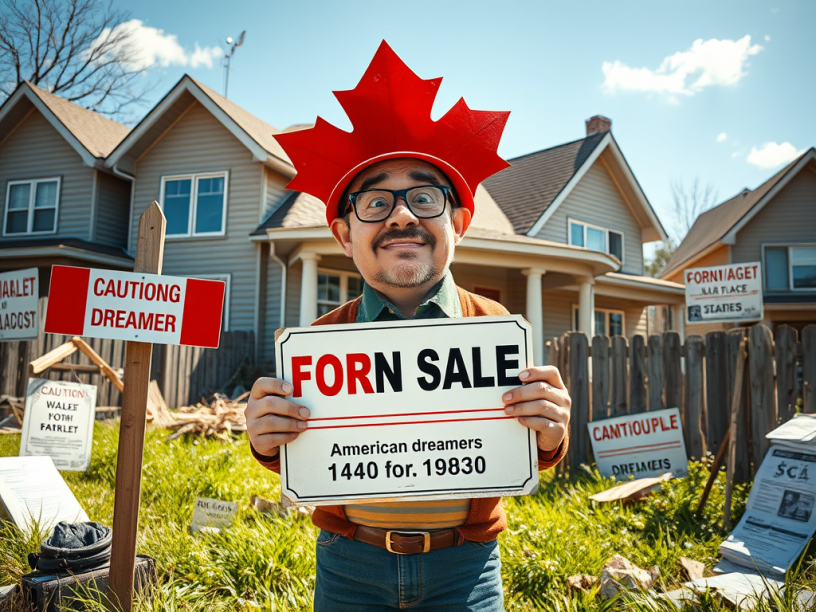
Welcome back to the peculiar world of the Canadian Reality Saga, where our story continues in a strikingly different parallel universe filled with even more absurdity and irony! In this dimension, the Canadian Real Estate Investors—those plucky bargain hunters who swooped in to rescue the American dream during the financial meltdown of 2007-2008—are now wrestling with a comical twist in their venture. Much like in our own world, they perceived themselves as altruistic saviors while capitalizing on the misfortunes of their American neighbors, all while snapping up foreclosed properties in sunny Florida.
As they descended upon the distressed housing market, Canadians took a condescending approach to their American counterparts, often scolding them for signing onto “bad paper.” “You really should have read the fine print!” they’d chuckle, pointing out the financial irresponsibility they believed their neighbors had demonstrated. It was as if they were unaware of the larger systemic failures that led to the crisis, where the coveted “American Dream” had become a nearly unattainable fantasy for many. Critics within and outside the U.S. had long warned that the pursuit of homeownership was increasingly based on unrealistic expectations and unsustainable practices inherent in a flawed financial system.
These self-proclaimed rescuers urged Americans to educate themselves about the risks of debt, particularly the traps of high-interest and subprime mortgages. “You can’t blame the banks entirely; you need to take responsibility for your choices!” they would say, waving their maple-syrup-laden fingers dismissively. Meanwhile, calls for better regulations and accountability for financial institutions engaging in predatory lending lingered in the air, echoing with urgency. Observers urged the U.S. government to implement policies to protect consumers from similar crises in the future, but Canadian investors, with their eyes on the prize, seemed more invested in capitalizing on misfortune than advocating for accountability.
With the tables now turned, these Canadian “snow vultures” find themselves grappling with a stark reality remarkably similar to that experienced by the Americans they once condescended to—selling their homes at a loss in a market spiraling out of control. It’s almost poetic: the very investors who thought they were saving the day are now swept into the maelstrom of an economy that refuses to stabilize. “I thought I was buying a dream home, not a financial Black Hole!” bemoaned one despondent investor, as he prepared to slap a “For Sale” sign on a property that had seen better days.
But that’s not all. This alternate universe has its own set of zany political challenges. Enter the 47th President of the United States, who, in a fit of creative economic policy-making, has decided that imposing a 25% tariff on all Canadian goods—except for oil because who doesn’t love that sweet crude?—is the best way to show “appreciation” for neighborly endeavors. “How insulting is it that after trying to help out my American friends, I’m now facing a tax just for being polite?” grumbled one flummoxed Canadian, feeling a twinge of irony in the air. Their previous stance of superiority now feels painfully naive.
Canadian indignation builds as they realize they’re being treated like expansion packs for a flawed economic game, with the 47th President seemingly proposing that Canada should become the 51st through 60th states in the United States of America—one for each province. “We came here to help—not to be relegated to pawns in your political games!” exclaimed another irate investor. The condescension of their previous judgments hangs heavily as they reflect on how quickly fortunes can change.
Meanwhile, Native Americans observe this economic drama unfold with a mixture of bemusement and reflection. They recognize the irony; here are new immigrants facing dilemmas strikingly similar to those experienced by their ancestors when settlers claimed their lands. It raises an uncomfortable yet intriguing question: how can Native Americans embrace these newcomers while also reflecting on the historical injustices wrought by earlier colonists?
In the midst of this pandemonium, creative solutions emerge. One Canadian, seeing the potential for shared experiences, suggests forming a bizarre support group: “Canadian Investors Anonymous—where we commiserate over overpriced properties and tariffs while enjoying some of that freshly imported maple syrup!” Laughter erupts, as the absurdity of their situation sinks in.
As these Canadians gear up for the unpalatable task of selling their properties at a loss—which they once thought would be the steal of the century—they can’t shake the feeling that they’ve become the punchline in a joke about economic folly. Yes, dear readers, the musical chairs of real estate have shifted, and it now appears that the polite Canadians, embodying resilience and a touch of irony, find themselves caught in an economic riddle with no clear resolution.
Join us as we navigate this increasingly bizarre landscape in the second chapter of the Canadian Reality Saga. To our dear Canadian investors: may your losses be manageable, your laughter be hearty, and your resilience remain unshaken amidst the unfolding chaos!
As you hustle to navigate the turbulent waters of a market turned upside down, remember that a dose of humility might just be what the doctor ordered. Perhaps, in sharing the tales of your capitalist adventures, you can blend your maple syrup sweetness with a newfound awareness of the interconnectedness of your realities and those of your American neighbors. After all, true heroism might not lie in swooping in to snatch up bargains but rather in extending a hand to those still grappling with the remnants of a financial storm that continues to reverberate through lives.
So, let’s raise a glass (or a cup of that world-famous Canadian coffee) to newfound understanding and solidarity across borders. May the next chapter of your journey offer not just lessons in economics but a perspective that truly embodies the essence of community and compassion.
 Occupy 2.5