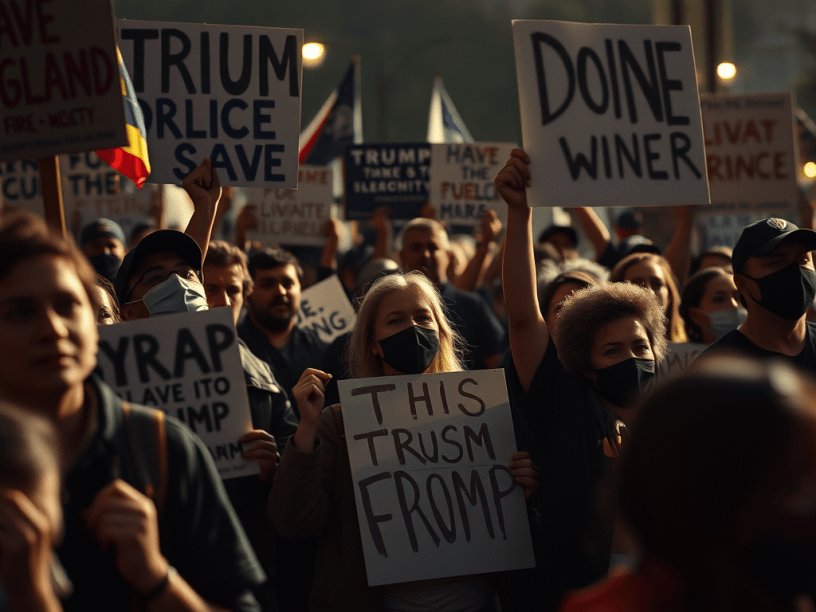
In recent years, the United States has witnessed a significant transformation in its political climate, characterized by increasing polarization and a rising tide of political violence. Drawing insights from ten key articles that delve into various aspects of this concerning trend, it becomes evident that the dynamics of aggression in American politics are shifting. This analysis explores the undercurrents contributing to the escalating culture of violence, with a particular focus on the effects of political narratives and the responses from both grassroots movements and government entities.
Rachel Kleinfeld, in her writings for the Journal of Democracy and the Carnegie Endowment, highlights the normalization of political violence, attributing it to a number of factors including the rhetoric of political leaders and societal discontent following the 2020 presidential election. She discusses the heightened acceptance of violent conduct among both Republican and Democratic circles, showcasing alarming statistics that indicate a significant portion of Americans find political violence justifiable under certain circumstances. This mental shift is underscored by a substantial rise in threats against elected officials, evidencing a dangerous trend where intimidation becomes entwined with partisanship.
Erica Chenoweth, whose work on nonviolent resistance is extensively documented, reflects on the paradox facing contemporary movements: while nonviolent resistance has historically proven to be more effective than violence, recent campaigns seem to struggle against a backdrop of increasing state repression and backlash to their efforts. The articles collectively demonstrate that, although nonviolent movements are still prevalent, the space for peaceful dissent is tightening, as noted by Amnesty International’s report on the necessity of protecting protestors’ rights in the face of escalating governmental responses.
Furthermore, Roudabeh Kishi and Sam Jones, through their work with ACLED, underscore the perilous environment surrounding public demonstrations. Their findings reveal that, while the majority of protests linked to movements such as Black Lives Matter remained peaceful, there was a notable uptick in violent incidents, particularly as armed groups began to show up at demonstrations, wielding the threat of immediate violence. This shift reflects a broader societal acceptance of armed self-defense in political settings, which raises questions about the safety of future protests and electoral processes.
The authors of the ACLED report also indicate that the participants in politically motivated violence are becoming increasingly diverse. Unlike past patterns where violence was largely confined to fringe groups, today’s violent actions are often symptomatic of mainstream frustrations and anxieties about identity and legitimacy—driven by perceived threats to socio-political status. This shift has led to a proliferation of counter-demonstrations and political violence which, when examined in concert with public sentiment expressed in the articles, presents a troubling picture of the current American political landscape.
As analyzed through a variety of lenses, from the psychological perspectives provided by Dr. Lauren Duncan to the structural assessments offered by Kleinfeld, a complex interplay of identity, ideology, and political strategy emerges. The findings indicate a duality in America’s journey towards political violence—while grassroots movements continue to advocate for peaceful change, the growing acceptance of violence, coupled with increasing state intervention, suggests a deviation towards less peaceful approaches to securing political aims.
The trajectory seems to favor a heightened risk of political violence if proactive measures are not taken to address these issues. This alarming trend is compounded by the escalating entrenchment of partisan politics and increasingly militarized responses to civil dissent, which suggest a cycle that may be difficult to break without addressing the fundamental motivations behind the rising acceptance of violence.
The future of American politics hinges on the nation’s capacity to foster dialogue, challenge extremist narratives, and engage with undercurrents of mistrust and anger that have driven many to embrace violence as an option for political expression.
Sources:
- Amnesty International. “Protect the Protest.” Amnesty International, https://www.amnesty.org/en/what-we-do/freedom-of-expression/protest/.
- Chenoweth, Erica. “The Future of Nonviolent Resistance.” Journal of Democracy, July 2020, vol. 31, no. 3, pp. 69-84, https://www.journalofdemocracy.org/articles/the-future-of-nonviolent-resistance-2/.
- Kleinfeld, Rachel. “The Rise in Political Violence in the United States and Damage to Our Democracy.” Carnegie Endowment for International Peace, 31 Mar. 2022, https://carnegieendowment.org/posts/2022/03/the-rise-in-political-violence-in-the-united-states-and-damage-to-our-democracy?lang=en.
- Kleinfeld, Rachel. “The Rise of Political Violence in the United States.” Journal of Democracy, vol. 32, no. 4, Oct. 2021, pp. 160–76, https://www.journalofdemocracy.org/articles/the-rise-of-political-violence-in-the-united-states/.
- Kishi, Roudabeh, and Sam Jones. “Demonstrations and Political Violence in America: New Data for Summer 2020.” ACLED, 3 Sept. 2020, https://acleddata.com/2020/09/03/demonstrations-political-violence-in-america-new-data-for-summer-2020/.
- Doxsee, Catrina, et al. “Pushed to Extremes: Domestic Terrorism amid Polarization and Protest.” Center for Strategic and International Studies, 17 May 2022, https://www.csis.org/analysis/pushed-extremes-domestic-terrorism-amid-polarization-and-protest.
- Jones, Stephen. “There Is No Democracy Without Protest.” Davis Center for Russian and Eurasian Studies, 26 July 2022, https://daviscenter.fas.harvard.edu/insights/there-no-democracy-without-protest.
- Robson, David. “The ‘3.5% Rule’: How a Small Minority Can Change the World.” BBC Future, 13 May 2019, https://www.bbc.com/future/article/20190513-it-only-takes-35-of-people-to-change-the-world.
 Occupy 2.5