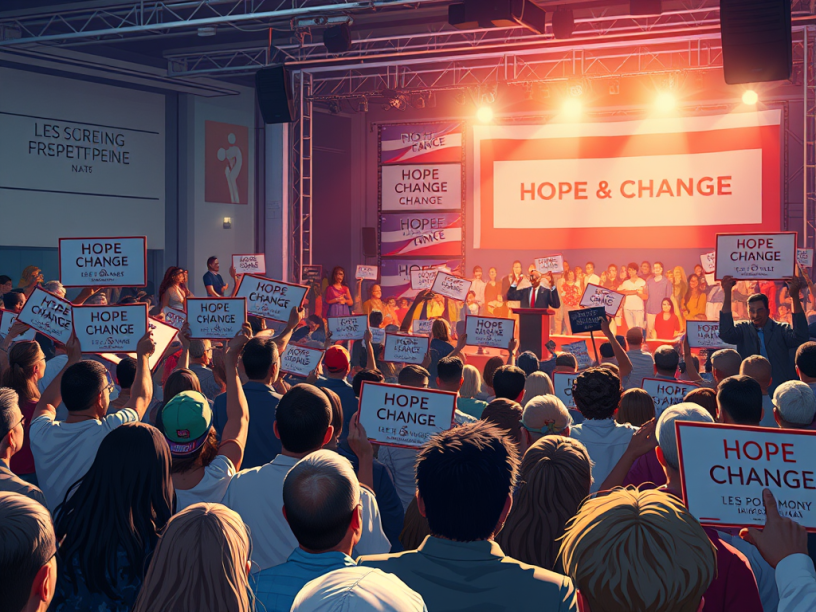
By Just Another Friendly Occupier, Inspired by Mike Royko
When it comes to campaign promises, we find ourselves clinging to the hope that maybe, just maybe, this candidate will be the one who actually delivers. After all, when the lights shine bright and the crowds gather, the tantalizing rhetoric flows like cheap beer at a dive bar. But why do voters believe these promises, despite a history riddled with empty words and unmet expectations?
It turns out there’s a strange alchemy at work. Candidates expertly tap into our deepest desires, holding out the allure of a brighter future, a better tomorrow. They ignite our imaginations with promises of job creation, healthcare reform, and social justice. They understand that a hopeful voter is far easier to sway than the skeptical one clutching disappointment like a lucky rabbit’s foot. Yes, trust or distrust—whatever you want to call it—bubbles down to a healthily maintained reputation. As studies show, when candidates keep their word, voters are more inclined to believe them again. But here lies the rub: when promises go unfulfilled or are broken, that trust erodes faster than the paint on an old fence.
Yet, even with this understanding, many of us are just too darn lazy when it comes to engaging with campaign activities. We sit on our couches, remote in one hand, and a bag of chips in the other, skeptical and detached from the very process that shapes our lives. It’s much easier to tune in to the next round of reality TV than to show up at a town hall meeting and hold our elected officials accountable. Who has the time to sift through campaign brochures or angry social media posts?
Let’s face it: politics has become a spectator sport, with entrenched partisanship transforming citizens into cheerleaders for their respective teams rather than active participants in the democratic process. Many voters seem resigned to the idea that their individual input doesn’t matter. After all, when was the last time one voice made a real difference in a sea of millions?
But here’s the kicker: campaign promises could indeed pave the way to collective action and community empowerment if only we could navigate the murky waters of partisan biases and voter apathy. These promises hold the potential to unite us under a common vision—for an equitable society, for strong communities, and for progress. Instead, too often, they serve only as fodder for electoral gamesmanship, trivial debates, and divisive politics.
In this column, we’ll explore the ins and outs of campaign promises across a series of eight articles. We’ll uncover why voters believe, or choose not to believe, what candidates say. We’ll look at the root causes of our political disengagement and how we came to treat politics like a show rather than a calling. We’ll highlight instances where promises sparked movements for change and instances where they just fizzled out, leaving us feeling used and left behind.
So grab a seat and stick around. It’s about time we start peeling back the layers of this electoral onion to figure out what lies beneath the shiny surface of campaign promises. Because, in the end, our future isn’t just about what candidates promise; it’s about the collective vision we establish for the better tomorrow we all deserve.
Here are all the APA citations generated based on the articles we have analyzed:
- Woolston, C. (2024, September 30). Why do politicians make promises they can’t keep? Department of Political Science, Washington University in St. Louis. https://polisci.wustl.edu/news/why-do-politicians-make-promises-they-can%E2%80%99t-keep
- Ganslmeier, M. (2023, September 6). Are campaign promises effective? Department of Social Policy and Intervention, University of Oxford. https://www.spi.ox.ac.uk/article/are-campaign-promises-effective
- Schmidt, M. (2024, November 6). Campaign promises and the economy. Investopedia. https://www.investopedia.com/articles/economics/09/campaign-promises-president.asp
- Aragonès, E., Postlewaite, A., & Palfrey, T. (2007). Political reputations and campaign promises. Journal of the European Economic Association, 5(4), 846–884. https://www.iae.csic.es/investigatorsMaterial/a9167111438archivoPdf67375.pdf
- Lang, M., & Schudy, S. (2023). (Dis)honesty and the value of transparency for campaign promises. European Economic Review, 159, 104560. https://doi.org/10.1016/j.euroecorev.2023.104560
- Bonilla, T. (2022). Promises kept, promises broken, and those caught in the middle. IPR Working Paper Series, WP-22-27. Northwestern University. https://www.ipr.northwestern.edu/documents/working-papers/2022/wp-22-27.pdf
- Cruz, C., Keefer, P., Labonne, J., & Trebbi, F. (2019). Making policies matter: Voter responses to campaign promises. IPR Working Paper Series. Northwestern University. https://harris.uchicago.edu/sites/default/files/making_promises_matter_6102019-cruz.pdf
 Occupy 2.5