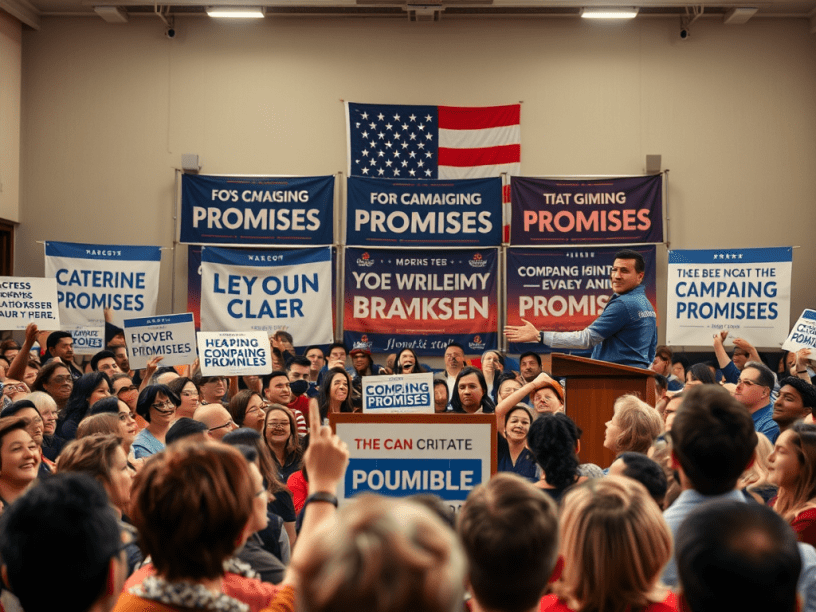
Campaign promises can be powerful tools for sharing a vision of a better tomorrow and galvanizing public engagement in the political process. Effectively utilizing these promises requires candidates to craft messages that resonate deeply with voters, fostering a sense of shared mission and collective identity. This approach aligns closely with the inspirational rhetoric exemplified by figures like John F. Kennedy, who famously urged citizens to consider their role in the broader societal context: “Ask not what your country can do for you, but what you can do for your country.”
- Articulating a Clear and Compelling Vision: Candidates must present a coherent and aspirational vision that articulates the future they seek to create. This vision should encompass key societal challenges that resonate with the electorate, such as economic opportunity, educational equity, healthcare access, and environmental sustainability. By framing campaign promises within this broader narrative, candidates can help voters see their participation not merely as support for a candidate, but as a step toward collective progress.
- Connecting Personal Narratives: To turn abstract promises into relatable commitments, candidates should share personal stories that connect their values and experiences to the issues at hand. When voters can see how a candidate’s vision aligns with their own lives, it fosters a sense of ownership over the proposed policies. This connection can be especially powerful in motivating individuals to engage with the political process and participate in discussions about the future.
- Encouraging Active Participation: Campaign promises should not simply be about what candidates will do if elected; they can also include calls for voter involvement. Candidates can inspire constituents by outlining specific ways individuals can contribute, whether through volunteering, participating in town halls, or advocating for local issues. This collaborative spirit encourages citizens to view themselves as active agents of change, rather than passive observers in the democratic process.
- Building Trust and Transparency: Candidates can bolster the credibility of their promises by committing to transparency regarding their actions if elected. Providing regular updates on progress and maintaining open lines of communication with constituents can enhance trust. When voters see that their voices are being heard and that promises are being actively pursued, it fosters a more vibrant political engagement.
- Harnessing Collective Efforts: Utilizing social media and community networks can amplify the message of campaign promises and the vision for a better future. Candidates should leverage these platforms to mobilize grassroots movements and encourage discussions around shared goals. Collective efforts, such as community organizing around key policy initiatives, can energize the electorate and create a sense of unity toward a common purpose.
- Highlighting Historical Precedents: Candidates can draw on historical examples of successful movements sparked by inspiring promises—like Kennedy’s call to civic duty—to remind voters of the potential impact of collective action. By linking their campaign promises to past achievements, candidates can inspire hope and motivation, reminding voters that collective efforts can result in tangible progress.
Campaign promises can serve as a catalyst for political engagement and societal transformation when effectively framed within a compelling vision for the future. To incite the population to participate actively in the electoral process, candidates should articulate clear, relatable commitments that resonate with voters’ aspirations. By reminding individuals of their significant role in shaping tomorrow and inviting them to be active participants in the democratic process, candidates can turn political promises into engines of collective inspiration and action, leading to a more engaged and responsive electorate.
Obama did this too!
Here are all the APA citations generated based on the articles we have analyzed:
- Woolston, C. (2024, September 30). Why do politicians make promises they can’t keep? Department of Political Science, Washington University in St. Louis. https://polisci.wustl.edu/news/why-do-politicians-make-promises-they-can%E2%80%99t-keep
- Ganslmeier, M. (2023, September 6). Are campaign promises effective? Department of Social Policy and Intervention, University of Oxford. https://www.spi.ox.ac.uk/article/are-campaign-promises-effective
- Schmidt, M. (2024, November 6). Campaign promises and the economy. Investopedia. https://www.investopedia.com/articles/economics/09/campaign-promises-president.asp
- Aragonès, E., Postlewaite, A., & Palfrey, T. (2007). Political reputations and campaign promises. Journal of the European Economic Association, 5(4), 846–884. https://www.iae.csic.es/investigatorsMaterial/a9167111438archivoPdf67375.pdf
- Lang, M., & Schudy, S. (2023). (Dis)honesty and the value of transparency for campaign promises. European Economic Review, 159, 104560. https://doi.org/10.1016/j.euroecorev.2023.104560
- Bonilla, T. (2022). Promises kept, promises broken, and those caught in the middle. IPR Working Paper Series, WP-22-27. Northwestern University. https://www.ipr.northwestern.edu/documents/working-papers/2022/wp-22-27.pdf
- Cruz, C., Keefer, P., Labonne, J., & Trebbi, F. (2019). Making policies matter: Voter responses to campaign promises. IPR Working Paper Series. Northwestern University. https://harris.uchicago.edu/sites/default/files/making_promises_matter_6102019-cruz.pdf
 Occupy 2.5