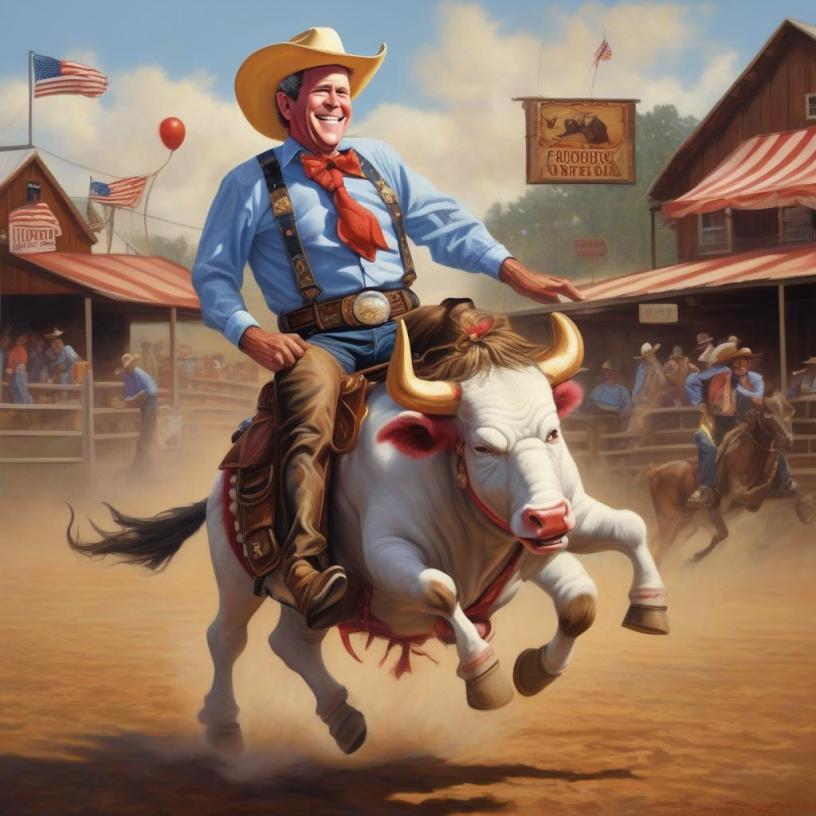
There’s an old saying that war is politics by other means. But in 2003, America gave that saying a new twist: politics was war by wishful thinking, selective intelligence, and a PowerPoint presentation. You may remember this one — “shock and awe,” “weapons of mass destruction,” and that unforgettable “Mission Accomplished” banner that looked like a backdrop for a Broadway flop.
The Iraq War was launched by President George W. Bush in March 2003, based on the claim that Saddam Hussein had weapons of mass destruction (WMDs) and ties to terrorists — both of which turned out to be about as real as Bigfoot driving a tank through Tikrit. But it made for good TV.
With the help of Vice President Dick Cheney, Defense Secretary Donald Rumsfeld, and a tightly curated script of talking points, the Bush administration convinced the American public that if we didn’t act, mushroom clouds were just around the corner (Woodward, 2006). It wasn’t just fearmongering — it was theater. And we all paid for front-row tickets.
The invasion toppled Saddam in record time, which would’ve been great if it didn’t turn into a protracted quagmire, nation-building experiment, and recruitment campaign for extremists all rolled into one. What followed was nearly a decade of chaos, sectarian violence, U.S. casualties, trillions in taxpayer dollars, and the birth of groups like ISIS. And no WMDs.
Now, let’s be clear — Saddam Hussein was no misunderstood philosopher king. He was a brutal dictator. But launching a war on bad vibes and thinly-sourced intelligence doesn’t exactly meet the bar for “sound foreign policy.” The United Nations wasn’t convinced. Our allies were divided. And most of the world watched as America shrugged and said, “Eh, we’ll do it live.”
This wasn’t just a bad policy call. It was a foundational failure of judgment, accountability, and leadership. Intelligence was cherry-picked, dissenting voices were drowned out, and anyone who questioned the war was labeled unpatriotic. You were either with the war or with the terrorists — there was no middle ground (Byman, 2015).
And what did we learn? Judging by how eager some leaders still are to flex military muscle first and ask questions later — not much. But at least it gave us a few grim lessons about the cost of overconfidence, the danger of echo chambers, and the staggering price of foreign policy by ideology.
If Gerald Ford gave us the most polite cover-up in presidential history, George W. Bush gave us the most costly case of confirmation bias ever launched by an aircraft carrier photo op. And for that, the Iraq War earns its place in our countdown of the Worst Presidential Fails.
 Occupy 2.5