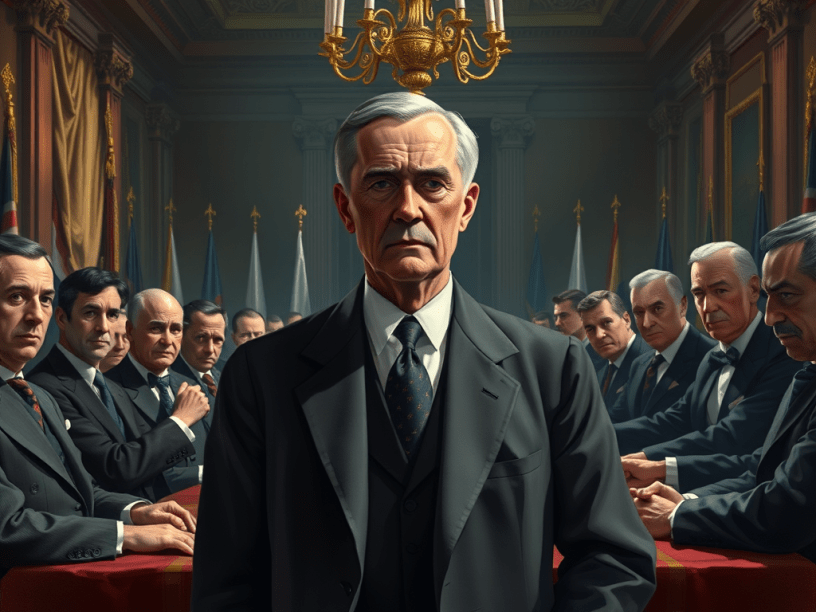
He Brought a Pen to a Gunfight
If you ever want a crash course in how to fumble both foreign policy and domestic politics in one swing, look no further than President Woodrow Wilson’s post-WWI antics. Here was a man who fancied himself the Messiah of Modern Diplomacy, rolling into Europe with his Fourteen Points like he was handing out stone tablets at Versailles.
He wasn’t. He was, in fact, woefully out of step with the mood of the moment.
Let’s rewind: World War I ended in 1918, leaving Europe in ruins and the Allies—especially France and Britain—hell-bent on squeezing every last mark out of Germany. Wilson, however, had different plans. He wanted “peace without victory,” a league of nations, and a postwar world ruled by lofty ideals and good intentions (MacMillan, 2001).
The problem? The Europeans weren’t in a mood for hugs. They wanted revenge, reparations, and territory. Wilson was treated with polite applause, but behind closed doors, they were divvying up colonies like Halloween candy. While he was preaching about self-determination, they were redrawing borders with all the grace of a blindfolded butcher.
Still, Wilson signed the Treaty of Versailles anyway, complete with the League of Nations. You might think that would be the hard part—winning over old world imperialists. But no. The real disaster was still ahead.
See, Wilson, in a move so politically dumb it deserves its own monument, refused to bring any leading Republicans with him to Paris. That includes Henry Cabot Lodge, the Senate Majority Leader and the man who could make or break treaty ratification. Instead of building a consensus, Wilson took the academic high horse and galloped off alone.
The treaty came back to Washington and promptly crashed into a wall of Republican resistance. Lodge had amendments. Wilson had stubbornness. So, in an attempt to win over the American people, Wilson boarded a train and went on a whistle-stop tour across the country. The trip nearly killed him—literally. He collapsed from exhaustion and suffered a massive stroke, after which the government ran under what many call the “Petticoat Presidency,” as his wife, Edith Wilson, managed access and decisions (Berg, 2013).
Meanwhile, the Treaty of Versailles was rejected. Twice. The U.S. never joined the League of Nations, the very organization Wilson had bet the farm on.
Editor’s Note: Wilson might have had vision, but he had no political instincts. His arrogance cost the U.S. a seat at the table in shaping the interwar world and arguably weakened the League from birth. The result? A global power vacuum that pave the road to World War II.
Another Thought: If there’s a modern lesson in Wilson’s blunder, it’s this—ideals are great, but if you can’t count to 67 (the number of votes needed in the Senate to ratify a treaty), you’re not a statesman. You’re just another guy with a pen and a dream.
References
Berg, A. S. (2013). Wilson. New York: G.P. Putnam’s Sons.
MacMillan, M. (2001). Paris 1919: Six Months That Changed the World. New York: Random House.
 Occupy 2.5