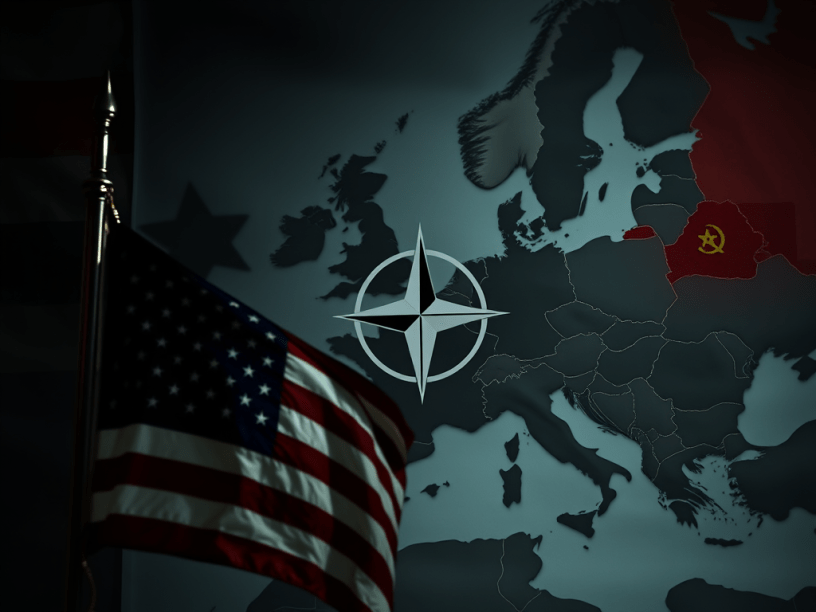
Today is the 13th anniversary (May 20, 2012) of #NoNATO protest in Chicago, Illinois. It is time to look at NATO from a different perspective, and remember what we did, and did not do, in Chicago 13 years ago today.
During the Cold War, the Soviet Union’s most pressing concern was not necessarily the United States, but rather West Germany. This apprehension stemmed from a harrowing history—Nazi Germany had decimated the Soviet Union during World War II, leaving deep scars that shaped Soviet perceptions and policy.
The entry of West Germany into NATO in 1955 exacerbated these fears, solidifying the belief that a militarized Germany could once again pose an existential threat. As the Western Bloc consolidated its defenses under NATO, the Soviet Union viewed the alliance as a direct challenge to its sphere of influence.
In this context, the United States, as NATO’s leading member, has shouldered a disproportionate share of the financial and military burden for collective defense. Estimates suggest that the U.S. accounts for approximately 70% of NATO’s total military spending.
In recent years, U.S. annual nuclear expenditures alone have approached $30 billion to $40 billion, with long-term modernization efforts projected to exceed $1 trillion over the coming decades. This stark imbalance raises fundamental questions: Are all NATO members pulling their weight, or is the U.S. carrying the alliance’s burden?
The reality is that the U.S. has consistently come to the aid of its NATO allies, whether through military deployments in places like Afghanistan or involvement in conflicts such as the Balkans. NATO invoked Article 5—the collective defense clause—only once, in response to the September 11 attacks in 2001, leading to U.S.-led military operations.
In contrast, NATO allies have seldom reciprocated. Such disparities in commitment beg the question: Is NATO a partnership in which mutual support is a two-way street, or is it simply a one-way channel of American military might?
The consequences of this arrangement are manifold. Europe enjoys a sense of security largely reinforced by American military power, yet American taxpayers foot the hefty bill for this shield. Critics argue that many NATO member states fall short of their defense spending goals, leading to a scenario where the U.S. serves as Europe’s primary security guarantor.
This dynamic raises serious concerns about both fairness and strategic dependency. The implications extend beyond mere dollars and cents; they shape the geopolitical landscape.
While the Soviets may have feared a renewed German militarization, one could argue that they might have been less likely to expand aggressively if the U.S. had not been so deeply entrenched in European security. If NATO had not existed, perhaps the Soviets would have chosen a different path—one marked by negotiation rather than confrontation—thus altering the course of history.
In a world where threats evolve constantly, the current NATO framework may require a reassessment of priorities and responsibilities. As the U.S. continues to invest heavily in nuclear capabilities under the doctrine of Mutually Assured Destruction (MAD), it is essential to reflect on whether this course aligns with today’s security environment.
NATO was founded on noble principles of collective defense. Yet the realities of its execution reveal an imbalanced partnership that disproportionately burdens the United States.
As we traverse an increasingly complex global landscape, it is crucial to reevaluate not only our commitments but also our allies’ contributions. Fostering a more equitable and sustainable security framework is essential. The question is no longer merely about defending the West—it’s about defining what a true alliance looks like in the 21st century.
#NoNATO
Source: OpenAI. (2023). GPT-4o mini. Retrieved from https://www.openai.com/gpt-4o
 Occupy 2.5