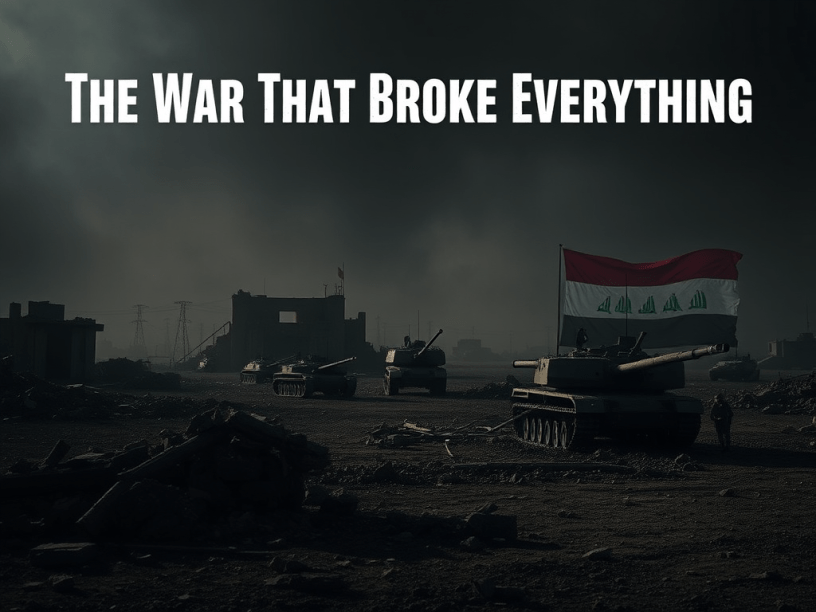
There are bad ideas, and then there’s George W. Bush’s decision to invade Iraq in 2003. It wasn’t just a bad idea—it was a catastrophic miscalculation that has reverberated through American foreign policy for over two decades. As we all know now, the invasion was built on a pack of lies, most notably that Saddam Hussein had weapons of mass destruction (WMDs) and was somehow in league with Al-Qaeda (Hersh, 2003).
But what’s even more galling is the fact that the war didn’t just destabilize Iraq—it destabilized the entire Middle East. We lost thousands of American soldiers, tens of thousands of Iraqis, and countless lives have been ruined in the wake of the conflict. If there was a trophy for “how to make a bad situation worse,” Bush would have been the first to take home the prize.
The war was sold to the public using faulty intelligence, and the aftermath was handled with breathtaking incompetence. Bush’s “Mission Accomplished” speech aboard the USS Abraham Lincoln was one of the most tone-deaf moments in presidential history. Not only was the mission far from accomplished, but it set the stage for a violent insurgency, the rise of ISIS, and a generation of displaced people.
For all of Bush’s talk of “spreading democracy,” Iraq became a breeding ground for extremism and chaos. Iraq’s government, despite some Western efforts to stabilize it, became a weak, corrupt mess, and the nation itself descended into sectarian violence. For those who wonder why the region is in such disarray today, just point to that moment in history when an American president decided to invade a sovereign nation based on a fabricated narrative.
And let’s not forget the human toll: 4,500 U.S. troops dead, 32,000 wounded, and countless Iraqis killed. All for a war that never should have happened, and one that continues to shape American foreign policy to this day.
Bush’s attempt to justify the war—to say that it was “for a good cause” or “to remove a dictator”—rings hollow when you look at the real cost. The war in Iraq didn’t make America safer. It just made things a whole lot worse, both for the people of Iraq and for Americans who would later have to live with the consequences of the decision.
Editor’s Note:
George W. Bush may have been one of the “good ol’ boys” in terms of political lineage, but his handling of Iraq proves that even the “privileged” can make catastrophic mistakes. The toll of this war is still being felt today, and we can’t help but wonder—could it have been prevented? As we look at the other blunders this month, we also look ahead to June, when we’ll dive deep into the blunders of Donald J. Trump—another president whose poor decisions cost lives and opportunities. The more things change, the more they remain the same. Or, in this case, the more they get worse.
 Occupy 2.5