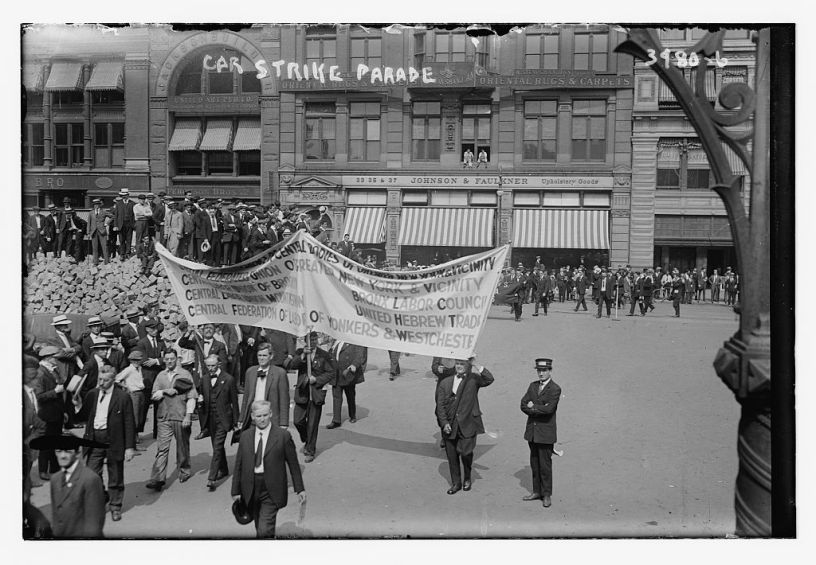
When American workers stopped working en masse, history didn’t politely ask them to go back—it screamed, flailed, and sent in the troops. The United States, despite its apple pie patriotism and bootstraps mythology, has always quaked when labor puts its foot down. And make no mistake: general strikes are the political equivalent of a steel-toed boot to the ribs of power.
Take 1877. The Great Railroad Strike began after three pay cuts in a row—because robber barons needed more yachts—and workers across multiple states decided enough was enough. It wasn’t just rail workers. It spread like a righteous virus through Baltimore, Pittsburgh, Chicago. For the first time, the federal government sent troops to suppress a domestic labor uprising. Why? Because when labor unified across sectors, it threatened the entire system (Brecher, 1997).
Then came Seattle in 1919. Roughly 65,000 workers, sparked by shipyard labor disputes, shut the entire city down. Everything stopped except milk deliveries and emergency services. It was disciplined, nonviolent, and effective. Business leaders screamed “Bolshevism!” like it was a safe word. The strike collapsed under red scare hysteria and internal labor divisions, but the message was clear: unity scares the hell out of capital (Dubofsky, 1994).
Fast forward to Oakland, 1946. One spark—a department store strike—turned into 100,000 workers walking off the job in under 24 hours. Transit, schools, services: gone. The city became a worker-run zone for three days. What broke it? The combined pressure of police, local politicians, and union leaders too cozy with management. Yes, the betrayal came from inside the house (Lichtenstein, 2002).
And of course, the last true general strike—Minneapolis, 1934—gave us blood on the streets. Teamsters shut down the city. Business leaders hired thugs. Police shot picketers. It was brutal. It was courageous. It also scared the elite so badly that major federal labor protections followed soon after. Because when the system feels the heat, it occasionally offers a bandage to keep the body alive (Zinn, 2003).
In short, U.S. general strikes proved that when the people stop working, power panics. Every time labor flexed too hard, elites cracked down harder. But now, the equation has changed. We have decentralized communication. We have dark web tools, anonymous forums, and encrypted peer-to-peer platforms. And we have memory—ours and theirs.
So, if another general strike brews, the real battle won’t be on the picket line alone. It’ll be in the narrative. Mass coordination is possible without centralized control. The key is to strike harder, smarter, and louder—where it hurts most: visibility, planning, and message control. And yes, there’s a Field Guide for that.
Download it. Print it. Share it.
Because when they can’t predict you, they can’t control you.
References:
- Brecher, J. (1997). Strike!. South End Press.
- Dubofsky, M. (1994). The State and Labor in Modern America. UNC Press.
- Lichtenstein, N. (2002). State of the Union: A Century of American Labor. Princeton University Press.
- Zinn, H. (2003). A People’s History of the United States. Harper Perennial.
 Occupy 2.5