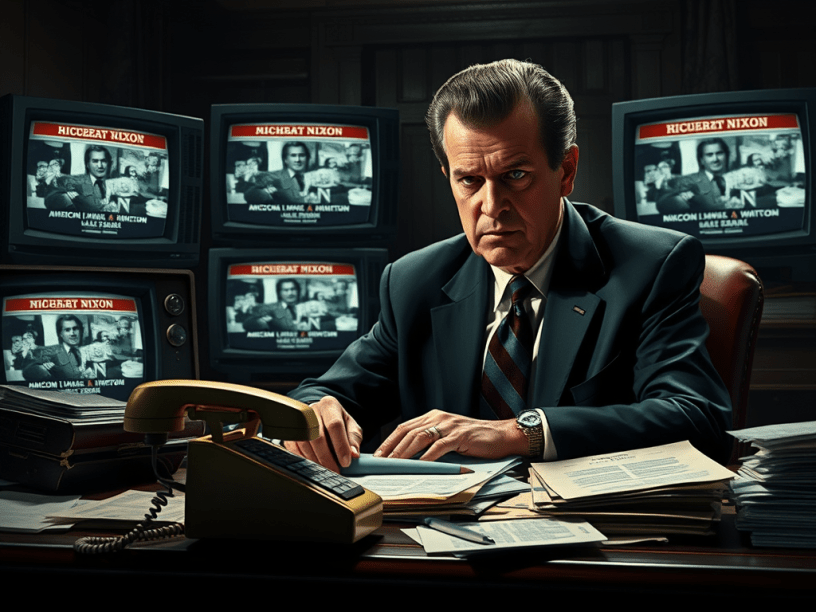
Richard Nixon’s Watergate scandal wasn’t just a scandal—it was the moment when the American public realized that their president was no longer a public servant, but a crook who thought he was above the law. It started as a simple break-in at the Democratic National Committee headquarters in Washington, D.C. in 1972. But soon, it became clear that this wasn’t just a random act of espionage—it was part of a coordinated effort to undermine the opposition and hold onto power at all costs.
Nixon’s involvement in the cover-up of the break-in was what ultimately led to his downfall. When the story first broke, Nixon vehemently denied any knowledge of the incident, even though there was mounting evidence to the contrary. As investigations ramped up, it became clear that Nixon and his aides had engaged in a massive cover-up to hide their involvement. They had illegally wiretapped, manipulated the press, and even used the FBI and CIA to quash any attempts to expose the truth.
By 1974, the scandal had spiraled out of control. The Senate held hearings, and the American public watched in shock as the evidence stacked up against the man they once trusted. What followed was the ultimate humiliation: Nixon became the first president in U.S. history to resign in disgrace, rather than face impeachment.
Watergate was a game-changer. It forever altered the way the American people viewed their political leaders. Nixon’s actions exposed the dangerous power dynamics at play within the White House and showed that even the highest office in the land was susceptible to corruption. The scandal also led to sweeping reforms in campaign finance and government transparency—though not nearly enough to prevent the corruption that followed.
The lasting impact of Watergate wasn’t just that Nixon resigned—it was that it shattered the illusion of presidential invulnerability. It showed the American people that their leaders could—and sometimes would—betray them for political gain.
Watergate remains a benchmark for political scandal in the U.S. and has set the bar for what counts as a presidential failure. Nixon’s arrogance, secrecy, and disdain for the rule of law proved that no one is untouchable, not even the President of the United States.
Third time on the Wall of Shame: Nixon makes his third appearance in our series, and it’s hard to blame him—after all, he did manage to make a comeback from the 1960 presidential defeat, only to leave office in disgrace. It’s the kind of irony you can’t make up.
Editor’s Note:
As we look back at Watergate, we can’t help but wonder how much this scandal truly changed the way Americans trust their leaders. Nixon’s fall from grace was a testament to the power of the people, but it also revealed the ugly side of political power—the lengths to which some will go to hold onto it. As we look at the present day, we see echoes of Nixon’s hubris in today’s politics. History has a funny way of repeating itself, and if Watergate taught us anything, it’s that the president can’t always get away with it. Or can they?
 Occupy 2.5