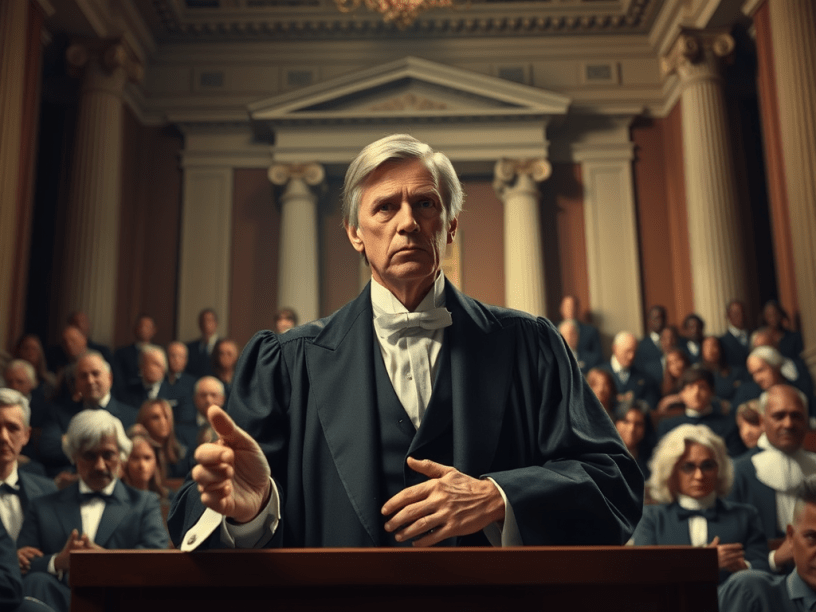
The second-worst screw-up in U.S. history came not from a president or military leader, but from the Justices of the U.S. Supreme Court, who in 1857 handed down the Dred Scott v. Sandford decision. This ruling, which became a central catalyst for the Civil War, not only reinforced the institution of slavery but also denied citizenship to African Americans, further deepening the divisions between the North and South. The decision was supported by Chief Justice Roger B. Taney and Justices James M. Wayne, John A. Campbell, Peter V. Daniel, Samuel Nelson, and Robert Cooper Grier, while the dissenting opinion came from Justices Benjamin R. Curtis and John McLean. The impact of this decision was both immediate and long-lasting, laying the groundwork for the Civil War.
Dred Scott was an enslaved African American man who had lived in free territories with his owner, Dr. John Emerson, a U.S. Army surgeon. Scott sued for his freedom, arguing that his residence in free territories made him a free man. The case was eventually taken up by the Supreme Court in 1857, where Chief Justice Roger B. Taney delivered the majority opinion.
The ruling, with Taney at the helm, was an absolute disaster on every level. The decision stated that African Americans—whether free or enslaved—could not be U.S. citizens, effectively denying them any right to sue in federal court. Taney argued that Black people “had no rights which the white man was bound to respect,” a declaration that echoed the racist sentiments of the time. This decision not only violated basic human rights but also insulted the very principles of liberty upon which the country was founded.
What made the decision even more catastrophic was its impact on the institution of slavery. Taney’s opinion also declared that Congress had no authority to ban slavery in federal territories, essentially nullifying the Missouri Compromise of 1820, which had sought to regulate the spread of slavery into western territories. By ruling that slavery could expand into all territories, the Court undermined the growing abolitionist movement and emboldened pro-slavery forces in the South. The decision, as historian Eric Foner notes, “added fuel to the sectional fire,” convincing many in the North that the federal government was irrevocably aligned with the South’s interests.
The Dred Scott decision served as a stark reminder of how the government was failing to address the fundamental issue of slavery, leading to a deeper rift between the North and South. It undermined the work of abolitionists and those who sought to contain slavery’s expansion. As a result, it pushed the country closer to war. The ruling was one of the key factors in the realignment of political parties in the 1850s, leading to the rise of the Republican Party, which was founded on the principles of stopping the expansion of slavery.
The Dred Scott decision ultimately strengthened the resolve of anti-slavery activists, while simultaneously fortifying the resolve of pro-slavery factions in the South. The ruling led to increased polarization in the nation, resulting in further tensions that eventually exploded into the Civil War in 1861.
While the Dred Scott decision was overturned by the 13th and 14th Amendments after the Civil War, its legacy is a reminder of the dire consequences of judicial overreach and the failure to uphold the principles of freedom and equality. It was a catastrophic mistake in the history of the United States, one that not only eroded the rights of African Americans but also deepened the divisions that led to the Civil War.
Editorial Note:
The Dred Scott decision exemplifies the dangers of ignoring justice and equality for political expediency. It’s a stark reminder that when the government fails to protect the rights of all citizens, it only deepens divisions and sows the seeds of conflict. The implications of this decision didn’t just affect one case or one person—it affected the course of an entire nation. While we often point to the actions of presidents and lawmakers as the root cause of national crises, this Supreme Court ruling is a prime example of how the judiciary can contribute to the failures of a country and push it to the brink of war. Today, when we look at how justice is applied—or misapplied—we must ask ourselves: how far have we come, and how much further do we have to go?
 Occupy 2.5