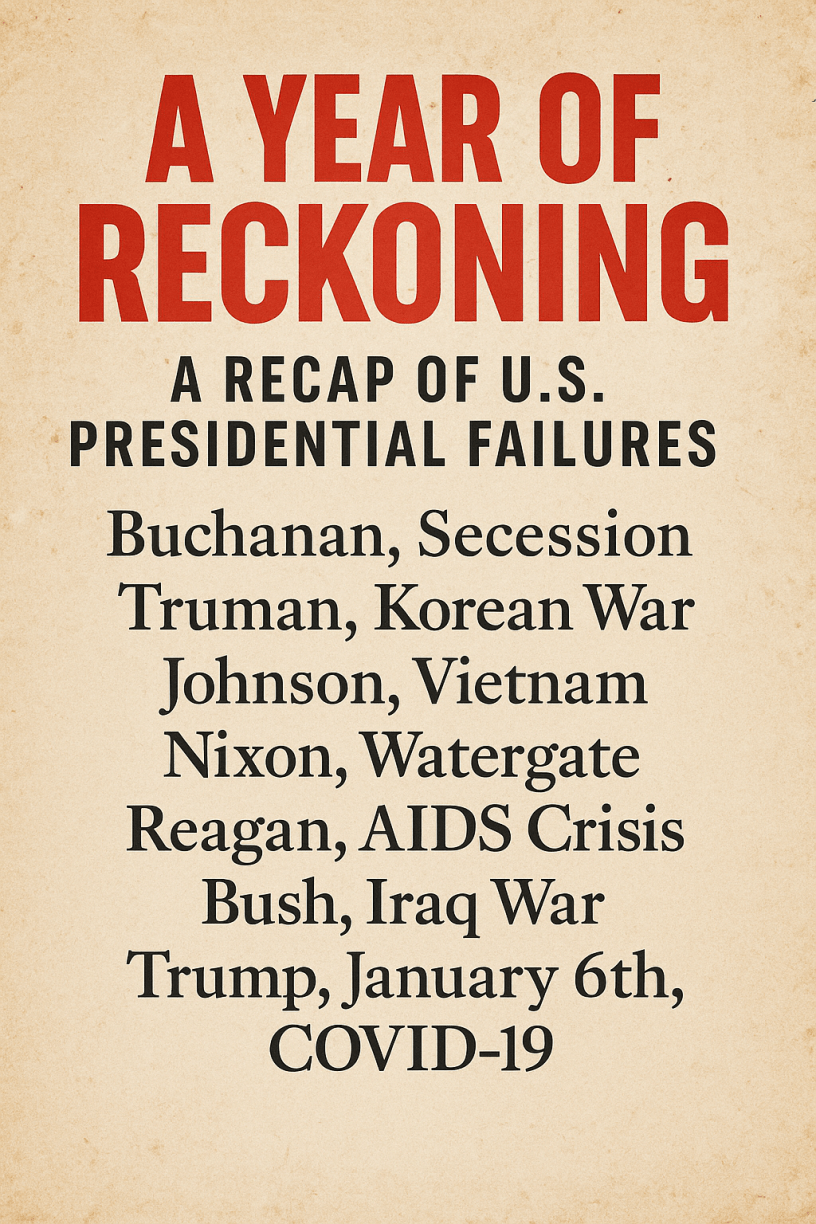
As this month of reflection comes to a close, we confront the uncomfortable truth that the presidency of the United States, often idealized as a beacon of leadership, has frequently been a source of catastrophic failure. The second half of the 20th century and the early 21st were filled with blunders, betrayals, and abuses of power. But these aren’t simply modern failings. From the early 1800s to today, we’ve been led into war, economic ruin, and constitutional crisis—often by men more concerned with image and influence than with justice or wisdom.
We began this journey examining the decisions that led to the Civil War. We watched Presidents like James Buchanan fail to act, enabling the rise of secessionist sentiment and the spread of slavery. Supreme Court justices, with the Dred Scott decision, made matters worse—enslaving the law itself to prejudice and fear.
But it didn’t end there. In 1950, President Harry S. Truman plunged the U.S. into the Korean Conflict, declaring war without ever seeking congressional approval—setting a dangerous precedent that presidents would follow for decades. The war itself ended in a stalemate, not a victory. Over 36,000 American lives were lost in a conflict that technically never ended. Korea remains divided to this day, and the U.S. military remains entangled in its consequences. Truman, often lionized for his blunt demeanor and postwar decisions, also bears the stain of launching a war under questionable authority and failing to secure a resolution.
Later, President Lyndon B. Johnson, riding the fabricated narrative of the Gulf of Tonkin Incident, escalated the U.S. into the Vietnam War—a quagmire that would claim more than 58,000 American lives and devastate Vietnam. Richard Nixon, instead of ending it swiftly, prolonged it while secretly expanding the war into Cambodia and Laos, causing even greater instability in Southeast Asia.
Ronald Reagan, for all his polished charm, presided over economic cruelty masked as prosperity, gutted mental health infrastructure, and looked the other way as the AIDS epidemic claimed tens of thousands of lives. His administration illegally funneled weapons to Iran while supporting right-wing death squads in Central America. George W. Bush brought us into the Iraq War under false pretenses, destabilizing an entire region and costing countless lives in the name of nonexistent weapons of mass destruction.
Then came Donald Trump. The chaos of his term culminated in the January 6, 2021 insurrection, a direct assault on democratic institutions incited by the president himself. His pandemic response was a disastrous blend of disinformation, negligence, and arrogance—one that contributed to the deaths of over a million Americans and left the nation broken and bitterly divided.
What binds all these failures together is not ideology or partisanship—but a repeated pattern of presidents placing ego, power, or political expedience above human life and constitutional principles.
Editorial Note:
It’s hard to edit these essays without becoming emotional. What stands out most over the past 31 days is the sheer callousness of U.S. leadership across the centuries. From Truman to Trump, presidents have sent Americans to die, ignored crises, and abused the trust of the people. This isn’t just about the last few decades—it’s a thread that runs deep through our entire history.
What can be done?
Two things: vigilance and adherence to law. We must stop giving unchecked power to individuals. We must remember that patriotism means holding leaders accountable—not worshipping them. If we’re not vigilant, if we do not stand firm for the rule of law, history will repeat itself. It already has.
 Occupy 2.5