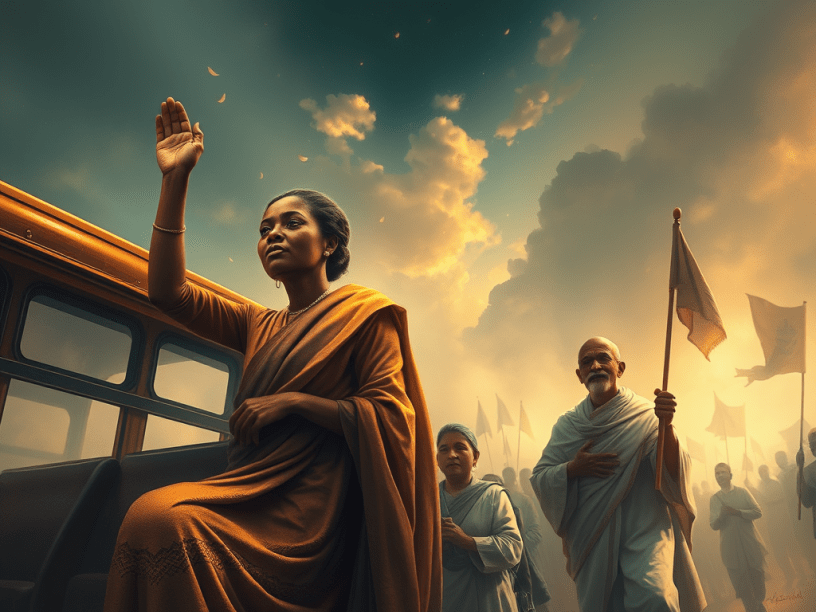
Gather ’round, dear friends, and let me tell you a tale from our shared history, a story woven with threads of courage, hope, and the indomitable spirit of those who dared to dream of a better tomorrow.
In the year of our Lord, 1955, in a land called Montgomery, Alabama, there lived a woman named Rosa Parks. She was a quiet soul, yet on one fateful day, her heart was filled with the weight of injustice. When asked to relinquish her seat on a segregated bus to a white passenger, she stood firm, like an ancient oak in a storm, proclaiming that enough was enough. This brave act sparked the Montgomery Bus Boycott, a powerful movement that would resonate throughout the land.
For 381 days of determined resistance, the people stood together, refusing to ride those buses that enforced segregation. Can you feel their resolve? They walked, carpooled, and rode bicycles, united in their demand for equality. Led by a young man named Dr. Martin Luther King Jr., the boycott became a beacon of hope for many. It was a testament to the strength of the human spirit when fueled by the desire for justice. And, in time, their voices were heard far and wide, leading to a historic Supreme Court ruling that ended segregation on public buses. Their victory was not just for themselves but for all who yearn for freedom!
Now, let me take you across the waters to the year 1930, where a humble man named Mahatma Gandhi dreamed of a free India under the sun. In this land, salt was more than a seasoning; it was a symbol of nourishment and life itself. Yet, the British imposed a tax on this precious resource, seeking to control the very essence of the people’s existence.
With unwavering determination, Gandhi gathered a small group of followers and embarked on the Salt March, a journey that spanned 240 miles from his ashram to the shores of Dandi. As they walked, their numbers swelled, attracting thousands eager to join the cause. Each step was a declaration—a refusal to bow to oppression. They made salt from seawater, defying unjust laws and standing as a testament to nonviolent resistance.
This march did not go unnoticed. It captured the hearts and minds of people everywhere, rallying support for India’s struggle against colonial rule. It ignited a flame of civil disobedience that would grow into a roaring fire of independence. Though it took years, their efforts bore fruit in 1947 when India finally broke free from the chains of oppression.
Dear friends, let these tales remind us of the power of nonviolent action—of how the courage of a few can inspire the hearts of many. The Montgomery Bus Boycott and the Salt March teach us that, even in the face of despair, hope prevails. When we stand together for what is right, we become a force to be reckoned with. Just as those who came before us, we too can rise to challenge injustice and create a brighter future.
So, let us carry these stories in our hearts and find strength in their lessons. Together, we can bloom like flowers in a meadow, vibrant and united, nurturing the seeds of change within our own communities. The legacy of courage lives on, urging us to take up the mantle and stand up for justice, for hope, and for a better tomorrow!
 Occupy 2.5