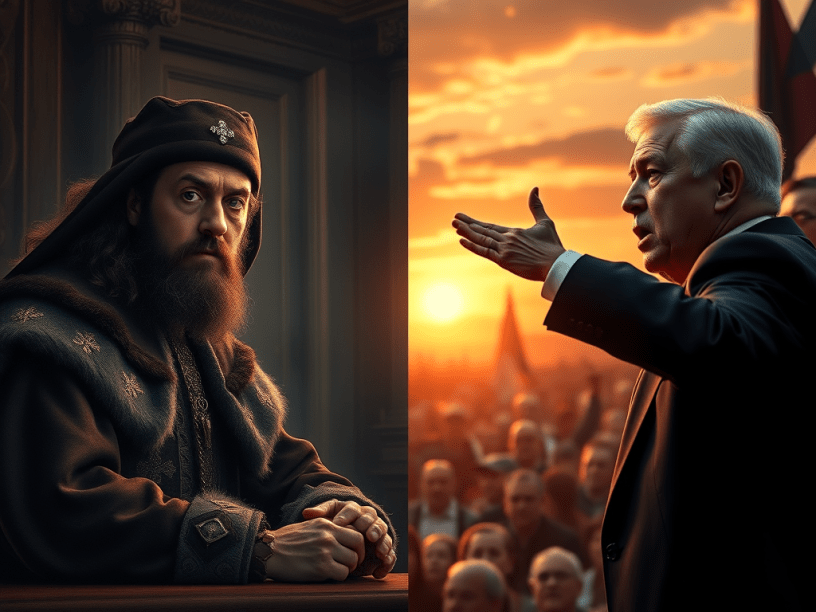
So here we are, folks, staring down the barrel of martial law, that old chestnut of authoritarianism that always seems to rear its ugly head when leaders start getting nervous. You’ve got to wonder if some people ever look at history and think, “Gee, maybe I shouldn’t go there.” Because, let’s be honest, ripping the democracy carpet out from under our feet is a great way to end up planting yourself six feet under politically, if not literally.
Take King Charles I of England. Back in the 1600s, this guy was throwing down martial law like it was confetti at a parade. Sure, he thought it was a nifty way to grab power and squish dissent like a bug on a windshield. But after enough public outrage and some messy battles, Charles found himself on the wrong end of a guillotine. That’s right, folks—executed for treason. Lesson learned? When you don’t listen to the public and instead try to oppress them, you might just end up as the main act at an execution.
And then there’s Indira Gandhi, another one who thought declaring a state of emergency was a smart move. In 1975, she slapped on martial law, thinking it would help her keep her grip on power while shoving her critics in a corner. But guess what? When the time came for elections, she lost in a landslide, and her violent reign ended with her own assassination just years later. Talk about karma coming back to bite you.
Now let’s not forget old Alberto Fujimori from Peru. This guy thought he could pull a fast one by declaring martial law in 1992. He figured it’d be a quick fix to his political woes. But as it turns out, trying to silence the dissenters only stirred up a hornet’s nest. After a mad dash to Japan to escape prosecution, he found himself in a prison cell instead of a palace.
So what’s the message here? Declaring martial law might feel good for about five minutes, especially if you’re feeling threatened by your opposition. But it’s like throwing gasoline on a flaming fire—it might burn the opposition for a while, but it’ll also scorch you in the end.
Now, if we shift our gaze to the present, we’ve got a former president prancing around with the idea that military force is the magic wand to wave at any dissent. The Trump administration and its ilk should take a page from history before they start thinking about flexing military muscle against its own citizens. We’re talking about using the military to crush free speech and peaceful protests here—an idea that simply reeks of betrayal to the principles this country was built on.
Using police and military as a hammer against the American people could lead to that all-too-familiar fallout. Just look at countries like North Korea and Russia, where leaders think guns and soldiers can buy loyalty. Spoiler alert: they can’t. When people’s rights are trampled, resentment builds, and history shows that those in power don’t often survive the backlash, one way or another.
So here’s the bottom line, dear leaders: if you’re tempted to start acting like you’re above the law and our cherished civil rights, remember the folks who came before you. They all ended up in the dustbin of history—executed, extradited, ostracized. Don’t let the shiny allure of absolute authority blind you to the lessons of the past. Keep your hands off that military power. Instead, honor the rights of the American people, or you might just end up writing your own political obituary.
Here are the MLA-style citations:
- Britzky, Haley. “Trump’s power grab could dissuade military leaders from refusing illegal orders, experts warn.” CNN, 21 Feb. 2025, http://www.cnn.com/2025/02/21/politics/trump-military-orders/index.html.
- Galston, William A. “Does the president have the power to fire or punish military officers?” Brookings Institution, 21 Feb. 2025, http://www.brookings.edu/research/president-firing-military-officers/.
- Editorial. “Editorial: Ukraine reaches 3 years fighting for justice and a lasting peace.” The Mainichi, 24 Feb. 2025, mainichi.news/article/20250224-edited-ukraine-peace.html.
- Deen, Thalif. “US Threat To Cut Off Military Aid To Egypt And Jordan May Provoke Arms Suppliers.” Eurasia Review, 25 Feb. 2025, http://www.eurasireview.com/2025/02/us-aid-egypt-jordan/.
- Editorial. “EDITORYAL — Mag Martial Law?” Banat, 24 Feb. 2025, http://www.banatnews.com/editorial-mag-martial-law/.
- Kim, Jun-il. “[Column] How leaders who declare martial law meet their ends.” Hankyoreh, 23 Feb. 2025, http://www.hani.co.kr/arti/english_edition/column/1032283.html.
- “Oliver North.” Encyclopedia Britannica, 6 Feb. 2025, http://www.britannica.com/biography/Oliver-North.
- “Iran-Contra Affair: Oliver North.” Encyclopedia Britannica, 6 Feb. 2025, http://www.britannica.com/event/Iran-Contra-Affair.
 Occupy 2.5