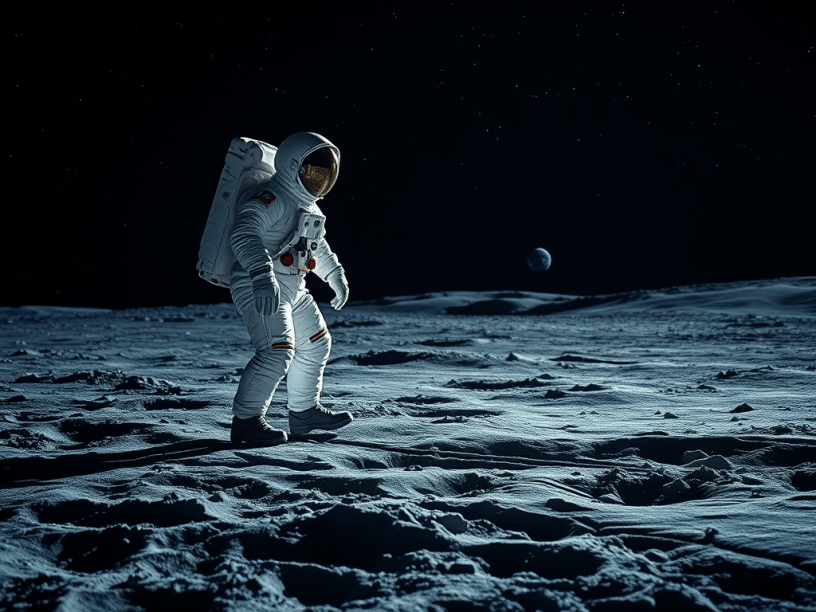
This July marks the 56th anniversary of the Apollo 11 mission. On July 20, 1969, Neil Armstrong and Buzz Aldrin made history. They became the first humans to walk on the Moon. This momentous event fulfilled President John F. Kennedy’s bold challenge to land a man on the Moon and return him safely to Earth.
The Apollo program launched on July 16, 1969, from Cape Kennedy. The Saturn V rocket lifted off, carrying Armstrong, Aldrin, and Command Module Pilot Michael Collins into space. The mission aimed to explore the Moon and gather scientific data. The astronauts planned to set up experiments and collect samples of lunar material.
As Apollo 11 traveled toward the Moon, the crew faced challenges. On their way, they performed maneuvers to enter lunar orbit. After circling the Moon, Armstrong and Aldrin prepared to land. They aimed for the Sea of Tranquility but encountered issues. A navigation error put them several kilometers from their intended site.
Despite these hurdles, the Eagle Lunar Module touched down on July 20. Armstrong announced, “The Eagle has landed.” This triumph unfolded in front of an estimated 650 million viewers worldwide. Armstrong then stepped onto the lunar surface, uttering the famous words, “That’s one small step for man, one giant leap for mankind.”
During their time on the Moon, Armstrong and Aldrin explored and conducted experiments. They collected samples of rock and soil. They deployed scientific instruments for measurements. Their mission included capturing stunning photographs of the lunar landscape. They interacted with mission control, providing updates on their activities.
Critics persistently challenge the Moon landing’s authenticity. Some claim that it was staged. They argue that the technology of the time could not achieve such a feat. However, compelling evidence debunks these claims.
First, thousands of people contributed to the Apollo program. The involvement of over 400,000 scientists, engineers, and technicians made the mission possible. Collaboration across various sectors ensured success. Any conspiracy would require a massive cover-up involving too many participants.
Second, lunar samples provide irrefutable proof. Armstrong and Aldrin returned with 21.6 kilograms of lunar material. Scientific analysis confirms that these samples differ from anything found on Earth. They include unique isotopic compositions and are rich in titanium. Such findings reinforce that the astronauts truly walked on the lunar surface.
Photographic and video evidence also supports the mission’s authenticity. High-definition footage captured Armstrong’s first steps. The images show distinct features of the lunar terrain, such as the moon’s cratered landscape and its low gravity. Lunar Lander models demonstrate the technology needed to achieve the landing.
Moreover, independent organizations corroborate the mission’s success. Numerous countries tracked Apollo 11’s trajectory in real-time. They confirmed radio transmissions, telemetry data, and other mission milestones. The Soviet Union, a leading adversary at the time, monitored the mission closely. They had every incentive to expose a hoax if one existed. Public acknowledgment of the moon landing from the Soviet authorities further attests to its veracity.
After nearly 22 hours on the lunar surface, Armstrong and Aldrin re-entered the Lunar Module. They successfully rendezvoused with Collins aboard the Command Module, Columbia. The crew splashed down in the Pacific Ocean on July 24, concluding an extraordinary mission. They spent 8 days, 3 hours, and 18 minutes traveling from Earth to the Moon and back.
The Apollo 11 mission revived public interest in space exploration. It demonstrated human ingenuity and determination. Following Apollo 11, NASA continued with several more lunar missions. Each mission expanded our understanding of the Moon, laying the groundwork for future explorations.
As we celebrate this anniversary, it is crucial to remember the legacy of Apollo 11. Armstrong, Aldrin, and Collins remind us of the heights humanity can achieve. Their journey not only united people worldwide but also ignited dreams of exploration beyond our planet.
The legacy of Apollo 11 inspires new generations. NASA continues to push forward with plans for Mars exploration. Future missions build upon the achievements of Apollo. As we reflect on the past, we also look toward the future. With each step, humanity strives to explore the cosmos. The journey continues.
Sources:
- BBC. (2024, July 16). Apollo 11 Moon landing: Everything you need to know. BBC Newsround. https://www.bbc.co.uk/newsround/48789792
- National Geographic Kids. (n.d.). The Moon landing. National Geographic. https://kids.nationalgeographic.com/history/article/moon-landing
- Lunar and Planetary Institute. (2025). Apollo 11 mission overview. Lunar and Planetary Institute. https://www.lpi.usra.edu/lunar/missions/apollo/apollo_11/
- NASA. (2024, October 11). Apollo 11. National Aeronautics and Space Administration. https://www.nasa.gov/mission/apollo-11/
- Loff, S. A. (2015, April 17). Apollo 11 mission overview. NASA. https://www.nasa.gov/mission/apollo-11/
- NASA. (n.d.). Apollo 11. National Aeronautics and Space Administration. https://www.nasa.gov/mission/apollo-11/
 Occupy 2.5