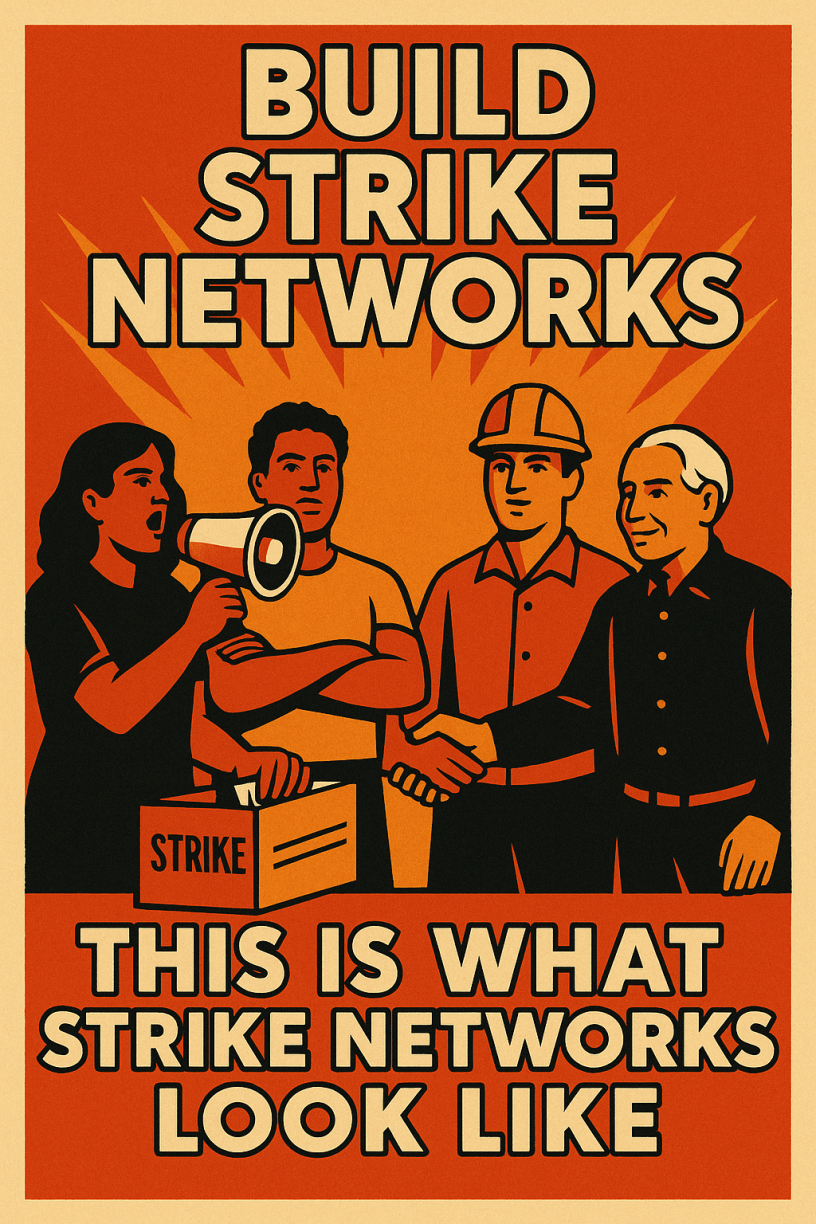
It starts with a look. A nod. A message passed quietly across a breakroom. A sticker on a stop sign. A whisper in the warehouse. A flyer in a locker. A group chat that starts with “Are you in?”
Strike networks don’t begin on picket lines. They begin in trust.
They are the backbone of resistance—not the headlines, but the heartbeats. They’re the lunch break where workers compare paychecks. The late-night meeting in someone’s garage. The ride home where someone says, “We don’t have to take this.” The stranger who tells you, “We walked out last month. You can too.”
Fascism thrives when workers are isolated, frightened, and pitted against one another. It feeds off silence, division, and desperation. But strikes—real strikes, rolling strikes, sickouts, slowdowns—they jam the gears. They break the rhythm of exploitation. And strike networks? They’re how we make that disruption permanent.
A strike network is a living system. It’s made of people who’ve got each other’s backs. People who share food, watch kids, swap shifts, and spread the word. People who remember that labor isn’t just a job—it’s life. It’s power. And when that power is organized, it becomes unstoppable.
You don’t need a union card to build a strike network. You need courage. You need curiosity. You need to be willing to ask the question: What would it take for us to walk together? And then listen.
Strike networks grow in every sector: in warehouses, call centers, schools, hotels, hospitals, delivery vans, and farms. In rural towns and city blocks. In red states and blue. They don’t wait for permission. They don’t wait for perfect timing. They build strength in motion, step by step.
Maybe you start by forming a crew that checks in on each other’s pay stubs. Maybe you print a QR code linking to organizing tips. Maybe you keep your eyes open and your mouth shut—until the moment comes when speaking up changes everything.
The best strike networks prepare like it matters. Because it does. They collect contact info. They build support systems. They map out who can cover for whom. They know who has a car, who has the loud voice, who has the snacks, and who knows the laws. They rehearse for the moment when the machine breaks—and they’re ready to hold the line.
You don’t need a leader. You need a signal.
And here it is: when we strike together, we win.
This is what strike networks look like:
A friend who won’t cross the line.
A nurse who says “not today.”
A teacher who leaves the classroom to demand more.
A barista who flips the sign to CLOSED and says, “We deserve better.”
It looks like us.
Quiet sometimes. Loud when it needs to be.
Smart. Bold. Ready.
Not someday.
Now.
 Occupy 2.5