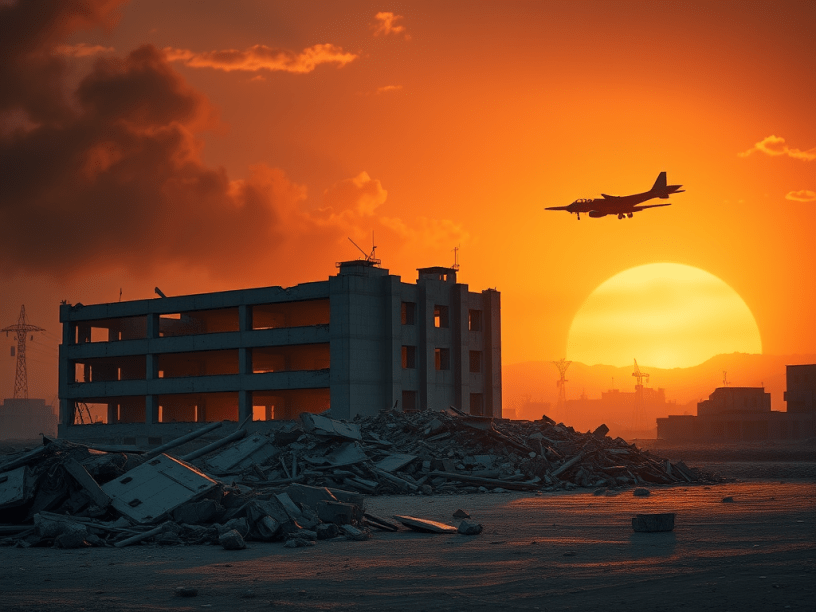
Clinton: Bombed a Sudanese Pharma Plant, Falsely Claiming Chemical Weapons 💣🌍 #Triangulation
On August 20, 1998, in a dramatic show of force, the Clinton administration ordered cruise missile strikes on the Al-Shifa pharmaceutical plant in Khartoum North, Sudan. The United States claimed the facility was involved in the production of chemical weapons and had ties to Osama bin Laden. Subsequent investigations cast serious doubt on those assertions, raising troubling questions about the motivations for the attack — and the human cost of getting it wrong. The strike remains one of the most controversial foreign policy decisions of the Clinton era and a classic case of what critics call “triangulation,” where political expediency outweighs truth or consequence.
Operation Infinite Reach: Targeting Terror or Saving Face?
The strikes came just 13 days after al-Qaeda bombed U.S. embassies in Kenya and Tanzania, killing 224 people and injuring over 4,0001. Operation Infinite Reach targeted what the administration said were terror-linked sites in Afghanistan and Sudan. While the Afghan strikes aimed at training camps, the Sudan target was Al-Shifa — a civilian pharmaceutical plant.
President Clinton claimed the factory was “associated with the bin Laden network” and involved in producing the precursor chemical EMPTA, used to make VX nerve gas2. He did not provide direct evidence to the public, citing intelligence secrecy. In his televised statement on August 20, Clinton said:
“Our target was Sudan’s principal pharmaceutical plant. The factory was involved in the production of materials used to make chemical weapons. Our evidence leads us to believe that this facility was linked to Osama bin Laden’s terrorist network”3.
However, no UN inspectors, no public investigation, and no follow-up strikes supported that claim. The plant was obliterated in the strike, along with the truth.
The Fallout: Medical Disaster in Sudan
The Al-Shifa factory produced over half of Sudan’s medicines, including treatments for malaria, tuberculosis, and veterinary drugs essential for livestock health. Human rights and humanitarian organizations immediately raised alarms about the consequences. A report from Médecins Sans Frontières warned that the strike would lead to thousands of preventable deaths from diseases treatable with drugs once produced at Al-Shifa4.
Sudan, which was already under U.S. sanctions and isolated diplomatically, lacked the infrastructure to replace these essential medicines quickly. Former U.S. Ambassador to Sudan, Donald Petterson, later acknowledged the humanitarian impact, calling it “severe and long-lasting”5.
The Case Falls Apart
In the weeks and months after the strike, evidence undermining the administration’s claims mounted. A key problem was the alleged presence of EMPTA. Samples were reportedly taken from soil outside the plant, but no independent body ever verified those findings. The administration admitted there was no evidence of VX production onsite, no weapons found, and no evidence the plant had any security or military connections6.
The plant’s owner, Saleh Idris, who had no known ties to terrorism, sued the U.S. government for damages. His assets had been frozen following the attack but were later unfrozen when the evidence of wrongdoing proved flimsy7.
Further, Germany’s Die Zeit and the UK’s The Guardian published reports casting doubt on U.S. claims, quoting European intelligence officials and aid workers who had visited the plant before the strike and confirmed its civilian nature89.
Clinton’s Response and Political Timing
At the time of the bombing, President Clinton was facing the crescendo of the Monica Lewinsky scandal. He had just testified to a grand jury and publicly admitted to an “inappropriate relationship” with Lewinsky three days before ordering the missile strikes.
Critics, including members of Congress, questioned the timing. Republican Senator Dan Coats stated:
“I think the timing raises suspicion. I think the President is in danger of being perceived as having diverted attention from his personal problems.”
While Clinton and his national security team denied any political motivation, the lack of solid evidence made the suspicions stick.
Strategic Triangulation: Politics Over Principle
This episode is emblematic of the Clinton administration’s pattern of triangulation — the political strategy of occupying the center by co-opting both left- and right-wing policies. Here, it manifested as a high-profile military response intended to appear tough on terror, while deflecting domestic scandal and criticism from conservatives who often accused Democrats of weakness on national security.
The political calculus seemed to be: respond decisively to terrorism to silence critics, even at the cost of a foreign civilian target with dubious links to extremism. Instead of international cooperation or forensic accountability, Clinton chose unilateral action with high public visibility. That gamble destroyed a critical piece of Sudan’s infrastructure and fueled anti-American sentiment in the region for decades.
Lessons and Legacy
The Al-Shifa bombing remains a cautionary tale in modern U.S. foreign policy. It exemplifies how incomplete intelligence, lack of oversight, and political incentives can converge to disastrous ends. The U.S. never apologized, and Clinton never publicly acknowledged that the evidence might have been wrong.
A decade later, The New York Times editorial board reflected on the incident, stating:
“The missile attack on Sudan remains a potent symbol of the dangers of intelligence without accountability and war-making without consequence.”10
This event foreshadowed later disasters, such as the Iraq War in 2003, where similarly thin evidence justified military action with far-reaching humanitarian consequences. The bombing of Al-Shifa underscores the importance of transparency, international verification, and a commitment to justice over public relations.
Conclusion
The destruction of Sudan’s Al-Shifa pharmaceutical plant was not just a tactical blunder or intelligence failure — it was a human tragedy fueled by political expediency. Clinton’s administration never provided credible evidence, never faced international inquiry, and never acknowledged the cost to Sudanese civilians. In a world where misinformation and militarism continue to collide, Al-Shifa remains a stark warning of the price paid when presidents prioritize triangulation over truth.
Footnotes
Footnotes
New York Times Editorial Board. (2008, August 20). Ten Years After Al-Shifa. https://www.nytimes.com ↩
U.S. Department of State. (1998). Embassy Bombings in Kenya and Tanzania. https://1997-2001.state.gov ↩
CNN. (1998, August 20). U.S. missiles strike terrorists in Afghanistan and Sudan. https://www.cnn.com ↩
Clinton, W. J. (1998, August 20). Address to the Nation on Military Action Against Terrorist Sites. The American Presidency Project. ↩
Médecins Sans Frontières. (1998). Health impact of U.S. strike on Sudan’s pharmaceutical infrastructure. ↩
Petterson, D. (2002). Inside Sudan: Political Islam, Conflict, and Catastrophe. Westview Press. ↩
Hersh, S. M. (2001, October 22). The Missiles of August. The New Yorker. https://www.newyorker.com ↩
Washington Post. (1999, May 3). U.S. Unfreezes Sudanese Assets After Missile Strike. ↩
Die Zeit. (1999, January 14). Die Lüge von Khartum. https://www.zeit.de ↩
The Guardian. (1998, August 23). Bombing of the ‘aspirin factory’ in Sudan questioned. ↩
 Occupy 2.5