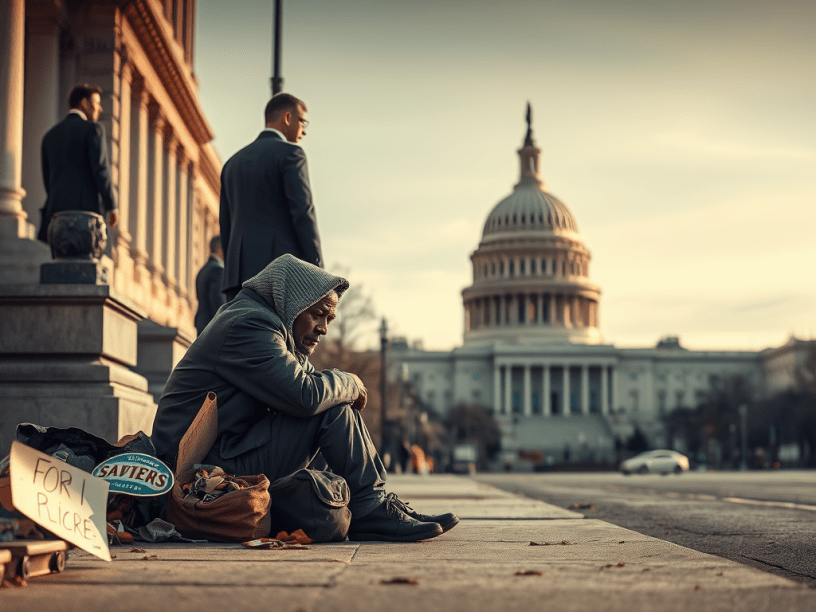
The Wealthy Disconnect: How Congress Has Forgotten America’s Homeless
I cannot just leave this here. It is absolutely imperative that you understand something that has persisted since the days of Obama. As we said on the streets, we were sold out while the banks were bailed out. The Great Recession was the kissing cousin of the disaster that was the 1929 crash and the subsequent depression.
Today, the homeless crisis in America has reached alarming levels, with approximately 735,000 individuals facing homelessness on any given night. This growing crisis is disheartening, particularly as wealthy lawmakers in Congress appear increasingly disconnected from the struggles of ordinary citizens. Many representatives, including influential figures like Rick Scott and Nancy Pelosi, hold substantial personal fortunes that shield them from the day-to-day realities faced by those living on the streets. As politicians prioritize policies that benefit the affluent, the urgent needs of the homeless often get pushed to the sidelines.
During the Great Depression of the 1930s, the unemployment rate in the United States soared, peaking at around 25% in 1933. In contrast, the unemployment rate hit 10% in October 2009 during the Great Recession, which followed the 2008 financial crisis. Franklin D. Roosevelt fought tirelessly against Republican opposition to support those who wanted to work, striving to help them maintain their dignity and place in society.
Obama, on the other hand, allowed banks to evict people from their homes, labeling them as toxic assets to be resold to the highest bidder. All we received were a few extensions on unemployment insurance, which we had only because of FDR’s initiatives in the 1930s. I was working and homeless during the Obama years. I know from firsthand experience what I speak of.
Public sentiment reflects a growing dissatisfaction with the politicians who forget their responsibilities. Our U.S. government has done very little for its citizens since the days of Lyndon B. Johnson. Now we face a choice: we can elect a Democrat, or we can put in another fascist Republican. The only thing that is clear is that we need a Democrat who will truly represent us. It is time to take a stand and demand a government that prioritizes the wellbeing and dignity of every citizen, not just the wealthy few. We must not settle for anything less.
In the current political landscape, wealthy lawmakers dominate the halls of Congress. Their immense wealth shapes their political careers while often blinding them to the struggles of ordinary Americans. Advocates for the homeless argue that the policies crafted in Congress typically neglect the experiences or needs of those without homes.
Campaign finance data illustrates how wealth has historically influenced politics. Figures like Nelson Rockefeller used their fortunes to dominate political landscapes with little scrutiny (Barrett, n.d.). The Watergate scandal prompted reforms aimed at limiting the influence of money in politics, yet many wealthy self-funded candidates still navigate around these limitations (Mutch, 2014).
Today, the impacts of this wealth divide are evident. Lawmakers who can self-fund their campaigns often prioritize initiatives that favor their financial interests. Critical solutions regarding homelessness become lost in the noise of economic discussions, and the needs of the less fortunate are sidelined.
Advocates emphasize the need for public pressure on elected officials to address these urgent issues. The public must demand accountability from their representatives, pushing for transparent campaigning and funding practices that prioritize the needs of all citizens. Grassroots movements can play a crucial role, mobilizing communities to advocate for policy changes aimed at alleviating homelessness.
A true democracy must reflect the experiences of every citizen, not just those with substantial financial resources. It is essential that elected officials reconnect with the realities faced by vulnerable populations. As the dialogue around wealth and political representation continues to evolve, we must remain vigilant in demanding a system that serves all, not just the elite few.
In the end, the convergence of wealth and politics presents a significant challenge for American democracy. It is time to demand a shift, prioritizing the voices of the marginalized and ensuring that every citizen has the opportunity for stability and dignity. Together, we can advocate for a government that addresses the critical needs of the homeless and creates a more equitable society.
Sources:
- Dorman, J. L., & Griffiths, B. D. (2025). Here’s a look at 9 ultra-rich members of Congress. Business Insider. https://www.businessinsider.com
- Kamarck, E., & Muchnick, J. (2025). Are the very rich taking over American politics? The Brookings Institution. https://www.brookings.edu/articles/are-the-very-rich-taking-over-american-politics/
- Schouten, F. (2019). These Democratic billionaires could help shape the 2020 election. CNN. https://www.cnn.com/2019/06/01/politics/democratic-billionaire-donors/index.html
- Barrett, M. E. (n.d.). “Millionaires are more democratic now”: Nelson Rockefeller and the politics of wealth in New York. University of Illinois at Urbana-Champaign. https://nysm.nysed.gov/sites/default/files/barrett_-_millionaires_are_more_democratic_now_a.pdf
- National Academy of Sciences. (1988). Homelessness, health, and human needs. National Academies Press. https://doi.org/10.17226/1098
- U.S. Department of Housing and Urban Development. (n.d.). CoC and ESG homeless eligibility – Four categories in the homeless definition. HUD Exchange. https://www.hudexchange.info/homelessness-assistance/coc-esg-virtual-binders/coc-esg-homeless-eligibility/four-categories/
- U.S. Congress. (n.d.). U.S. Code Title 42 CHAPTER 119 SUBCHAPTER I § 11302 – General definition of homeless individual. Cornell Law School. https://www.law.cornell.edu/uscode/text/42/11302
- Substance Abuse and Mental Health Services Administration. (2018). Definitions of homelessness. SAMHSA SOAR Technical Assistance Center. https://soarworks.samhsa.gov/article/definitions-of-homelessness
 Occupy 2.5