🛠️ Occupy25.com: compliments of Occupy Oakland 2011/2012
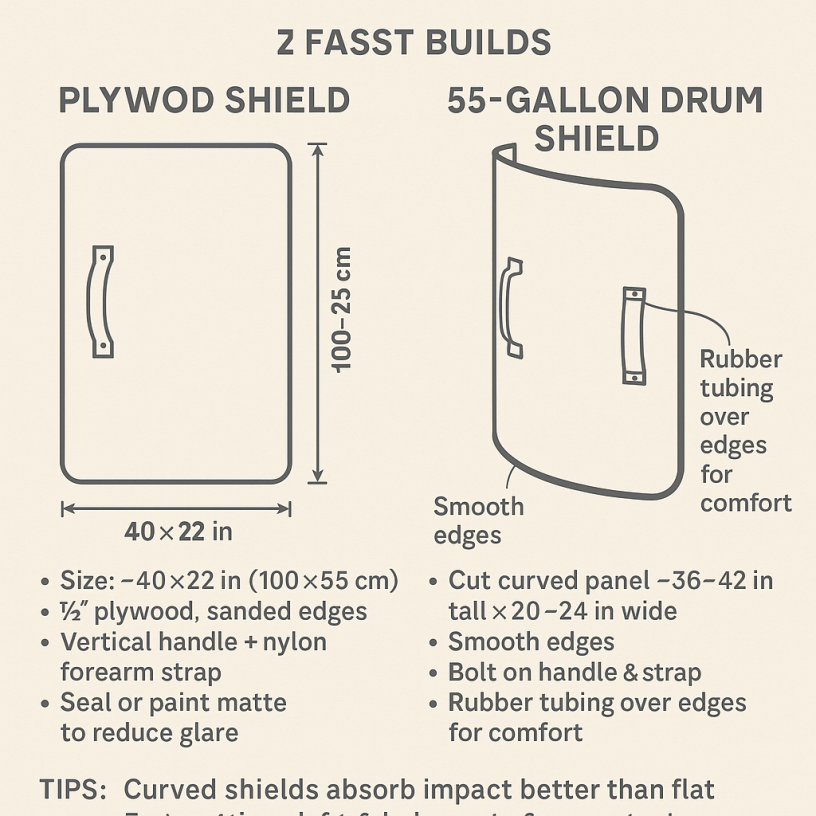
When the state brings shields and body armor to a protest, what are they expecting? Compliance. Intimidation. Retreat. But sometimes, resistance looks like courage made out of scrap metal. Here’s how to build your own riot shields — not for war, but for defense, dignity, and survival — using a standard 55-gallon steel drum.
🧯 Safety First, Always
Before you cut a steel drum, know what it held. Many drums once stored flammable or toxic substances.
- Triple rinse the inside with detergent.
- If it held fuel or chemicals, fill it with dry ice and let it vent before cutting — otherwise, one spark can kill you.
- Leave it open and upside down to vent for several hours. Do not skip this step.
Use personal protection:
- Thick gloves
- Goggles or a full face shield
- Long sleeves
- Proper ventilation
This isn’t a hobby project. It’s field prep.
✂️ The Cut Plan
Goal: 4 curved riot shields per drum.
Material: Standard 55-gallon drum (about 35” tall, 23” diameter, 18–20 gauge steel).
Step 1: Remove the Ends
- Use an angle grinder to carefully cut off both the top and bottom.
- Set the round lids aside — they can be turned into smaller “buckler” shields or repurposed as signal gongs, mask holders, or armor accents.
Step 2: Slice the Side
- Make a single vertical cut down the side to open the cylinder.
- Use clamps, mallets, and pressure to flatten the curved metal into a sheet. If needed, heat gently with a torch to soften it. (Not required, but helps.)
Step 3: Mark and Cut Shield Panels
- You’ll be cutting 4 shield panels from the flattened drum.
- Use a cardboard template: about 17” wide x 34” tall with a rounded top for deflection.
- Cut using a grinder or heavy-duty metal shears.
- Deburr the edges with a metal file or flap disc to prevent injury.
🛡️ Building the Shield
Use the drum’s natural curve. It adds structural strength. Straight panels are weak. Keep the arc.
Add Handles:
- Drill 4 holes in each panel: 2 for the hand grip, 2 for the forearm strap.
- Use bolts, rivets, or screws to attach:
- Straps from backpacks, belts, or salvaged webbing
- Wooden or PVC grips
- Padded forearm rests if possible
Test fit it. It should ride your non-dominant arm snugly, allowing the other hand free.
Optional Upgrades:
- Paint matte black, green, or grey to reduce visibility.
- Add rubber edging (from car doors or old hose) to protect from cuts.
- Bolt scrap plastic or polycarbonate over the front for layered protection.
- Line the inside with yoga mat foam to absorb hits.
🚨 What It Can and Can’t Do
This is not bulletproof. It’s not even shrapnel-proof. But it will deflect:
- Rubber bullets
- Beanbags
- Baton strikes
- Tear gas canisters
- Pepper balls
- Flashbang debris
It’s also psychological. A line of homemade shields shows you’re not afraid. That breaks their narrative.
📢 Final Thoughts
These shields are tools of dignity. They say: We don’t back down. We don’t go quietly. We come prepared. In every movement, there are those who take the hit so others don’t have to. These shields are for them.
Build. Train. Defend.
We’re not asking permission to resist fascism. We’re doing it.
 Occupy 2.5