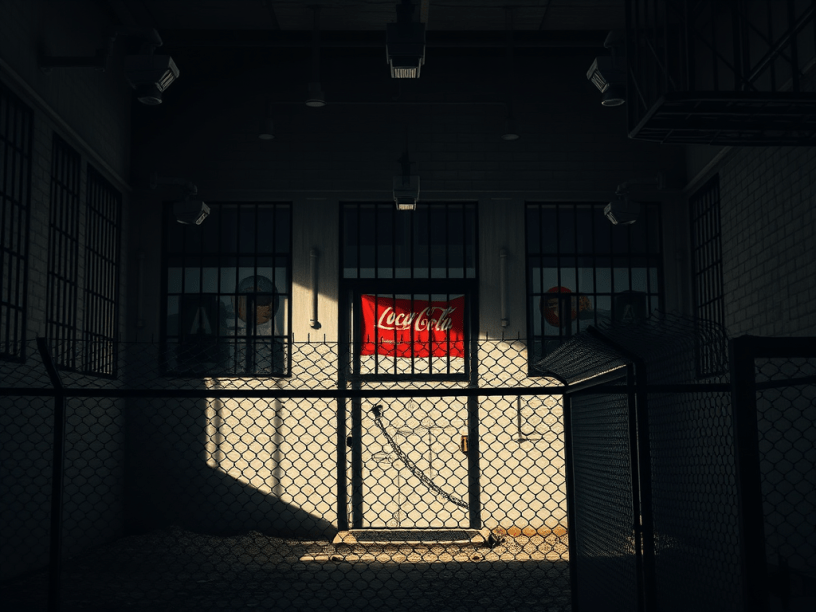
🛑 Let’s Be Honest: This Isn’t “Tough on Crime”—It’s Criminal
If you strip away the buzzwords, what are we really doing? When you don’t rehabilitate people, when you do keep them locked up for as long as possible, and when you exploit their labor for pennies on the dollar—you’re not fighting crime. You’re running it.
We’ve already seen this in places like Iowa, where incarcerated people are made to work under conditions that would make any labor rights advocate scream. And for what? To feed a system that profits off punishment, not progress.
Calling that “tough on crime” is a lie dressed in a suit. It’s not safety. It’s not justice. It’s modern-day slavery. It’s cruelty masquerading as policy.
So here’s the question we all need to start asking—What the hell has the leadership of the United States been doing to its own people since the early 1990s?
Because this?
This is unconscionable.
Clinton: Expanded Private Prisons—Justice for Profit 🏢🔒 #Triangulation
In the 1990s, the prison system in America changed in a big way. One major reason was President Bill Clinton. During his time in office, private prisons grew fast. These are prisons run by companies, not the government. They make money when more people go to jail. This idea is called “justice for profit,” and it became a big problem.
Clinton signed laws that made sentences longer and harsher. The 1994 Crime Bill, also known as the Violent Crime Control and Law Enforcement Act, gave states money to build more prisons1. It also increased the number of crimes that sent people to jail. As a result, the number of people in prison rose fast.
Private prison companies saw this as a chance to grow. They promised to save the government money. But in truth, they often cut corners. People in these prisons lived in worse conditions. There were fewer programs to help inmates get better. And the companies made more profit the longer people stayed locked up.
One of the largest private prison companies is CoreCivic, formerly called Corrections Corporation of America. Another is GEO Group. Both of these companies made lots of money during and after Clinton’s time in office2. In fact, CoreCivic admitted in 2016 that their growth started with the 1994 Crime Bill3.
Many people went to prison for non-violent drug crimes. Clinton supported the war on drugs, which led to tough penalties for things like having small amounts of marijuana. Black and brown communities were hit hardest. More people of color were arrested and locked up. Families were torn apart. The system became more unfair4.
Even after leaving office, Clinton admitted that the crime bill made things worse. In 2015, he said the law had put “too many people in prison and for too long”5. But by then, private prisons were a big part of the system.
The problem with private prisons is that they have a reason to keep people locked up. That means less focus on helping people change and more focus on making money. This is why so many people say that justice should not be for profit.
Clinton’s policies helped private prisons grow. His “tough on crime” approach seemed popular at the time. But the long-term effects were harmful. Today, many are working to undo the damage. Some states are cutting ties with private prisons. Others are trying to reduce prison populations.
Still, the legacy of Clinton’s policies remains. Many of the problems in the justice system today started during his presidency. It is important to look at the past so we can make better choices for the future.
#Triangulation means making choices that try to please everyone. Clinton used it a lot. But in this case, trying to look tough on crime pleased corporations and hurt communities. Justice is not a business. We should not let companies get rich off people’s suffering.
Footnotes
- Mauer, M. (1999). Race to Incarcerate. The New Press. ↩
- Eisen, L.-B. (2017). Inside Private Prisons: An American Dilemma in the Age of Mass Incarceration. Columbia University Press. ↩
- Corrections Corporation of America. (2016). Annual Report 2016. https://www.corecivic.com/investors ↩
- Alexander, M. (2010). The New Jim Crow: Mass Incarceration in the Age of Colorblindness. The New Press. ↩
- Clinton, B. (2015). Remarks at the NAACP Annual Convention. https://www.c-span.org/video/?327321-1/president-clinton-remarks-naacp-convention ↩
 Occupy 2.5