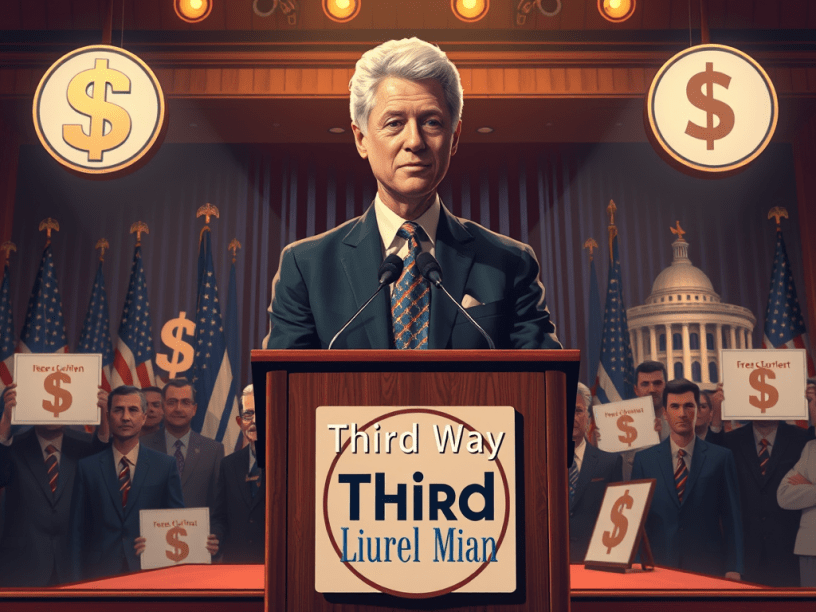
When Bill Clinton entered the White House in 1993, he promised a new kind of politics—one that moved beyond the stale ideological battles of the Cold War. This was his “Third Way,” a centrist framework he championed as a bold synthesis of liberal values and conservative economics. But beneath the branding, Clinton’s Third Way was not a revolutionary middle ground. It was a repackaged version of the same market-driven ideology promoted by Ronald Reagan and Margaret Thatcher. In reality, Clinton adopted the language of progress while advancing the policies of neoliberalism. In doing so, he alienated the progressive base of the Democratic Party and failed to earn lasting favor from the Republican right.
What Is Neoliberalism?
Neoliberalism is an economic and political philosophy that advocates for free markets, deregulation, privatization, austerity, and limited government intervention in the economy—except when it serves corporate interests. It assumes that private enterprise, competition, and individual responsibility are inherently more efficient than collective or state action.
Under neoliberalism, the role of government shrinks, while corporate power expands. Social services are framed not as rights but as burdens, and economic inequality is tolerated—even justified—on the basis of merit and market value. First implemented at scale by Margaret Thatcher in the UK and Ronald Reagan in the U.S., neoliberalism reshaped the Western political landscape from the 1980s onward. Clinton, rather than resist this tide, embraced it.
Clinton’s “Third Way” as Neoliberal Continuity
Clinton presented his “Third Way” as a post-partisan solution—an end to the old left-right divide. But the policies he enacted were clear continuations of Reaganite economics. His administration pursued financial deregulation, embraced welfare reform, passed free trade agreements like NAFTA, and enacted punitive criminal justice laws that disproportionately affected communities of color.
One of the most defining acts of Clinton’s presidency was his support for the 1996 Personal Responsibility and Work Opportunity Reconciliation Act, which ended the federal guarantee of cash assistance and imposed harsh work requirements on welfare recipients. Clinton called it “the end of welfare as we know it”[1], but in practice, it was a surrender to Reagan-era rhetoric that demonized the poor and marginalized.
Similarly, the Gramm-Leach-Bliley Act of 1999, which Clinton signed into law, repealed the Glass-Steagall Act’s separation of commercial and investment banking. This deregulation opened the door to high-risk speculation and directly contributed to the 2008 financial crisis[2].
Playing Both Sides: Clinton’s Political Calculus
Clinton’s triangulation strategy aimed to appeal to both sides of the aisle. He attempted to satisfy progressive Democrats with rhetorical nods to justice, inclusion, and opportunity, while simultaneously courting neo-conservatives like Newt Gingrich by adopting their fiscal and criminal justice agendas. Clinton didn’t just reach across the aisle—he brought the right wing into his own house.
But this strategy was doomed from the start. The Republican Party, under Gingrich’s leadership, pursued a scorched-earth strategy aimed at delegitimizing Democratic governance. The infamous 1994 “Contract with America” outlined a hardline conservative agenda focused on tax cuts, deregulation, and welfare reduction. Clinton attempted to outflank the GOP by adopting pieces of their platform, but this only emboldened his opponents. Rather than creating unity, Clinton’s concessions were seen by the right as admissions of defeat—and invitations to push harder.
Progressive Betrayal and Ideological Erosion
While Clinton’s strategy failed to win over the Republican establishment, it decisively fractured the Democratic coalition. Labor unions, civil rights activists, and social justice advocates—once core pillars of the party—found themselves abandoned. The party’s messaging shifted from solidarity and systemic change to individual responsibility and market incentives.
Even health care reform, a cornerstone of Clinton’s 1992 campaign, was gutted and left for dead. Faced with resistance from corporate interests and Republican obstruction, the Clinton administration quickly backed away from the fight. Progressive Democrats were left with little to show for their support.
By embracing neoliberal logic, Clinton undermined the moral authority of the Democratic Party to speak on behalf of workers, the poor, and the disenfranchised. He paved the way for two decades of bipartisan consensus around austerity, corporate tax cuts, and “personal responsibility”—a consensus that abandoned millions of Americans to economic precarity.
A Lasting Legacy of Neoliberal Dominance
Clinton’s presidency left a profound legacy—not of balance, but of ideological capitulation. His Third Way politics rebranded neoliberalism as common sense, blurring the distinctions between left and right. By the time George W. Bush took office, the groundwork had been laid for further privatization, deregulation, and militarism.
Even Barack Obama, despite his progressive appeal, governed largely within the framework Clinton helped create. Wall Street remained dominant, inequality worsened, and social programs remained underfunded and politically toxic.
The progressive revival we see today—with voices like Bernie Sanders, Alexandria Ocasio-Cortez, and grassroots movements like the Fight for $15—emerged not in spite of Clintonism but as a direct response to it. They represent a rejection of the idea that centrism and market worship are the only paths to victory.
Conclusion: Compromise or Capitulation? 🎭
Clinton’s “Third Way” was never truly a third way—it was the same neoliberal road in a different costume. By trying to triangulate between corporate conservatives and justice-oriented progressives, Clinton alienated his base and empowered his opposition. His administration diluted progressive goals and sold the soul of the Democratic Party to the free market.
In the end, compromise isn’t noble when it abandons principle. Clinton’s legacy is a cautionary tale: appeasement of the right doesn’t lead to unity—it leads to surrender. 🧩
Footnotes:
[1] Clinton, B. (1996, August 22). Remarks on welfare reform legislation. The American Presidency Project. https://www.presidency.ucsb.edu/documents/remarks-welfare-reform-legislation
[2] Stiglitz, J. E. (2010). Freefall: America, free markets, and the sinking of the world economy. New York: W. W. Norton & Company.
 Occupy 2.5