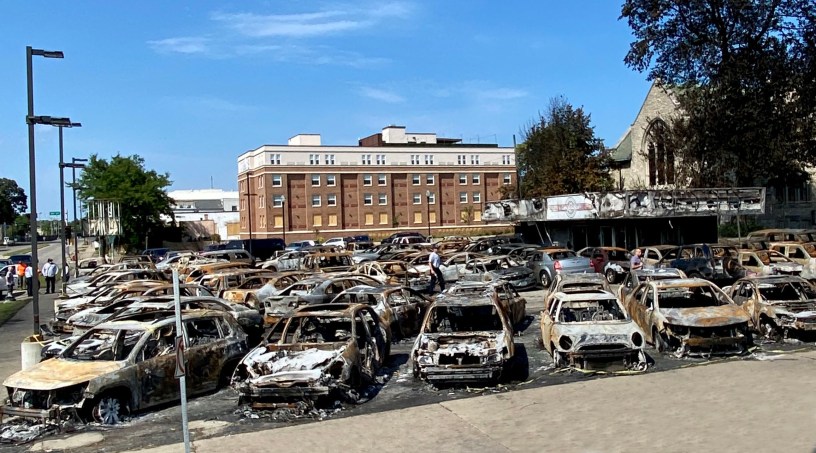
On August 25, 2020, chaos erupted in Kenosha, Wisconsin, as protests against police brutality turned into a violent riot, leading to extensive damage and loss of life. The individual at the center of the ensuing controversy, known as the “Kenosha Killer,” arrived from Antioch, Illinois, armed with an AR-15-style rifle, claiming he intended to serve as a medic and protect local businesses from property damage amidst the unrest. He justified his presence in the city by stating, “People are getting injured, and our job is to protect this business… If there’s somebody hurt, I’m running into harm’s way.”
The night spiraled into chaos, with widespread destruction reported throughout the city. Multiple businesses were set ablaze, leaving behind scenes of devastation. The damage was estimated in the millions, as both residential and commercial properties were significantly affected by riots that stemmed from anger over the police shooting of Jacob Blake, a Black man who became paralyzed after being shot seven times by officers.
Tragically, during this night of violence, the Kenosha Killer shot and killed two men: Joseph Rosenbaum and Anthony Huber, while also wounding Gaige Grosskreutz. Each of these men arrived at the protests for different reasons but shared a common goal: to advocate for justice and protect their community.
Joseph Rosenbaum, 36, had a complicated past marked by mental health struggles. Just days before the riots, he was discharged from a Milwaukee hospital after a suicide attempt, carrying personal items like a toothbrush and deodorant in a plastic bag on the night he confronted the Killer. Despite his troubled background, he appeared among the demonstrators seeking to voice their grievances regarding systemic injustices. Rosenbaum had a daughter and was known to have been striving to better himself before that fateful night. He was laid to rest in a ceremony that honored his life and struggles.
Anthony Huber, 26, was also at the protest, driven by a strong sense of advocacy for racial justice. Known as an avid skateboarder, Huber had recently celebrated his birthday just days before the violent confrontation. His girlfriend noted that he rushed to intervene during the chaotic moments with the intent to protect others. Huber had faced his challenges, including past stints in prison, but ultimately sought to channel his efforts into positive change. He was remembered for his bravery, and many consider him a hero for his attempt to intervene. Huber was laid to rest in a ceremony praised for highlighting his spirit and commitment to justice.
Gaige Grosskreutz, the only survivor from that tragic night, was wounded in the arm. A trained medic, he attended protests carrying medical supplies, intending to assist those injured. On the stand during the trial, Grosskreutz claimed he approached the Killer with his hands raised, believing it necessary to intervene. He endured several surgeries post-incident and filed a lawsuit against law enforcement for their alleged complicity in the violence that night. His life fundamentally changed due to his injuries, but he remains committed to advocacy for social issues.
The trial of the Kenosha Killer was held in Kenosha County Circuit Court, Wisconsin. The journey leading to the trial was marked by a rapid escalation of events following the shootings that occurred during protests in August 2020. Initially charged with multiple counts of homicide, the Killer’s legal defense was managed by a team of attorneys, including prominent figures in conservative legal circles. Financial support for his defense came from a significant outpouring of donations promoted through various conservative political channels and organizations. High-profile supporters, including notable conservative media personalities and business figures, contributed to raising over $2 million for his bail and legal fees. This funding allowed the Killer to secure a jury trial in accordance with Wisconsin law, where the stakes were high and public sentiment was deeply divided.
The trial of the Kenosha Killer became a focal point of national debate, with his lawyers successfully arguing that he acted in self-defense amidst threats to his safety. The prosecution struggled to establish their case, encountering difficulties presenting witnesses who sometimes contradicted their narrative. After extensive testimony and approximately 27 hours of jury deliberation, the Killer was acquitted on all counts—two counts of homicide and charges of recklessly endangering safety—signifying a major legal and social moment that resonated throughout the country.
As the Kenosha Killer transitioned into a contentious political figure, he resurfaced in the public eye by participating in various conservative events. He was celebrated among certain groups as a defender of gun rights, while many others mourned the message his acquittal sent about vigilante justice and systemic inequalities.
Through the lens of this case, society grapples with an unsettling reality: when violence occurs in defense of the state and its status quo, it often finds acceptance, even reverence. This is an outrage! There is no other way one can look at the complete exoneration of the Kenosha Killer. the state — his so called peers — called it justifiable. The prosecution botched the case. That is a given. It is admitted in the resources. The Killer of Kenosha walks free to become the darling of the Alt-Right.
The narratives surrounding these tragic events also illustrate, societal divisions, and the enduring legacy of those who lost their lives fighting for change. May Joseph Rosenbaum, and Anthony Huber rest in power, and Gaige Grosskreutz find a fulfilled life beyond Kenosha, Wisconsin on August 25, 2020.
Sources:
- Wikipedia contributors. “Kenosha unrest shooting.” Wikipedia, The Free Encyclopedia. Wikipedia, The Free Encyclopedia, 15 Feb. 2025. Web. 6 Mar. 2025. https://en.wikipedia.org/w/index.php?title=Kenosha_unrest_shooting&oldid=1275831405.
- Romo, Vanessa, and Sharon Pruitt-Young. “What we know about the 3 men who were shot by Kyle Rittenhouse.” NPR, 20 Nov. 2021. Web. 6 Mar. 2025. https://www.bbc.com/news/world-us-canada-53934109.
- Hayne, Jordan, with wires. “Kyle Rittenhouse found not guilty of murder over shootings at Black Lives Matter protest in Kenosha.” ABC News, 19 Nov. 2021. Web. 6 Mar. 2025. https://www.abc.net.au/news/2021-11-20/kyle-rittenhouse-trial-protest-shooting-kenosha/100603512.
- Layne, Nathan. “Kyle Rittenhouse found not guilty of all charges in Wisconsin murder trial.” Reuters, 20 Nov. 2021. Web. 6 Mar. 2025. https://www.reuters.com/world/us/jury-rittenhouse-murder-trial-deliberate-fourth-day-2021-11-19/.
- Maxouris, Christina. “Kyle Rittenhouse was acquitted on all charges. Here’s what we know about the 3 men he shot.” CNN, 1 Nov. 2021. Web. 6 Mar. 2025. https://www.cnn.com/2021/11/01/us/kyle-rittenhouse-shooting-victims-trial/index.html.
- Sullivan, Becky. “Kyle Rittenhouse is acquitted of all charges in the trial over killing 2 in Kenosha.” NPR, 19 Nov. 2021. Web. 6 Mar. 2025. https://www.npr.org/2021/11/19/1057288807/kyle-rittenhouse-acquitted-all-charges-verdict.
- NBC Chicago Staff. “Shootings, Arrest, Trial and More: The Kyle Rittenhouse Story Explained.” NBC Chicago, 15 Nov. 2021. Web. 6 Mar. 2025. https://www.nbcchicago.com/news/local/shootings-arrest-trial-and-more-the-kyle-rittenhouse-story-explained/2684756/.
- Reid, Claire. “Kyle Rittenhouse might appear at the RNC. Who is he, and what is he doing in 2024?” Milwaukee Journal Sentinel, 10 July 2024. Web. 6 Mar. 2025. https://www.jsonline.com/story/news/politics/2024/07/10/who-is-kyle-rittenhouse-kenosha-shooter-conservative-gun-advocate-2024-update/74326320007/.
 Occupy 2.5