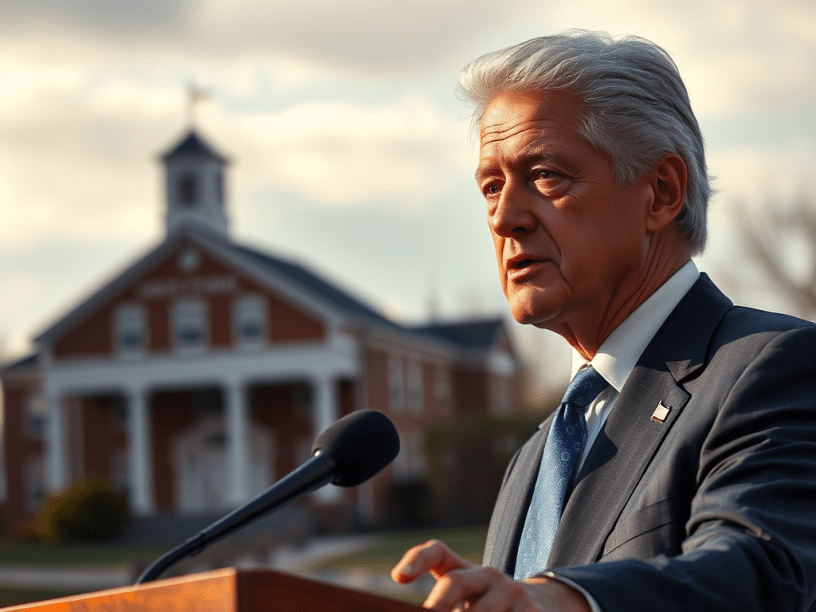
Clinton: Charter Schools Diverted Public Funds with Weak Results
Introduction
In recent years, the charter school movement has become a controversial topic in American education reform. While proponents argue that charter schools provide innovative educational options and increase competition, critics, including former President Bill Clinton, highlight that these institutions often divert public funds away from traditional public schools and deliver subpar academic results. This news article examines Clinton’s stance on charter schools, the implications for education funding, and the ongoing debate surrounding educational equity.
What Happened?
Bill Clinton, during recent discussions on education policy, raised concerns about the effectiveness of charter schools and their impact on public school funding. He argued that while the charter school movement began with noble intentions, the reality has often fallen short. Clinton pointed out that many charter schools lack accountability and frequently produce disappointing educational outcomes. He stated, “We have got to ask ourselves if we are using public money wisely” (Clinton, 2023).
Charter schools, publicly funded but independently run, operate under a different set of regulations than traditional public schools. They were initially designed to provide innovative educational options and to foster competition that would, ideally, enhance the quality of education for all students. However, evidence has emerged suggesting that many charter schools do not perform significantly better than their traditional public counterparts.
Who Is Affected?
The consequences of diverting public funds to charter schools primarily affect students attending traditional public schools, their families, and teachers. When public funds are reallocated to charter schools, it often leads to budget cuts in district schools, which can result in larger class sizes, reduced program offerings, and less support for educators and students.
Students in underserved communities, who may rely heavily on public schools, have been particularly disadvantaged by this trend. Access to quality education is delayed for many young learners, further exacerbating existing educational inequities. According to a report by the National Assessment of Educational Progress, statistically, charter schools have not consistently outperformed public schools, especially in terms of reading and math proficiency (National Assessment of Educational Progress, 2021).
Where Did It Happen?
The issues related to charter schools and public funding are evident across the United States, with notable concentrations in urban areas. Cities like Detroit, Chicago, and New Orleans have experienced significant growth in charter school enrollment. However, this shift has sparked fierce debates about resource allocation and educational equity within those communities. Critics contend that the expansion of charter schools contributes to the fragmentation of the public education system, further dividing resources that could support all students.
When Did It Happen?
The charter school movement gained momentum in the early 1990s, with the first charter school opening in Minnesota in 1992. Over time, the concept spread across the country, driven by bipartisan support. During Clinton’s presidency in the 1990s, the administration actively supported charter school initiatives as part of broader education reform efforts. However, as the charter school sector matured, the consequences of limited accountability and inconsistent results became clearer, prompting Clinton to reassess his earlier support.
In 2020, as the movement continued to expand, Clinton publicly expressed his concerns, pointing to data that showed many charter schools failing to improve educational outcomes for students while diverting essential funding from public schools. The growing awareness of these issues has intensified discussions about how best to address the shortcomings of both charter schools and traditional public school systems.
Why Did It Happen?
The rise of charter schools can be attributed to several factors, including the desire for educational reform, parental choice, and accountability. However, the initial intentions have not always translated into effective educational practices. Critics argue that insufficient oversight and regulation have allowed some charter schools to operate without a clear focus on student achievement. Moreover, the focus on competition has led some schools to prioritize enrollment numbers over educational quality.
The push for charter schools also reflects broader trends in U.S. education, such as the emphasis on market-based solutions to public services. For many advocates, the idea was that introducing competition would lead to improvements across the board. However, the ongoing debate underscores the complexity of the issues involved, as not all charter schools effectively serve their students.
Accountability and Responsibility
Clinton’s recent comments draw attention to the accountability measures in place for charter schools and the implications of their operations for the education system as a whole. He has called for a reevaluation of how public funds are used in the education sector, emphasizing the need for greater transparency and accountability among charter schools.
While charter schools were intended to increase choices for families, the lack of standardized oversight has led to varying results across different schools. Many argue that educational outcomes must be prioritized over profit motives and enrollment numbers. Clinton’s advocacy for a more responsible approach reflects a growing consensus that decisions affecting public school funding should be guided by a commitment to student achievement, equity, and community investment.
The Path Forward
As the debate over charter schools and public education funding continues, it is crucial to consider the lessons learned from the experience to date. Policymakers must recognize the importance of supporting all students, regardless of the school they
 Occupy 2.5