Caleb Renner fancied himself a high school Kolchak.
Armed with his digital recorder, a spiral-bound notebook, and a habit of lurking in hallways after hours, he wrote exposés for the Sunndale Sentinel—covering cafeteria food scandals, budget cuts, and once, the great mold crisis in the boys’ locker room.
But ghosts? Demons? Doppelgängers?
“Nah,” he’d tell his readers. “Leave that stuff to reruns on late-night TV.”
Still, when the drama club president, Shayla Brooks, came to him with panic in her eyes and said, “Someone’s been pretending to be me—and doing a better job,” Caleb had to check it out.
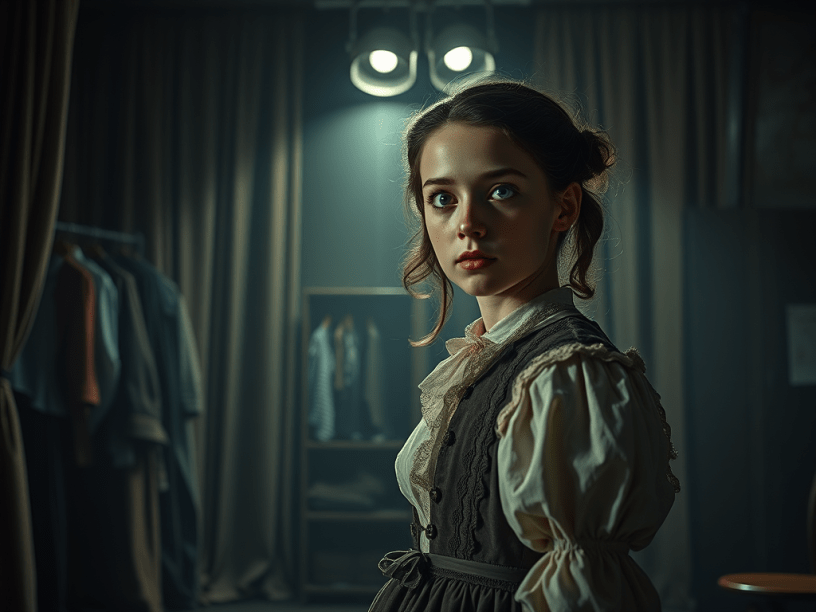
The drama room was tucked behind the old gym, a retrofitted space with threadbare curtains and a closet full of dusty costumes that smelled like lavender and mothballs. Shayla swore her double had been seen rehearsing after hours—by teachers, janitors, even her own cast.
“They said I nailed the monologue from Macbeth, but I wasn’t even there,” she whispered.
Caleb nodded, skeptical but curious. “Mind if I stay late and see for myself?”
That night, as the stage lights cast long shadows on the scuffed wooden floor, Caleb sat in the darkened tech booth with a thermos of coffee and his trusty notebook. Hours passed. Nothing but creaks, groans, and the occasional mouse.
Then, precisely at 11:11 PM, the stage lights flickered on.
A girl stepped into the spotlight. Shayla.
She moved with eerie precision—confident, regal, tragic—as she launched into a Shakespearean soliloquy that chilled Caleb’s blood. Her voice was smooth, but not quite right. There was something hollow in it. Echoing. Like a performance without a soul.
When she finished, she bowed to an empty room.
And then, she looked directly at Caleb.
He ducked, heart racing. By the time he peeked out again, she was gone.
The next day, Caleb interviewed the real Shayla in the courtyard. “It’s a glamour,” she said, flipping through a dusty old stagecraft textbook. “We just started covering illusions in class—how theater used to use mirrors and lighting tricks to create ‘ghosts’ onstage. Maybe someone took it too far.”
That was the hook Caleb needed. “School saves the day,” he muttered, half-smirking. That afternoon, he hit the library and dug into stage illusion history, uncovering a technique known as Pepper’s Ghost—a 19th-century trick using angled glass and special lighting to create spectral figures.
He returned that night with a plan.
This time, Shayla joined him. She brought the big mirror from the dressing room and set it at a calculated angle facing the stage. Caleb adjusted a spotlight to bounce off it, just right. Then they waited.
At 11:11, the lights surged. The doppelgänger emerged again, a perfect copy of Shayla—except for her eyes. They were ink-black and empty.
“She’s copying you,” Caleb whispered, scribbling notes. “Feeding on your performances.”
“She’s not me,” Shayla whispered back. “She’s what I pretend to be.”
The double began another monologue. Caleb, thinking fast, aimed a second light at the mirror, amplifying the beam. The illusion wobbled. The double paused mid-line, her hands twitching like broken marionette strings.
“You have no audience,” Shayla shouted, stepping onto the stage. “You’re a shadow of a role—not the actor.”
The doppelgänger hissed, cracked down the center like glass, and shattered into motes of light. The mirror fogged over, then cleared.
Silence.
Caleb checked his recorder. Static. Of course.
But the next day, Shayla’s real performance brought the house down—and no one mentioned her phantom twin again.
Caleb published a front-page article: “Drama Club Spooked by Stagecraft Mystery.” Tongue firmly in cheek, he credited optical illusions and overworked actors for the sightings.
But in his private notes, he scribbled a single line:
There’s more to this school than meets the eye.
And maybe—just maybe—he didn’t want it any other way.
 Occupy 2.5