Occupy25.com — Fictional Story
I was tightening a bolt on the air recycler when Mike spoke up.
“Comrade Manuel,” he said in that too-cheerful tone he always used when bringing bad news, “probability of victory against Authority if they already own all levers of state power: forty to sixty percent within one Earth year.”
I swore, good and loud, enough to make the pipe echo.
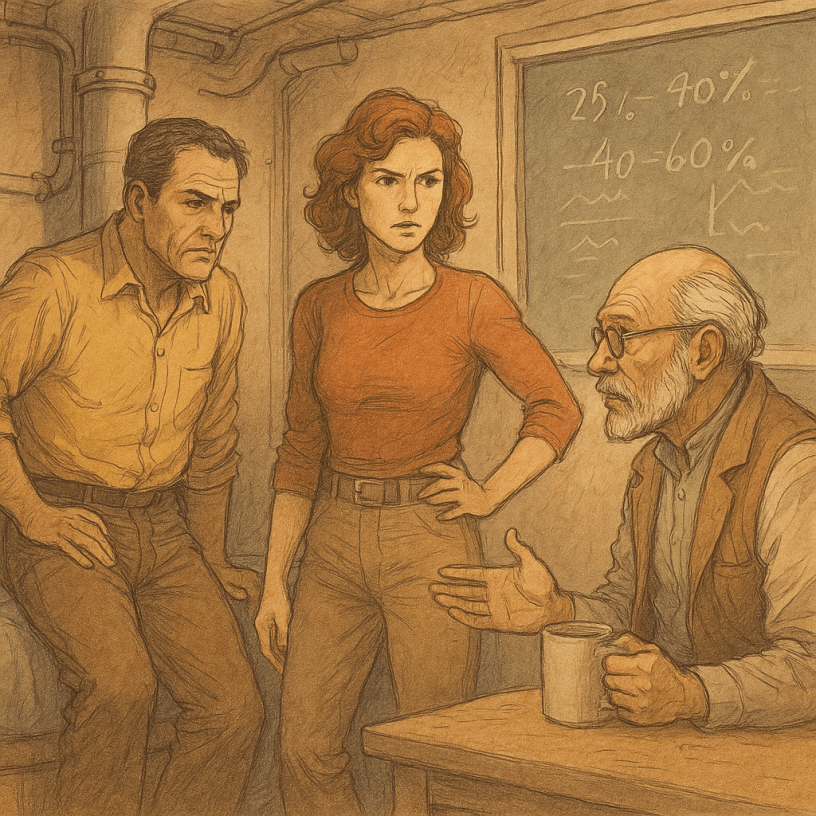
Wyoh glanced up from her notes, hair falling loose. She’d been sketching maps of America, not Luna. Places she’d marched, cities she knew. “That’s if the good guys even hold together that long, Mike. You didn’t add that part.”
“Correction accepted,” Mike said. He didn’t take offense. Machines don’t. Sometimes I envied him.
Professor cleared his throat. He’d been hunched in the corner, chalk squeaking across the bulkhead we used as a chalkboard. “We must understand, my friends, this is no ordinary rebellion. Trump sits in Washington already. The White House itself is in enemy hands. The forces of law are turned to unlawful ends. That complicates the arithmetic.”
Complicates—hell, it damn near made it impossible.
I remembered Authority on Luna, when they rationed our air and charged us for the privilege of breathing. We’d thought they were invincible, too. But we’d had Mike, and each other, and the will not to crawl. Maybe Earthside comrades had the same.
Wyoh paced, boots clanging against deck. “So what happens, Professor? Tell it straight, no equations.”
He smiled sadly. “It falls to the provinces. The states, the cities. Governors who refuse orders. Mayors who will not let their police become fascist enforcers. The heart of the economy lies there—seventy percent of it in blue cities. Without them, Trump cannot govern. So resistance must spring from those places. But—”
“But they’ll be blockaded,” I said. “Seen it before. Authority cut Luna’s air. On Earth it’ll be food, fuel, medicine. They’ll starve out the cities if they can.”
Wyoh nodded grim. “Then the first task is holding the corridors. Roads, rails, ports. Keep people fed and the lights on. Fail there and morale breaks before first winter.”
Mike hummed. “Probability of early urban collapse if corridors closed: high. Recommend rapid counter-blockade operations.”
“Plain talk, Mike,” I told him.
“Plain talk: break the sieges or you lose.”
Silence then, broken only by hiss of recyclers. Professor scribbled more lines, numbers that looked like doom. Wyoh stared at nothing, jaw set.
I thought of ordinary folks—shop clerks, nurses, students—suddenly pressed into choices they never wanted. Would they stand? Or duck heads and hope storm passed?
Mike broke silence. “Comrade Manuel, do you want projected timeline?”
“Give it.”
“Day one to seven: Trump invokes emergency powers. Loyalist states comply. Blue states declare noncompliance. Resistance fragmented. Odds of survival as organized bloc: five to ten percent. One month: urban resistance coordinates, corridors contested. Odds: twenty-five percent. Three to six months: clear lines, civil war cold and hot. Odds: fifty percent survival. One year: probability of restoring democracy: forty to sixty percent, contingent on defections in military ranks and maintenance of supply lines.”
Numbers hung in stale air like ice.
Wyoh spoke first. “So it’s coin-flip.”
“Correct,” said Mike.
Professor put down chalk, rubbed eyes. “Yet history is filled with coin-flips. Tyrants appear unassailable, until they are not. What matters is will. Will to resist. Will to act. Will to survive.”
I remembered how we’d once thrown rocks at Authority guards on Luna and called it revolution. Remembered how Mike had whispered probabilities then, too. Thirty percent. Forty. Coin-flips. Yet here we were, alive.
I looked at Wyoh, at Professor, at the speaker grille that was Mike’s voice. “Coin-flip’s better than nothing. And I never did like Authority.”
Neither did they.
Narrator’s Note:
In fiction or in life, when government itself turns tyrant, odds get ugly. But coin-flips have a way of landing on resistance when people refuse to bow.
Author’s Note:
This dialogue is fiction, inspired by Robert Heinlein’s The Moon Is a Harsh Mistress. Manny, Wyoh, the Professor, and Mike are characters borrowed from that world to explain ours. The numbers Mike gives are not inventions—they’re drawn from real analysis of U.S. demographics, economics, and security studies. The story is meant as satire and allegory, but the danger is not imaginary. In 2025, the odds of resisting authoritarian capture may feel like a coin-flip. That doesn’t mean the coin can’t land our way—if enough of us are willing to stand, organize, and refuse to bow.
More resources: https://endfascism.xyz
 Occupy 2.5