September 25, 2025
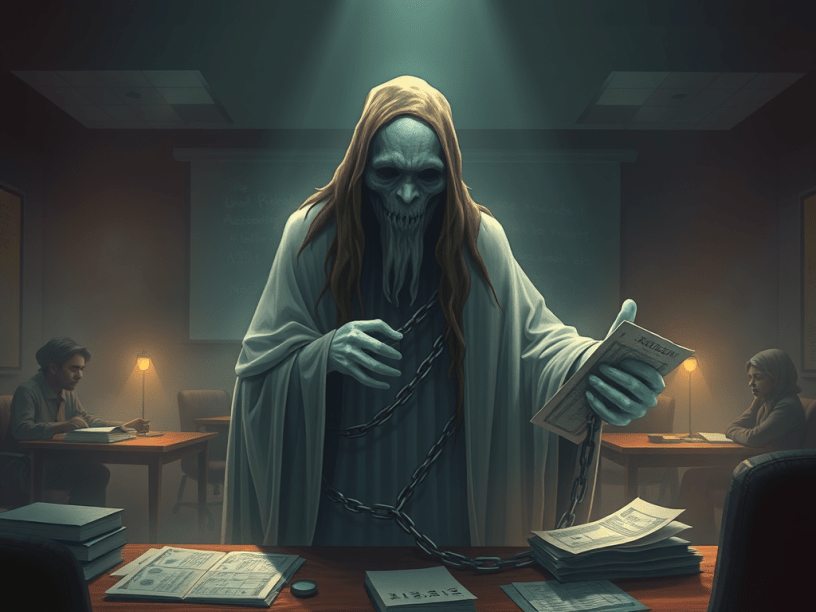
Tonight, a public high school economics class. The lesson: capitalism. The guest lecturer: a long-dead bookkeeper with an eternity of regrets. His chains are forged from interest rates and unpaid wages. The syllabus? Ethics—final exam pending.
Three months to Christmas, and Mr. Bauer’s third-period economics class at North Hollow High had finally reached the dreaded chapter: “Global Capitalism and You.” The fluorescent lights buzzed overhead. Students slouched behind aging textbooks and half-dead Chromebooks, half-listening while Bauer droned on about supply chains, profit margins, and offshore labor. It was the sort of day where time dragged like a broken shopping cart—until the power flickered.
Every screen went black. The lights cut out with a pop. Then came the cold. Not the kind that sneaks in from a cracked window—but something ancient and creeping, as if the room itself had inhaled a breath that never left.
“Stay calm,” Bauer said, his voice a notch higher than usual.
The overhead projector, which hadn’t worked in years, sparked to life. Static danced on the screen, then resolved into the hazy image of a man wrapped in chains. Heavy ledgers dangled from his arms like manacles. Account books, balance sheets, rusted keys, even a mortgage or two, clinked and scraped across the floor.
“Good afternoon,” the figure rasped. “I am Jacob Marley. Perhaps you’ve heard of my associate, Ebenezer Scrooge.”
Gasps rippled through the class. A few students laughed nervously. But Marley’s eyes—dead and glowing—held them.
“I come not to frighten, but to warn,” he said. “You live in an age of illusions—a thousand screens promising wealth without work, freedom without consequence. But economics, my dear children, is not a game of numbers. It is the ledger of your soul.”
The projector dimmed. The walls of the classroom dissolved like fog. And suddenly, they were somewhere else.
The first vision: a factory floor in Dhaka, Bangladesh. Children barely older than the students hunched over sewing machines, their fingers raw, their backs bent like reeds. A corporate logo—familiar, bright, and cheerful—hung over the workstation.
“These are your Christmas sweaters,” Marley intoned. “Designed in boardrooms, produced in sweatshops. Your joy. Their burden.”
The scene shifted. A boardroom high above Manhattan. A CEO sipped scotch while skimming through employee termination reports. Automation had saved the company millions, and the stock had surged. The CEO smiled, nodded, and approved the layoffs.
“This is efficiency,” Marley whispered, “but is it ethical? The machine thrives, but the community bleeds.”
The students were quiet now. Even Bauer said nothing.
Next came the medieval past: a village after the Black Death. Peasants now demanded wages. Lords, once secure in their inherited power, scrambled to retain workers. Marley explained, almost gently, how devastation reshaped the feudal economy—and birthed the wage labor system they now took for granted.
“It was death,” Marley said, “that forced fairness into the hands of the elite.”
Then, the room filled with the clamor of early industrial Britain. Smoke choked the sky. Children worked by candlelight in coal mines. Men died young with dust in their lungs. But above it all, the ledgers kept growing—always in the green.
“Progress,” Marley sneered. “Built on bones.”
And then they stood inside a classroom—not unlike their own—circa 1983. A chalkboard read: “Reaganomics: The Trickledown Effect.” A teacher earnestly drew a pyramid, explaining how wealth at the top would eventually reach those at the bottom. Meanwhile, through the window, real wages for workers dropped, unions crumbled, and manufacturing jobs fled overseas.
“Still waiting for the trickle?” Marley asked. “The wealthy have umbrellas.”
The final vision was now. Their town. Their neighbors. A single mother working three part-time jobs to afford groceries. A retired machinist reapplying for work at sixty-seven because his pension vanished in a merger. A valedictorian—her scholarship revoked—filing online orders for minimum wage in a warehouse lit by motion sensors and despair.
“This,” Marley said, “is not inevitable. It is designed.”
The lights in the classroom surged back on. The projector popped and fizzled out. The students were back in their seats, pale and blinking. Bauer clutched his textbook like a life preserver.
Then, written in glowing letters across the whiteboard: Ethics before Profits. People before Profit.
Marley’s voice lingered in the air like old perfume. “Choose wisely. Or wear the chains I forged.”
The bell rang. No one moved.
It was a Christmas warning come three months early, delivered by the ghost of a man who had watched the world sell its soul one ledger entry at a time.
That day, Mr. Bauer assigned no homework. And every student in that room, at least for a while, thought differently about the price of the things they bought—and the value of the lives behind them.
The lesson is over. The chains have rattled. And somewhere between supply, demand, and the souls who got lost in between, the bell has tolled. Tomorrow’s markets may open, but not everyone gets to close their books.
 Occupy 2.5