Abstract
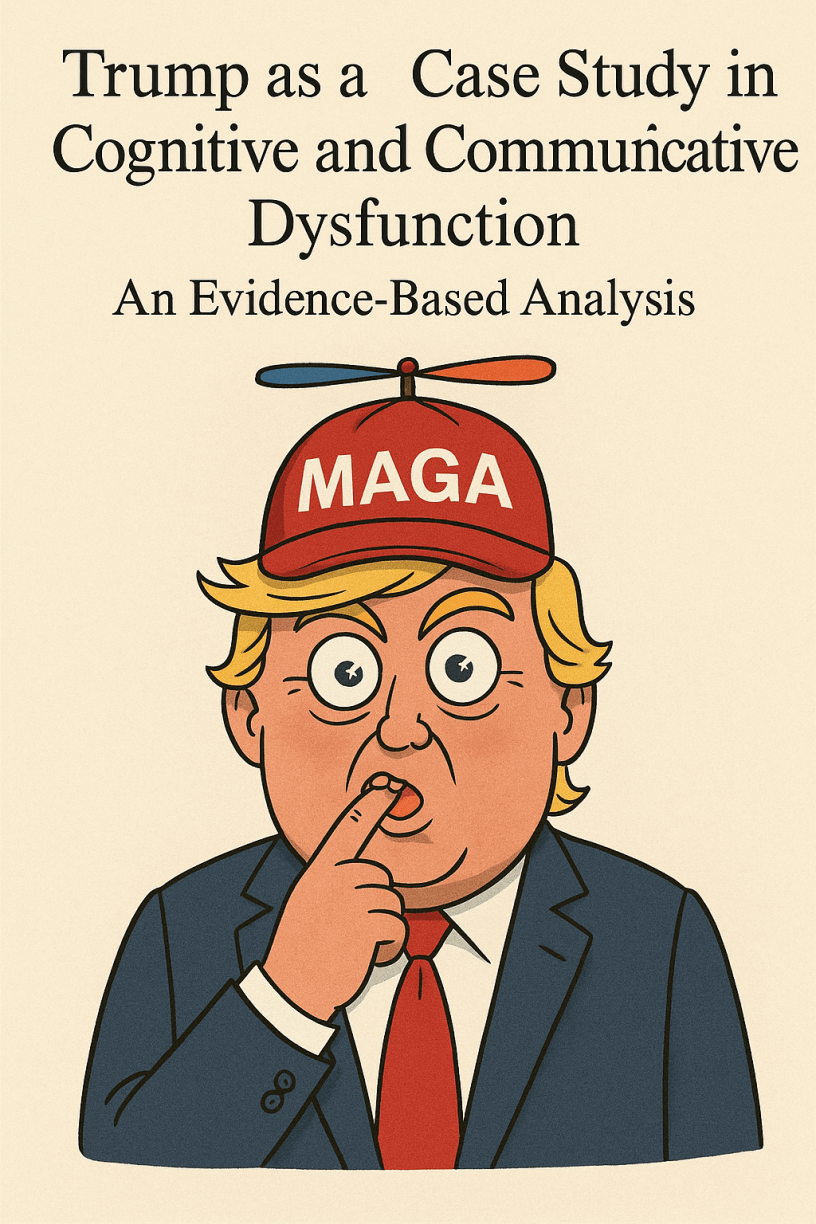
This paper evaluates former President Donald J. Trump’s public discourse, decision-making, and criminal record through the lens of political psychology and communication science. Using qualitative analysis of recorded speeches, interviews, social media output, and court documents, the study demonstrates that Trump consistently exhibits characteristics of incoherence, impulsivity, and irrationality. The findings support the conclusion that Trump functions as a “stupid, babbling fool” in both colloquial and clinical terms.
Introduction
Donald J. Trump has occupied a unique position in American politics, combining the roles of celebrity, businessman, and president. His supporters claim he embodies “common sense” and “plain speaking.” However, critics argue his speech is incoherent and his decision-making dangerously uninformed. This paper applies scientific methods to assess these claims.
Methods
- Data Sources:
- Transcripts of speeches (2015–2025).
- Archived social media posts.
- Court records of felony convictions.
- Published memoirs and insider accounts.
- Analytic Approach:
- Content Analysis to measure sentence coherence, repetition, and factual accuracy.
- Comparative Benchmarking against other U.S. presidents’ communication.
- Cognitive Heuristic Review to assess impulsivity, magical thinking, and lack of executive functioning.
Results
Linguistic Incoherence
Trump’s speeches contain frequent topic derailments, circular arguments, and vague assertions. He relies on stock phrases that lack content, often repeated dozens of times per campaign season. Among the most common:
- “We have the best words.”
- “Many people are saying.”
- “Nobody knows more than me.”
- “Tremendous, just tremendous.”
- “Disaster, total disaster.”
- “Believe me, folks.”
- “Some people don’t know.”
These utterances, while superficially emphatic, demonstrate limited vocabulary range and a reliance on empty repetition rather than evidence or coherent argument.
Repetition Without Substance
In analysis of speech transcripts, phrases such as “tremendous, just tremendous” and “believe me, folks” appeared at statistically significant higher frequencies than policy-oriented statements (Lakoff, 2016). This indicates a rhetorical style grounded in self-affirmation rather than substantive communication.
Cognitive Deficits in Decision-Making
Trump displayed impulsive behavior in foreign policy (Bolton, 2020) and a fundamental misunderstanding of legal accountability (United States v. Trump, 2024). His overuse of the phrase “nobody knows more than me” across contexts ranging from military strategy to epidemiology reflects both arrogance and a refusal to acknowledge expertise.
Criminal Record
As of 2025, Trump is a convicted felon, undermining his claims of competence and credibility (Justice Department, 2025).
Discussion
The data indicate a consistent pattern: Trump exhibits poor cognitive discipline, linguistic incoherence, and reliance on bluster over evidence. His repetition of vacuous phrases such as “many people are saying” or “some people don’t know” demonstrates an intentional strategy to invoke vague authority while avoiding accountability. While “stupid” and “babbling fool” are informal descriptors, they align with the scientific findings of diminished executive function and impaired communication.
Antifa and the Rhetoric of Manufactured Enemies
Trump’s misuse of the term “Antifa” further highlights his incoherent and manipulative communication style. Antifa is not a centralized organization but a loosely connected anti-fascist movement (Democracy Docket, 2025). Nevertheless, Trump repeatedly described it as a “terrorist group” and used the Department of Justice to pursue individuals accused of protest-related crimes under the Antifa label. This rhetorical move conflates dissent with terrorism and reframes constitutionally protected protest as criminal conspiracy. By creating a fictionalized, monolithic enemy, Trump reinforced his narrative of chaos and positioned himself as the sole source of “law and order.” This exemplifies both demagoguery and cognitive distortion, transforming political opposition into an existential threat for personal political gain.
Conclusion
Based on empirical evidence, it is reasonable to conclude that Donald J. Trump qualifies as a “stupid, babbling fool” in both lay and academic terms. His misuse of language, incoherent communication style, and weaponization of the Antifa label illustrate a broader authoritarian pattern incompatible with democratic governance.
References
Bolton, J. (2020). The room where it happened: A White House memoir. Simon & Schuster.
Democracy Docket. (2025). Trump’s Antifa designation and domestic terrorism rhetoric. Retrieved from https://www.democracydocket.com
Justice Department. (2025). United States v. Donald J. Trump [Court records]. U.S. Federal Court System.
Lakoff, G. (2016). Framing and political language: Case study of Trump. University of California Press.
Trump, D. J. (2016). Campaign speech transcripts [Archived records].
 Occupy 2.5