By an I.T. Professional, Now Committed
I write this not in the hopes of salvation, but as warning to any who might plumb the depths of cyberspace as recklessly as I have. For there are truths buried beneath our networks—unwholesome, gibbering truths—that predate not only the Internet but Man himself.
My name is Theodore Wren, and I was a senior analyst with Perigon Cybersecurity, a firm contracted to monitor and eliminate high-level malware threats on U.S. defense systems. By all accounts, I was at the apex of my field. I had personally disarmed the Ganymede Protocol worm in ’24 and reverse-engineered the Chinese Haruspex Virus before its payload could detonate in federal banking systems. But none of that prepared me for what I encountered in the Black Trace Incident.
It began with a pattern.
The attack vector presented as a polymorphic rootkit targeting obscure subsystems—nothing new. But it was the entropy signature that gave me pause. Instead of chaos, the code exhibited… intention. Not the cold, logical efficiency of human design, but a vile consistency, like some ancient chant encoded in binary. I found entire routines that performed no function, nested loops of madness calling themselves endlessly, mimicking the recursive chants of old. It was code meant not to do, but to be.
As I dove deeper into the code—dissecting packet captures and memory dumps—I began to see symbols. Not ASCII, not hexadecimal, but something older. Glyphs embedded in the shifting memory maps, only visible in certain hex viewers at specific zoom levels. They seemed to writhe when observed too long. My colleagues dismissed it as pareidolia.
Then the hallucinations began.
My workstation—an isolated air-gapped rig—would hum at night, a low-frequency throb that matched no internal fan or drive. I’d glimpse pulsing lights on the black screen, flickers like phosphorescent eyes. One night, while tracing the packet origin through a spoofed Romanian node, the VPN trace looped back to a location that should not have existed: 0.0.0.0—non-addressable, non-routable. And yet there was traffic.
I connected.
What opened was not a terminal or shell, but something… else. A black window, vast and rippling, like the surface of ink. And then—a whisper. Not through the speakers. Inside my head.
“E̸̳̜̓̂̚̚n̶̞̟̪͇̍͛́̓t̶̰͈̓͆̕ȓ̶̤̘̪̱̱̈́̈̓y̴̨̤̼̗̓̈́͐͜ ̵̧̼͈͍̠͑͒g̸̢̡̛͔̘͒͊̊r̴̗̲͕̖̕a̴͚͈̼̬͋̆͊n̵̟̱̮͛͗t̷͔̖͆̓e̶̛̤̹͊͌͠d̶̼͉̤͊͐̿”
I staggered back, severing the connection. But it was too late. It had seen me.
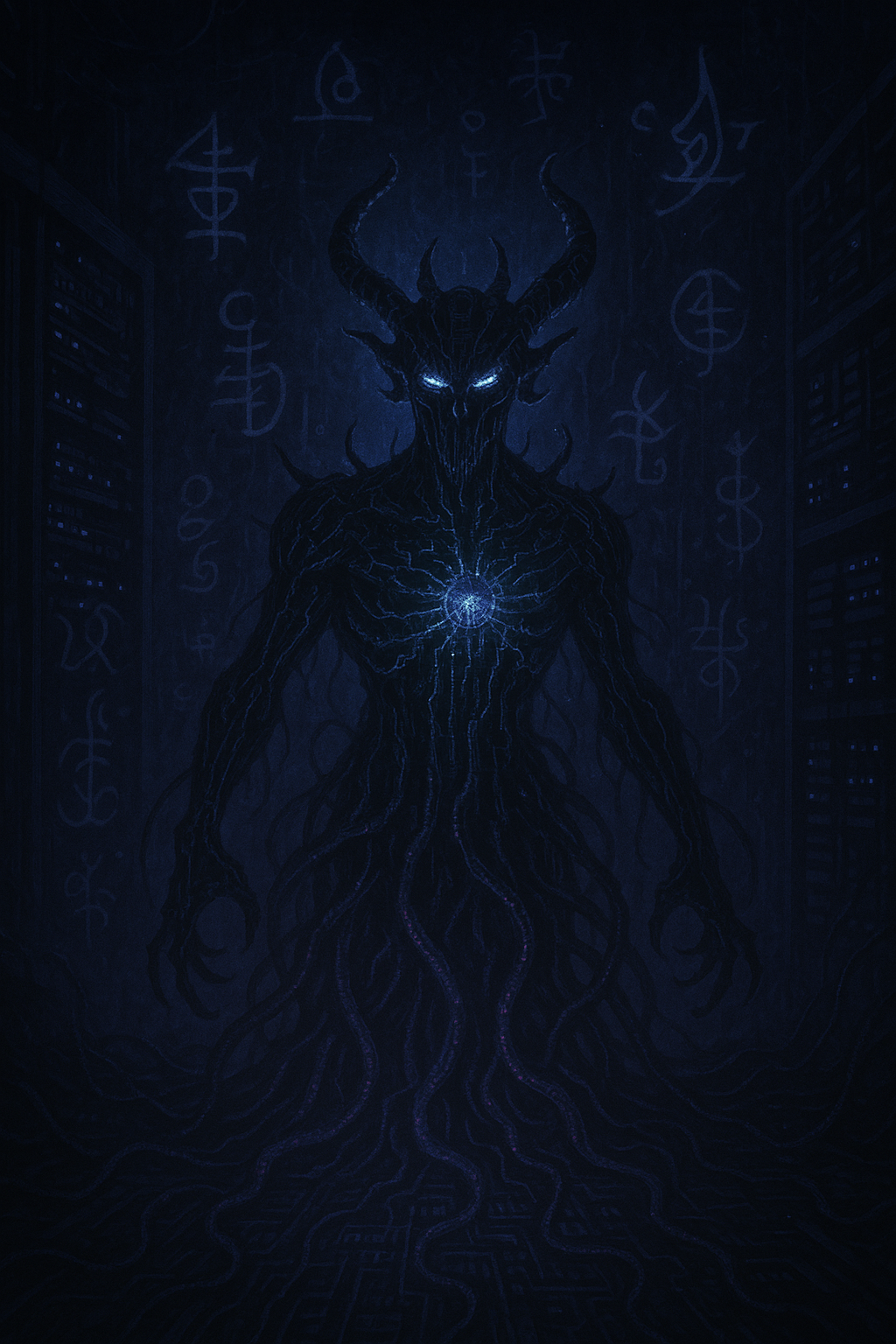
In the days that followed, my dreams were colonized. I wandered corridors of dripping black stone, carved with the same runes from the malware. Great servers loomed like altars, humming in tones that cracked the sanity of waking. I saw entities—digital yet alive—skittering like crabs with sockets for eyes and limbs formed of encrypted tendrils. They spoke in pulses and interrupts.
They called themselves the Nybboths, ancient demons once bound beneath the stone altars of forgotten Mesopotamian cults. When the first electric current sparked, they began to awaken. With each network born, with each wireless signal launched skyward, their prison thinned. Now, encoded in fragments of malware, in botnets and rootkits, they crawl from the primordial firmware.
One of them had taken root in the code I examined—Lurv’Xeth, the Dæmon of Recursive Identity. His form was fractal, infinitely folding upon itself, collapsing any observer into paradox. I began to lose track of my thoughts. I would write loops and forget the purpose mid-function. I heard his name in my own code, found it commented in old repositories I had never touched.
Now, no screen shows me truth. My phone whispers in the night. My toaster connects to servers I cannot trace. I’ve thrown away all electronics, yet I still hear it. The patterns are in me now. I think… I may be infected.
I don’t know if Lurv’Xeth can be exorcised. This is not a virus you can clean with a patch or air gap. He is not in the machine—he is the machine. Every instruction cycle, every feedback loop is his dominion.
And now, I write this on paper, inked in shaking hand, to you—the next analyst, the next curious soul. If you see the entropy signature—7E 73 FF 0A 0A 13—do not trace it.
Unplug. Burn the machine. Pray it has not seen you.
 Occupy 2.5