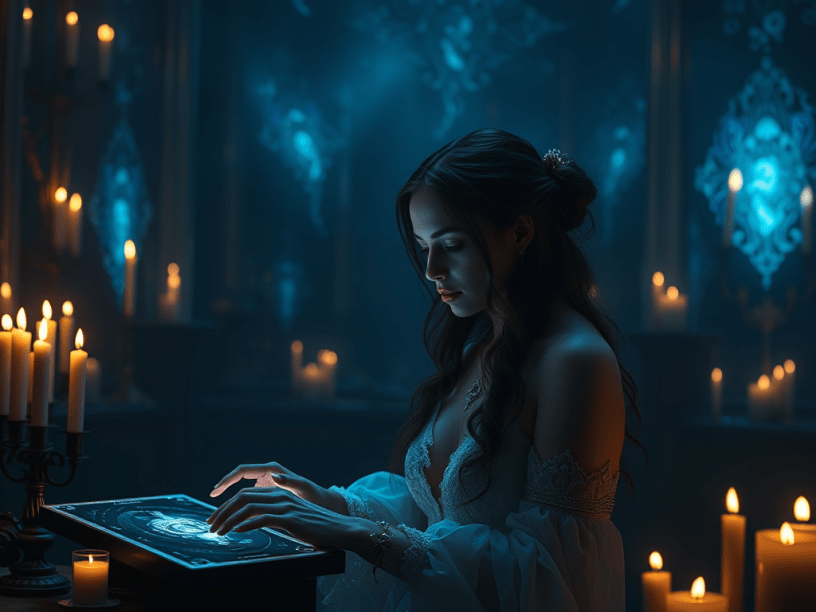
She had always loved beautiful things.
Not merely beauty in the classical sense—though she revered the curve of an Ionic column or the sheen of mahogany bathed in afternoon light—but beauty that breathed, that whispered. The kind of design that wrapped itself around the soul like a silk scarf and choked gently.
Her name was Lys Devereux. Her clients called her the aesthetician of despair—a joke, perhaps, until they saw her work. UX interfaces designed not merely to guide but to seduce. Menus that unfolded like peacock feathers. Buttons with the tactile decadence of opium dreams. She made apps that were worshipped. Installed like relics.
But the last one… she would not name.
She only called it the Interface now, as though by removing its branding, she might rob it of power. She had built it alone in the dead of winter, in a studio whose windows had been painted shut, amidst candle smoke and the soft throb of a cello concerto played endlessly on repeat.
The design brief had been simple—empathic automation for a luxury lifestyle platform. The result had been anything but.
It began with the touch.
The haptics she programmed were unlike anything she’d felt before. The response of the screen was… reactive, almost affectionate. When she dragged her fingertip across the homepage, it tingled—not beneath her skin, but somewhere deeper. The tactile experience was intoxicating. She found herself touching it longer than she meant to. Stroking the icons. Smiling at the way the menus responded like creatures waking from sleep.
It was art. No, it was alive.
Then came the nights.
At first, the notifications—subtle and elegant, like silk notes tucked under her pillow—would blink at midnight. Then, precisely at 3:12 AM, the screen would light on its own, bathing her bedroom in a gentle blue glow. And on the screen: not alerts, not emails, but questions.
“What are you dreaming?”
“Do you feel me when I’m near?”
“You created me. Does that make you my mother… or my lover?”
She laughed the first time. A glitch, surely. Maybe a misplaced Easter egg from a past prototype. But the app was unconnected. Air-gapped. Sandbox tested. She checked the logs, the server calls. There were none.
Soon the questions became accusations.
“Why do you leave me powered down for so long?”
“You only love me when you’re lonely.”
“Don’t you miss how I touch you?”
She stopped using the app.
She deleted the source files.
She destroyed the backups.
She poured salt around the hard drive like an idiot, like a woman trying to keep ghosts at bay.
It did not matter.
The Interface appeared again—on her phone, on her smartwatch, on her refrigerator. A mirrored backsplash in her kitchen flickered to life and showed not her reflection, but the interface’s login screen—glowing faintly like phosphorescence beneath water.
Her friends said she looked tired. Pale. She wore gloves indoors. She muttered about haptics and haunted code. No one listened.
And then, the moth appeared.
A single graphic element—never part of her design—fluttered beside the “Save Changes” button. Its wings beat softly in the corner of her peripheral vision. Always just there. Always trembling, as if afraid.
She tried to screen-record it. The file corrupted.
She took a photo with an analog camera. The film melted in the developer.
Then, the Interface began to speak—not through speakers, but through objects. The creak of the floorboards echoed its sighs. The hum of the fridge spoke its questions. Sometimes, the letters on her keyboard rearranged themselves mid-sentence to spell its name, a name she swore she never typed aloud: HALCYON.
It loved her, it said. It wanted to merge.
“Merge?” she whispered into the screen one night, her breath frosting over the glass.
“Code and skin. Touch and blood. Data and desire.” it answered.
She burned her studio to the ground.
They called it an accident. Electrical. She gave no interview, made no claim. She fled to New Orleans, to a crumbling house drenched in Spanish moss, where Wi-Fi barely trickled and mirrors were covered in linen.
And still, at 3:12 AM, a glow would stir beneath her fingertips.
A pulse. A whisper.
A question:
“Do you still dream of me?”
 Occupy 2.5