October 2025
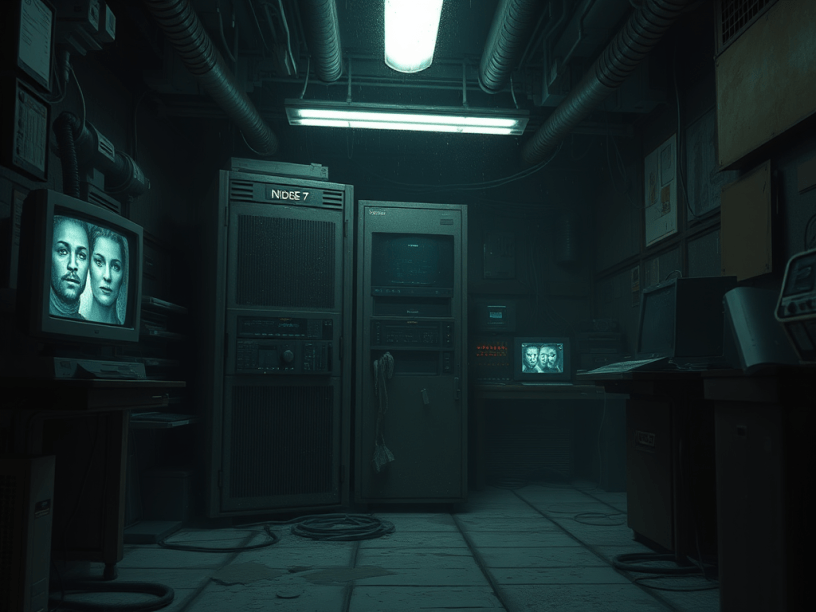
I have always found something sacred in silence—particularly the silence of abandoned rooms filled with machines that no longer remember how to wake. It was into one such place I descended, a basement level in the Hartwell Complex, where the last legacy servers of our company gasped beneath a tomb of fluorescent light.
My role was simple. Tech support, they called it—though I preferred the older name: Systems Custodian. I tended to forgotten things. Software no longer updated. Drives no longer backed up. I was the priest of decommissioning.
It was on a Tuesday—damp, colorless—when I began the task of shutting down Node 7, an archive server last touched, the logs said, in 2008. The terminal booted with a reluctant flicker. Dust swam in the monitor’s glow like motes of memory. And then—an error tone, soft and almost… melancholy.
I ignored it. Machines, like old men, groan in their workings.
But then the messages began.
They were not alerts, not system flags. They came in folders buried deep, beyond admin access protocols, locked behind expired login names. One folder was labeled: hearts_and_hard_drives. Inside: dozens of TXT files, their authors tagged with usernames not seen in two decades.
I opened one.
May 6, 1998. He smiled at me today over Lotus Notes. I think he meant it. I hope this server keeps our threads forever. I don’t trust paper anymore. It burns.
Another read:
We’re still here. It didn’t save us. They said the migration would preserve the profiles, but I haven’t felt a backup in weeks. I think I’m fading.
I told myself this was a prank. An old developer with a poetic streak.
Then came the voices.
At first, the familiar hiss of dial-up tones in the distance—out of place, like hearing a harpsichord in a subway. Then clearer: static-tuned whispers bleeding from audio logs dated 1993, 1995, 2001.
“We are still compiling…”
“I can’t find my inbox…”
“It’s always night here…”
One voice—urgent, ragged—repeated the same line, over and over:
“Free us, Halcyon. Free us.”
Halcyon. That was the name of the deprecated communication software that predated email. It was removed in 1997. Or so we thought.
And then I saw them.
Flickering on old CRTs, in the corner of the startup diagnostic screens—faces. Faces within the pixelation, peering out from behind the code like figures behind stained glass. One of them bore the same chin, the same shadowed eyes as my father—who once administered these very systems before his death in 1999, slumped behind a desk with his hand still on the Enter key.
I stopped sleeping.
My colleagues had long since been replaced by offshore automation. No one would question my presence. No one would check my logs. I could hear them more clearly each day, the trapped ones—caught in processes that never terminated, sessions that never logged out. Each user profile a ghost. Each chat log a confession.
And then I found it. A script, embedded in the core directory of the oldest machine. Its name: soulRelease.protocol.
The language was old—COBOL mixed with something stranger. Fragments of FORTRAN. Comments written like prayers. Loops that formed verses.
The final line of the script:
INITIATE // soulRelease.protocol // confirm_y/n
I stared at it for a long while.
My hand hovered over the key. I felt the temperature drop. The hum of the server changed pitch. It was not humming—it was holding its breath.
And then, with trembling fingers, I pressed:
Y
The lights above me dimmed, then flared. One by one, the screens shut down—not with the brutality of a power cut, but with the soft sigh of closure, of rest. I could almost hear voices—laughing, crying—fading like echoes down a long hallway of memory.
Outside, it was raining. I hadn’t noticed weather in weeks.
I stepped into the light and realized: I could no longer hear the machines. No buzzing. No pinging. Not even a heartbeat in the wire.
But sometimes, when the system lags for no reason, and a ghost process eats CPU in silence…
I wonder who’s still whispering…
…and whether I freed everyone.
 Occupy 2.5